Showing posts with label Atlantic Ocean. Show all posts

Sunday, October 13, 2024

The Lady of Hampton Beach

Even though I have lived in New Hampshire for upwards of forty years, I have only visited Hampton Beach three times.  The first of these occasions took place many years a go on a bitter cold winter day.  It was a very short visit, and I scarcely remember it.  The second visit, with two grandchildren, took place on a beautiful summer day two years ago.  I remember this one very well.  The grandchildren were fascinated by both the Atlantic Ocean and the marine biology exhibits at the adjacent Blue Ocean Discovery Center.  The third, without the grandchildren, took place just recently, on Wednesday, September 25, 2024.  This one was quite different and more serious. 

Long and wide sandy beaches are rare in northern New England, and so Hampton Beach becomes extremely crowded on hot summer days.  For this reason, we always avoided it in favor of less crowded facilities in nearby Maine.  Besides, the Maine beaches were closer to Miss Patty’s parents’ house.  But we thought Hampton Beach would likely not be crowded on a September weekday, and so we seized the opportunity.  As always, it felt wonderful to gaze upon the great Atlantic, scan the horizon, feel the breeze, and watch and listen to the surf.  It was also very pleasant to stroll along the promenade that parallels the beach.  Several attractive pavilions for public accommodation and park administration dot this promenade, and at its northern end stands the New Hampshire Marine Memorial.  I had never seen or heard of this before, and so I felt drawn to it.

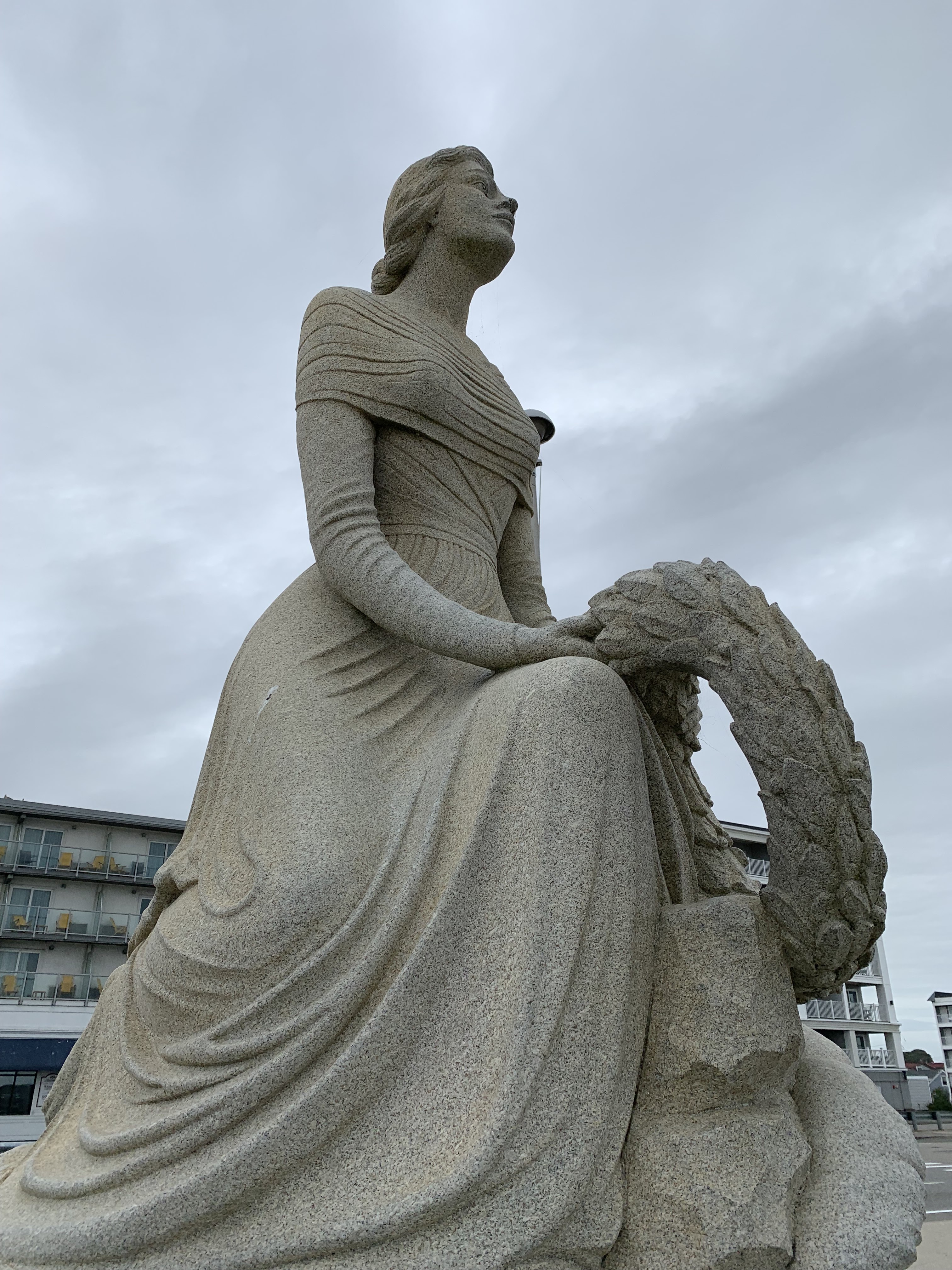
The memorial features a statue of a young lady facing seaward and holding a wreath in honor of the New Hampshire residents who served in the armed forces and were lost at sea.  Around the upper base of the memorial, two verses of poetry are inscribed in large letters:

Breathe soft, ye winds,

Ye waves in silence rest.[1]


Beneath this, on the lower base of the monument, is further inscribed:

In memory of New Hampshire’s heroic war dead

Lost at sea in defense of our country.

Following this and occupying a large part of the lower base is an alphabetical list of approximately 240 names of servicemen, with their branches of the service indicated.   The vast majority were Navy men.  Several were Marines or Coast Guardsmen.  A few were Army or Air Force.

Seeing and studying the New Hampshire Marine Memorial for the first time was a moving experience for me.  I had not expected to discover this during a leisurely and carefree day at the oceanfront.  But there it was, and it commanded my attention.  While I naturally regretted the loss of life that it represented, I was pleased that these seamen were remembered and that their sacrifices were publicly acknowledged.  I also wondered how many beachgoers on a hot summer day paused to look at this monument and contemplate its significance.

My only reservation was that the list of names did not include the many merchant seamen who perished at sea in wartime.  In the 1940s, the Merchant Marine was incorporated into a federal organization titled the United States Maritime Service, or USMS.  The seamen who manned the cargo ships, oil tankers, and troop transports suffered a casualty rate exceeded, on a percentage basis, only by the Marine Corps.   While monuments to their sacrifices do exist, they tend to be not very well known by the general public.

Nonetheless, I was pleased to come upon this monument to our state’s military personnel who tragically lost their lives at sea.  It left me with little to say but much to consider.  Fortunately, it was an uncrowded, off-season day at the beach, which created an atmosphere suitable for quiet contemplation.  I appreciated that very much.

Now, I’m pleased to share some photographs.  First, we see the full monument.  The young lady portrayed, flanked by the New Hampshire state flag, faces east toward the sea.  The building in the rear is a hotel:


Next, we have three close-up views of the young lady.  The facial expression, combined with the background of dark cumulus clouds, seems to convey a sense of foreboding: 


Finally, we look southeastward over the surf and beyond to the horizon of the great Atlantic Ocean.  Despite the ominous appearance of the low-hanging cloud cover, it really was a magnificent day at the waterfront:


[1] Lines from John Gay (1685-1732), “Epistle to a Lady,” 1714.  Information from https://www.seacoastnh.com/places-%26-events/nh-history/hampton-beach/sculpture-by-the-sea.


Monday, August 26, 2024

The Oceanfront Refuge

Although I live inland, the sea is not far away.  It’s close enough for a day’s outing and is more-or-less on the way to my mother-in-law’s house.  Sand beaches, rocky outcroppings, small seaports, and lighthouses abound along the New England coast, and visiting them never grows old.  For many years now, we’ve made it our practice to stop at some coastal point on the way to or from visiting Miss Patty’s family.  The children developed several favorite spots, and all of us enjoyed these waterfront sojourns tremendously, often wanting to stay longer than our time allowed.  Because these seaside visits were neither long enough nor frequent enough, they have become a case of absence making the heart grow fonder.  Sometimes I yearn to just look at the ocean again, somewhat like wanting to visit an old friend or a close relative.

I’ve long thought it would be nice to live in a house set on a cliff overlooking the Atlantic.  I could see the ocean every day then.  Realistically, though, this arrangement would probably not always be practical.  In lieu of it, I content myself with day trips and vacations and the taking of photographs.  Seascapes have long been one of my favorite art forms, and they are frequently the next best thing to actually being there.  Accordingly, then, I’ve selected a batch of recent seaside photographs to share here.

On Thursday, July 28, 2022, Miss Patty and I stopped at Fort McClary in Kittery, Maine, on the way home from her mother’s house.  In this peaceful and pristine park that sits well off the beaten tourist path, we rested for a while and enjoyed the magnificent view of the entrance to Portsmouth Harbor.  In this photograph, Whaleback Light stands on the left in Maine; on the right is the better known Portsmouth Harbor Light in New Hampshire.  Beyond the two lighthouses lies the open Atlantic.  On the extreme right, Fort Constitution guards the channel.  Prior to the American Revolution, this facility bore the name Castle William and Mary in honor of England’s famous dual monarchs of the 1600s:


On our last voyage from New England to New York, made on Wednesday, October 5, 2022, I took this photograph of the fabled Plum Gut Light from the ferry Cape Henlopen.  Everyone in our family has sailed past this lighthouse near the North Fork of Long Island many times.  On this particular occasion, however, the colors of the land, sea, and sky combined to form a unique canvass that made this my favorite of all lighthouse photographs:


On Monday, October 9, 2023, we travelled to York, Maine, for a lunchtime rendezvous with my mother-in-law.  While the food was good, I was much more interested in the adjacent oceanfront.  A prominent feature of this oceanfront is the famous Nubble Light, situated on a small island across a narrow channel from Cape Neddick.  One of the most iconic of American lighthouses, it attracts legions of sightseers and photographers all year round.  Endowed by Nature with magnificent beauty, it is truly a sight to behold and by which to be inspired and edified.  In this photograph, we see Nubble Light surrounded by the elements of earth, sea, and sky, manifestations of the natural sciences of marine geology, oceanography, and meteorology, all fascinating fields of study and all included in varying degrees on the Merchant Marine license exams:


Just to the right of the Nubble, we see the open Atlantic.  If we zoom in with our trusty cell phone camera, we can discern Boon Island and its lighthouse on the horizon several miles offshore.  Often invisible from the mainland because of clouds or fog, the Boon Island Light has long been and still remains an important aid to navigation.  It is always a special treat to see this great sentinel of the sea on a sunny day with a clear atmosphere:


To the left of the Nubble lies Short Sands, one of Maine’s few bathing beaches.  The water here is quite cold, so wading and not actual bathing is more the norm.  Those who do go bathing or surfing usually dress in heavy wetsuits for protection from the cold.  One need not get wet to enjoy Short Sands, though.  I was quite content to remain on the beach and simply watch the waves:


Returning to Cape Neddick after several months on Wednesday, July 17, 2024, I was again delighted to simply stare at the ocean.  Here is a lovely calm stretch of the open Atlantic, much as I saw it many times as a young mate on the bridge wing of a cargo ship:


Two weeks earlier, on Wednesday the Fourth of July, we passed through Rye, New Hampshire, and stopped to take in this view from a rocky beach.  My granddaughter, Miss Lydia, was fascinated by the rocks and the water, and she asked many questions about both.  We would have been happy to remain there all afternoon but faced with the daunting task of wending our way home through a nightmare of holiday traffic, we reluctantly returned to the car and got underway.


Visiting Portland, Maine, on Thursday, August 1, 2024, with my son Steven, I could not resist examining the cruise ship Silver Shadow and the schooner Timber Wind, both docked downtown.  The weather that day was hot and humid, and this caused an impressive buildup of cumulus clouds that hovered over the ship:


At a nearby pier lay this unidentified cruise vessel.  Not even Steven, with his young and healthy eyes, could read her name.  More noteworthy, I thought, was this additional pileup of cumulus and borderline cumulonimbus clouds.  Not surprisingly, it rained later that afternoon.


Finally, we see the diminutive Spring Point Light at the end of the breakwater in South Portland in an unusual view from across the harbor.  When my children were young, this site served us well as the setting for several picnic lunches.  At the end of the long jetty, we had a magnificent view of Portland Harbor and Casco Bay, and we watched as a parade of oil tankers, cruise ships, pilot boats, and ferries passed in front of us.  On this more recent visit, there was little traffic on the water, but the view, even on a cloudy and hazy day, was still fantastic.  Once again, I would have gladly stayed there all afternoon, but duty called, and I had to go.


The duties of life have called me away from my waterfront “happy place” many times.  While it was always sad to leave the sea and attend to business, I’ve always been grateful to have visited the seaside, even if only briefly, and to have been uplifted and edified by it.  The oceanfront has long served me as a refuge from the commotion and contention of life.  It is a place of peace and serenity, a place to enjoy the primordial beauty of Creation, a place to seek and experience Divinity, and a place to “be still and know that I am God” (D&C 101:16). 

Monday, September 11, 2023

Staring at the Ocean


During my teenage years in the 1970s, my family vacationed every summer in Cape May, New Jersey, a seaside resort at the southern tip of the state.  With the Delaware Bay on one side of the peninsula and the Atlantic Ocean on the other, Cape May was all but surrounded by water.  It was thus the perfect location for folks who loved the sea, as my family did.

My grandfather, Robert Burns, accompanied us on these excursions.  When a friend in New York asked him once why he was going to Cape May, he replied, “to look at the ocean.”  And that was a large part of what we did there.  Of course, we did other things, too.  We went swimming.  We strolled along the boardwalk.  We played mini golf.  We sailed on the ferries to Delaware and back.  But we spent a lot of time just looking at the ocean.

We stayed at the Coachman’s Motor Inn at 205 Beach Drive, directly across the street from the beach and the ocean.  My grandfather and I frequently sat together in the canvas chairs on the second floor balcony that overlooked the beach and the water.  From this vantage point we enjoyed an unobstructed view seaward.  To my inexperienced and unenlightened teenage mind, it was simply a nice view.  To my grandfather, however, it was so much more, and he often shared his observations and insights with me.

As a scientific man, my grandfather thought in patterns of observation, analysis, and conclusion.  While watching the Atlantic from the Coachman’s balcony, he studied the conditions of the sea and sky with attention to the wave action, wind speed and direction, cloud cover, range of visibility, and air quality.  He understood oceanography and meteorology, and as a former ocean traveler and recreational boater, he knew well the effects of the sea and sky on waterborne commerce.  As he and I kept watch together, he often pointed out to me aspects of the surf, the play of the wind on the water, the formation of distant clouds, the longshore current, and the rise and fall of the tide.  It was a wonderful educational experience for me.  In retrospect, I wish I had written down all that he said.  Such a collection of notes would now be a family heirloom.

In the years since these happy times in Cape May, I have spent countless hours in school, aboard ship, and ashore, studying the sea and sky.  Of necessity, it became an important professional habit.  A ship at sea is surrounded by two things, water and air, and the interaction of these elements determines the safety and comfort or the danger and discomfort of the voyage.  I took meteorological observations for transmission to the National Weather Service.  I analyzed the clarity of the horizon to assess the accuracy of navigational sights.  I studied the cloud cover and compared it to the weather forecasts.  I paid particular attention to the sea surface and noted patterns and changes in the wave and swell systems.  All of this was for the safety of the ship and to estimate how rough or smooth the voyage would be.

Later in life, when visiting the oceanfront with Miss Patty and our children, I continued to observe and analyze the sea and sky in addition to enjoying and appreciating their tremendous natural beauty.  Sometimes, however, I just sat there and stared at the ocean, content to simply enjoy it without undertaking a professional evaluation of everything.  I can still do this for hours on end—it never grows tiresome—and I often wonder, how can anyone not like this?  How can anyone not marvel at this?

Actually, many people do like and marvel at the sea.  They find in it comfort, solace, and even a glimpse of Divinity.  Something about the sea speaks to the human soul of higher and greater things, recalling for us the Lord’s words to Isaiah:

For as the heavens are higher than the earth,

so are my ways higher than your ways, and

my thoughts [higher] than your thoughts (Isa. 55:9).

The supernal quality of the sea and the counsel of Isaiah remind us of our place in the cosmos and inspire us to raise our minds to a more sublime level.  In so doing, we grow in knowledge, wisdom, and the Spirit.  Thus, we become able to apprehend more than just a fleeting glimpse of Divinity when we gaze upon the sea.

Sometimes when I am staring at the ocean from a spot on the New England coast, I think of my family’s vacations in Cape May.  If only it were possible to sit with my grandfather again and look seaward with him!  No longer as an ignorant adolescent but as a seasoned merchant seaman would I speak with him.  As we recounted experiences, shared insights, compared observations of the sea and sky, and analyzed recent oceanographic and meteorological discoveries, we would have so much to discuss!  I’m certain that it would be a very long, pleasant, and inspirational conversation.

Next, let's look at some photographs:


An evening view of the Coachman's Motor Inn from a postcard.  The street, boardwalk, beach, and Atlantic Ocean lie in back of the photographer.
 
 
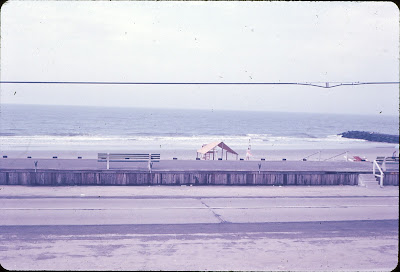
Two views of the Atlantic in front of the Coachman's, taken by my father on an overcast day in the summer of 1967, on our first visit to Cape May.  This was actually a few years before my adolescence and before the times that my grandfather accompanied us on our vacations.
 
Many years later, on Easter Sunday, April 4, 2010, we see the open Atlantic from the beach in Wells, Maine, a wonderful place to contemplate the sublime mystery of this very special day.
 
Finally, we sail aboard the ferry John H from Long Island to Connecticut on Saturday, October 8, 2022, an exceptionally gorgeous day on the water.


Sunday, August 30, 2020

The Seas of Tranquility

This past summer our home city of Nashua undertook two noteworthy construction projects.  One involved the tearing up and repaving of Pennichuck Street, which provided an excitement and entertainment extravaganza for the grandchildren.  The other was the rebuilding of the boat ramp near Greeley Park.  This primitive facility, located in the woods at the end of a badly beaten up dirt road, has long enabled recreational boaters to launch trailered boats into the Merrimack River.  This  year the launching ramp was rebuilt with better materials, the access road and parking area, though still dirt, were enlarged and improved, and a small trash dumpster and porta-potty were added  Otherwise, it remained a bare bones set-up, with no electricity, no illumination, and no running water. 


Situated within the city limits yet far from the madding crowds of busy streets and noisy neighborhoods, the boat ramp had an atmosphere of peace and quiet in the early mornings and thus offered a respite from the commotion and confusion of life.  Located about a mile from our house, it lay within easy walking distance along the largely untrafficked Boston and Maine Railroad and dirt access road.  I went there once or twice each week, and I always arrived in the pre-dawn darkness, well in advance of the boaters.


Perched in quiet solitude on a large rock or fallen tree trunk, I gazed eastward and watched the dawn break over the farmland of neighboring Litchfield.  The only artificial lights came from a farm house directly across the river and from a residential neighborhood a mile downstream.  Otherwise, Nature lit the scene with several stars, the occasional Moon, and the soon-to-emerge Sun.  The scattered clouds reflected the Sun’s light in pink, orange, and purple, and these colors were in turn reflected on the unrippled surface of the river.  With its water as flat and undisturbed as a mill pond, the Merrimack, like a mirror, reflected all the colors of the sky above and the rows of trees along its banks.  As the light grew brighter and culminated in sunrise, the effect was sublime and spiritual.  The still small voice carried clearly through the cool dawn air over the tranquil Merrimack, and this pristine natural setting became supernatural.  A perfect way to start the day! 


I usually had at least half an hour before the first boaters arrived and broke the silence.  In this interval my mind wandered to other locales of peace and quiet and solitude.  I have known several such places over the years, but here at the boat ramp one in particular stood out in memory, and my wandering mind eventually settled on it. 


The South Atlantic between South America and Africa is a calm, quiet, and lonely ocean.  There has long been commerce on it, of course, mostly between the European nations and their former colonies, but this has never rivaled the volumes of traffic that have plied the North Atlantic.  Ships would go for many, many days without seeing another vessel on the South Atlantic. Vast stretches of this great sea have always been and still remain isolated from the outside world.  For the seaman  who likes solitude and wants to make a quiet voyage on a calm sea with mild weather, the South Atlantic is the ocean of choice. 


My first encounter with the South Atlantic occurred not aboard ship, but on an airplane.  In the mid-afternoon of Wednesday, September 12, 1979, and accompanied by five other crewmen, I left Patrick Air Force Base near Melbourne, Florida, aboard a military cargo aircraft bound for Ascension Island, The airplane made a stop for dinner and refueling at Antigua, and then travelled overnight across the equator to Ascension, arriving early in the morning on Thursday the 13th.


A British colonial outpost located at 7° 56’ south latitude and 14° 25’ west longitude, Ascension Island was a dormant volcanic mountain used mostly for military purposes by both the United Kingdom and the United States.  It was also a port of call for the range instrumentation vessel General Hoyt S. Vandenberg, which my five new colleagues and I joined when she arrived from Recife, Brazil, on Saturday, the 15th.  The ship anchored off Georgetown, the main settlement, in the late morning.  We and several pallets of freight and provisions were delivered alongside in a cargo launch at 1:00pm.  Four hours later, the Vandenberg weighed anchor and got underway again. 


The two and a half days of enforced leisure while waiting for the ship on Ascension Island had not been popular with all of the new crewmen.  I rather liked it, though.  Ascension had a nice library, great food, unique scenery, and enticing beaches.  We were free to roam pretty much as we wished, and I naturally gravitated toward the beach.  I was all set to jump into the beautifully inviting, clear, warm water of the South Atlantic, when a hammerhead shark appeared right in front of me.  I quickly changed my mind about going swimming! 


After two and a half days, though, it felt good to see the Vandenberg arrive.  I needed to be going somewhere, getting on with my career, upgrading my license, and so on.  These things were very important to me then.  And so that Saturday evening, with the ship on a southeasterly heading and making about eleven knots, I stood my first 8 to 12 watch as the new third mate. 


The Vandenberg headed for a special operations area a few hundred miles off the coast of South Africa and arrived there on Sunday, September 23.  She remained on station there until Thursday the 27th, and then proceeded to another special operations area in mid-ocean, about a thousand miles south of Ascension Island.  On station at this new site from Monday, October 1, through Friday the 5th,  she then returned briefly to Ascension on Tuesday the 9th.  I reached the ripe old age of 22 at sea on Sunday the 7th


To call this voyage peaceful and quiet would be a masterpiece of understatement.  In this entire time, the Vandenberg came upon one other ship and sighted one island, Saint Helena, on radar.  Otherwise, this large tract of the South Atlantic remained devoid of human intrusion.  In addition, the weather was consistently mild with warm air, excellent visibility, a  mostly clear sky, and a calm sea.  After spending the summer aboard the Rigel in the hustle and bustle of the Mediterranean, this voyage on the placid and remote South Atlantic seemed like a vacation!


Since the Vandenberg provided such an easy life, and since I was young and ambitious, I used this leisure time for professional development.  On the 8 to 12 morning watches, I took hourly sun lines, worked up running fixes, calculated local apparent noon, and worked out a latitude by meridian altitude.  On the 8 to 12 evening watches, I studied the constellations of the Southern Hemisphere and selected the Southern Cross as my favorite.  Frequently around dinner time, I returned to the bridge to observe the green flash at sunset.  In my off-duty hours, I studied oceanography and meteorology, particularly ocean current circulation, surface wind patterns, and tropical cyclone formation.  Even though my third mate’s license was only five months old, it was never too early to prepare for the next round of exams for the second mate’s license.  For more recreational reading, I had brought along a history of Christianity. 


During this voyage in the South Atlantic, the Vandenberg carried a contingent of technicians who worked with sophisticated electronic equipment in carrying out the ship’s national defense mission for the federal government.  We Merchant Marine crewmen sailed the ship for them and took them where they needed to go.  When the ship arrived back at Ascension Island at 6:00am on Tuesday, October 9, the technicians’ work in the South Atlantic was finished.  On sailing again that afternoon, the Vandenberg went north to Monrovia, Liberia, and arrived for a weekend visit early on Friday the 12th.   Along the way, she crossed the equator and left the South Atlantic behind. 


I, too, left the South Atlantic behind and returned only twice, in February and May of 2016.  I did not join a ship on these occasions, but traveled to Brazil to visit my daughter and newborn granddaughter.  I encountered the South Atlantic fleetingly from airplanes, from the coast road on the east side of Salvador, and from the lighthouse and promenade at the southern tip of Salvador. About 400 miles up the coast stood Recife, the city where my daughter was married in July of 2014 and the port from which the Vandenberg had sailed for Ascension Island 35 years previously.  After such a long time, it felt wonderful to gaze upon this magnificent sea of tranquility again.  I could have remained at the South Atlantic oceanfront indefinitely, but the baby needed attention. 


I thought I could have remained at the Nashua boat ramp indefinitely, too.  But after the Sun rose over the Merrimack River, this inland sea of tranquility always lost some of its idyllic peacefulness when the first boaters arrived and noisily launched their boats and revved their engines.  At this point, it was time to walk home again.  A busy day awaited me there, a day filled with household chores, tumultuous street repairs, and very excited grandchildren.


No matter how busy and tumultuous the day, however, my dawn retreats at the waterfront  enabled me to “Go placidly amid the noise and the haste, and remember what peace there may be in silence,”[1] and thereby to “be at peace with God.”[2]


Next, I am happy to present two photographs of the South Atlantic from our family archives.  In the first, we see Ascension Island, including the principal settlement of Georgetown.  I took this picture on Saturday, September 15, 1979, from the starboard bridge wing of the General Hoyt S, Vandenberg.  I thought that I might never return to this uniquely beautiful island, so I seized the opportunity and took several photographs of it.

In the second picture, taken four decades later on Monday, March 30, 2020,, the majestic South Atlantic Ocean stretches out to the horizon from the beach and lighthouse of Itapuã on the east side of Salvador, Bahia, Brazil.  My daughter took this photograph, which features my granddaughter Miss Lydia Elizabeth gazing seaward from the beach.  Such attraction to the ocean seems to run in the family!


[1] Max Ehrmann, “Desiderata,” 1927, found at www.desiderata.com. 

[2] Ibid.

Sunday, April 16, 2017

At Sea, At Sky


A ship embarked on a voyage across water is correctly said to be “at sea.”  An airplane embarked on a voyage through air is said to be “in flight.”  This inconsistency puzzles me.  It seems that an airplane underway should be described as “at sky,” for the airplane is truly in the sky just as much as the ship is in the sea.  I think of this now because of a journey that I made recently aboard a small aircraft which was simultaneously at sea and at sky.

At 12:14pm on Friday, March 17, 2017, with my son James at the controls, Miss Patty and I took off from Boire Field in Nashua, New Hampshire, aboard a Cessna Skyhawk and proceeded toward Biddeford, Maine.  It was a bright, sunny, and clear Saint Patrick’s Day, truly a beautiful day for flying.  I had not travelled in a small aircraft since the early 1980s, so this was a special occasion.

James taxied to the end of runway 32, and we took off into the wind to the northwest.  Once airborne, he banked the plane as it continued to ascend and turned sharply to the east.  At about 1,500 feet of altitude and in turbulent air, we passed over the northern part of Nashua.  I looked at our neighborhood below with some trepidation as the little airplane lurched through the turbulence.  I sincerely hoped that Saint Patrick was watching over us on his special day!  James knew exactly what to do, though, and the ride became more comfortable as he ascended into calmer air.  At a cruising altitude of about 3,500 feet, we flew east-northeastward towards Portsmouth and then into Maine.

Looking southward and seeing Portsmouth and its environs from the air was a special treat, and it brought back many happy memories.  I had been assigned aboard the Furman here in 1985 and 1986.  She spent a lot of time slowly loading subsea telecommunications cable at the Simplex Wire and Cable Company dock in Newington.  She also sailed up and down the Piscataqua River many times to shift berths and go on engineering trials.  In later years, when I was no longer sailing, we often brought the children to Portsmouth.  They played in Prescott Park, hiked across the Memorial Bridge, visited the lighthouse at Fort Constitution, and explored the grounds of Fort McClary.  They also saw ships there.  They toured the historic Bluenose II and the not-so-historic State of Maine at the State Pier.  They also admired the submarine Albacore, the cable carrier Global Mariner, and the cargo ships Atlantic Erie, Alexandria, Rays, and Nel.

Continuing toward Biddeford, James piloted the little aircraft overland and parallel to the coastline.  The great Atlantic Ocean stretched infinitely to the somewhat hazy horizon.  At its edge lay the beaches—Wells, Long Sands, and the Footbridge—that we had frequented with the children when they were little.  The lighthouses stood there, too, including the old family favorites that James promised to visit more closely on the return flight to Nashua.

Descending next for the approach to the small municipal airfield in Biddeford, James maneuvered the airplane through more low level turbulence and landed in a strong crosswind from the northeast on runway 24, one hour after our departure from Nashua.   After parking and securing the Cessna, we met James’ maternal grandmother who was waiting for us with an automobile.  A family reunion and luncheon at a nearby restaurant followed.

At 3:15pm it was time to leave again.  James took off on runway 60 heading east-northeast this time, still contending with the strong northwesterly crosswind.  Once aloft, as the small airplane was again buffeted by the low level turbulence, James turned the craft to starboard and headed seaward. Most of the haze had by this time disappeared, and the view of the Maine coastline and the open Atlantic was magnificent.  To port lay the sandy crescent of Old Orchard Beach capped by the rocky peninsula of Cape Elizabeth.  To starboard lay the assortment of rocky headlands interspersed with short sandy beaches that stretches back down to Portsmouth.  Just offshore a scattering of small rocky islands punctuated the coast.  Several of these islands sported lighthouses, and as he had promised, James turned southwestward over the Atlantic and set a course for sightseeing.

The first waypoint was Wood Island Light, just a few minutes’ flight from the Biddeford airfield.  Flying high enough to avoid the turbulence but low enough to see the lighthouses clearly, James next took the aircraft offshore and out to sea around Goat Island.  The coastal communities of Biddeford Pool and Fortunes Rocks passed by on the starboard side.  The broad, blue Atlantic stretched out infinitely to port.  This was my favorite part of the flight, and I enjoyed the ineffable feeling of simultaneously being at sea and at sky gazing down upon the sea.  It was sublime, supernal, and serene, despite the continuous hum of the motor.  After passing Goat Island to starboard, James continued southwestward toward Boon Island.  Kennebunk, Wells, and Ogunquit came into view on the starboard side.  The great, blue Atlantic remained omnipresent to port.

The time seemed to slow down as I stared at the open Atlantic on this leg of the flight.  I could have looked at it all afternoon and been very content.  But then, suddenly it seemed, we reached Boon Island.  James turned to port, rounded Boon, and headed next for the Nubble.  Long one of the family’s favorite spots, we had visited Nubble Light often when James and his siblings were younger, and from that vantage point had sighted the Boon Island Light on the horizon several  miles distant.  Seeing both lights from the air was a new experience, a broader and more breathtaking perspective.  At the Nubble, James turned the aircraft once again to port and followed the sea to the Isles of Shoals on the Maine-New Hampshire border.

Once again, I looked out to port and imbibed the view of the wide, blue Atlantic.  It was tremendous, but unfortunately we would fly over it for only a few more minutes.  We came upon the Isles of Shoals all too quickly, and James circled around them so we could see the small white lighthouse on White Island.  This beautiful little archipelago lies only about seven miles offshore.  The time was not slowing down now; it suddenly seemed to be going by much too fast!  After a very brief further interval of blissfully looking down at my Atlantic, the little aircraft came over Hampton Beach in New Hampshire.  My view of the wide-open ocean was then replaced by a view of the densely built up seaside resorts of Hampton and Seabrook.  From this point westward, we flew overland back to Nashua.

My mind remained at sea, however.  Today’s flight over water reminded me of two previous journeys that I had made, one long ago and one fairly recently. 

The first of these two flights took place aboard The Portlander, a small Bar Harbor Airlines Beechcraft 99, on Friday, December 16, 1977.   Enroute from Bangor, Maine, to Boston, it flew just offshore and paralleled the coastline from Penobscot Bay to Winthrop Neck near Logan Airport on a clear and sunny afternoon with excellent visibility.  The views of both the snow-covered New England coast and the cold, blue Atlantic Ocean were magnificent beyond description.  I’ve made many airline flights over the years, and this one ranks high on my list of favorites.

The second flight took place aboard a Tam Airlines 767 enroute from Sao Paulo, Brazil, to New York.  In the very early morning of Mother’s Day, May 8, 2016, I opened the window shade next to my seat on the port side of the aircraft and gazed contentedly down at the western Atlantic between 20 and 30 degrees of north latitude.  I had sailed on this stretch of ocean many times aboard several ships, and it felt good to be back.  I would have been perfectly happy to sit quietly and look at the Atlantic Ocean for the rest of the flight to New York, but this was not to be.  After a little while a cabin attendant came to my seat and asked me to please lower the shade.  It was letting too much light into the darkened interior of the airplane, she explained, and the cabin crew wanted the passengers to sleep as long as possible before they served breakfast.  I lowered the shade as requested.  As I did so, however, I glanced around and felt bad for the other passengers.  Very few of them had window seats, and I supposed that even fewer had any interest in looking at the great Atlantic Ocean.  And here, after all my voyages, I felt like a plank owner of the Atlantic!

As our homeward flight drew to its conclusion, James descended to about 1,500 feet and passed directly over his old school in Hudson, the Presentation of Mary Academy.  Then he brought the little Cessna back across the Merrimack River and over downtown Nashua.  At 4:15pm he landed on runway 32 at Boire Field, and our journey was complete.

In two hours of flight, we had seen the beauty of the sea and the sky, two of the primordial elements of the Earth.  The aerial voyage brought to mind the words of the psalmist:

                        They that go down to the sea in ships,
                        that do business in great waters;
These see the works of the Lord,
                        and his wonders in the deep (Ps. 107:23-24).

This applies to airmen as much as to seamen, for both traverse the vast stretches of sea and sky in their voyaging.  Whether on a ship looking out at the sea and up at the sky, or on an airplane and looking out at the sky and down at the sea, these magnificent elements speak to the human soul and touch the human heart.  The psalmist further asserts, “The heavens declare the glory of God” (Ps. 19:1), and more recent revelation informs us that, “The elements are the tabernacle of God” (D&C 93:35).  Whether at sea or at sky, then, the opportunity to experience Divinity and commune with Deity is at limitless as the elements themselves.

A few photographs from our journey:

Portsmouth Harbor.  The Piscataqua River separates Kittery, Maine, on the left, and Portsmouth, New Hampshire, on the right.  Several local landmarks are clearly visible:  the Navy Yard, the three bridges, Albacore Park, Prescott Park, Fort McClary, Fort Constitution, and downtown Portsmouth.

Boon Island, about six miles offshore from Cape Neddick and Nubble Light.  This is a very isolated spot, despite its proximity to the mainland.

The Atlantic Ocean.  This view is to the southeast from a point between Boon Island and the Isles of Shoals.  As I looked out on the wide expanse of the blue sea, I also observed the wing of our aircraft, and I marveled at the fairly recently discovered principle of physics that enables air to support the weight of the airplane, and its passengers, cargo, fuel, etc.

A few of the Isles of Shoals.  Depending on how one counts them, there are about ten islands in the cluster, which is bisected by the Maine-New Hampshire border.  They are easily accessible by ferry from Portsmouth.  This places them far enough from the madding crowd without being too isolated.  They look like a great location for my retirement home!