Showing posts with label Lighthouses. Show all posts

Monday, August 5, 2019

Illuminata


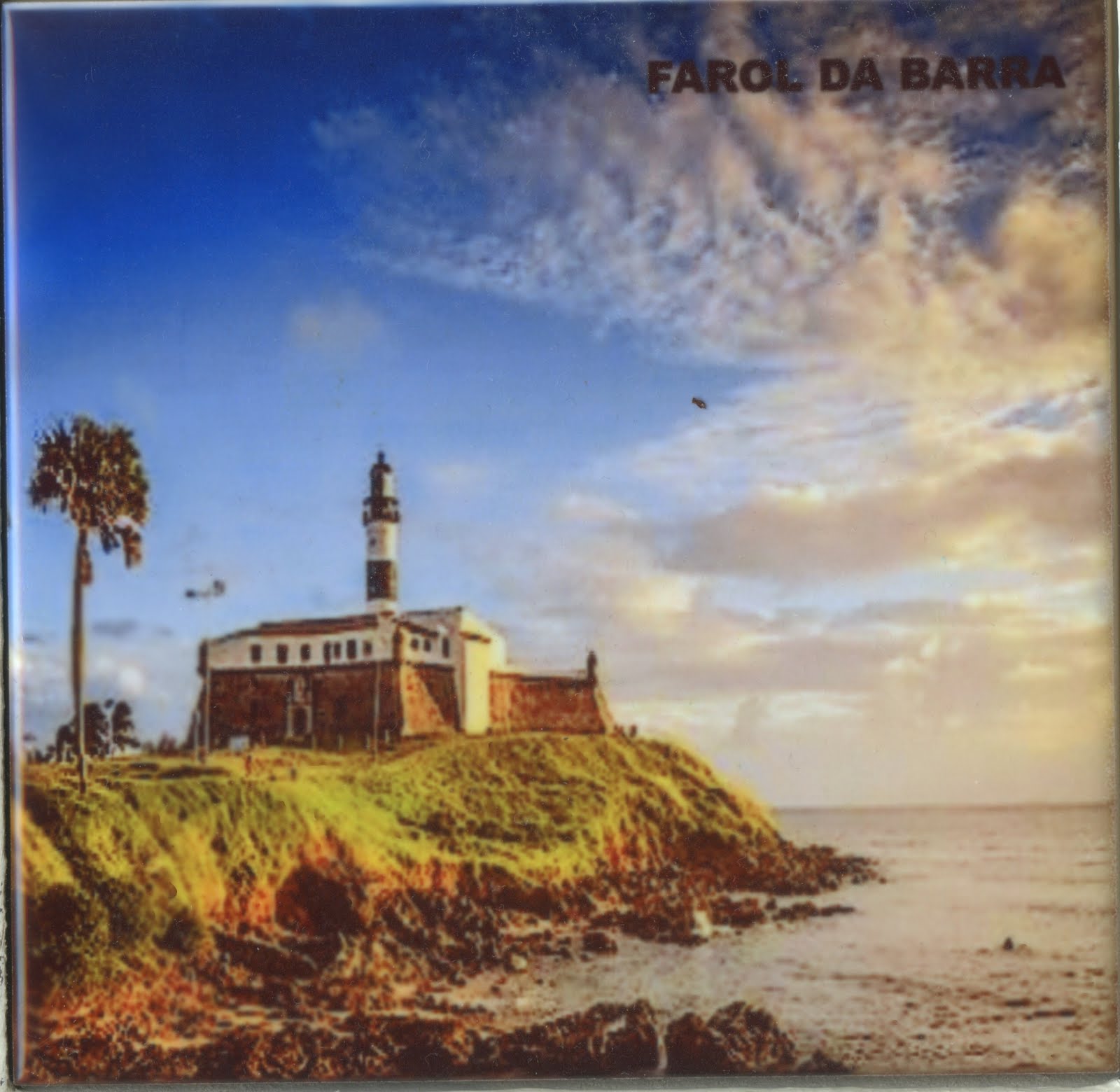
Hanging on the wall over my desk and next to my Merchant Marine license is a key ring holder.  Normally, such a pedestrian object would have no business there, but this key ring holder is special.  Furthermore, it is not there to hold keys.  A gift from Miss Patty after a recent visit with the children, it contains above the key-holding hooks a framed ceramic tile with a painting of a lighthouse on it.  While the world’s coastlines are full of lighthouses, this one serves as more than an aid to navigation.  It represents family.

In the southwest corner of Salvador, Bahia, Brazil, stands the Farol da Barra—the Lighthouse of the Barra—the Barra being the adjacent neighborhood of the city.  Situated on a slight promontory along the coast road, this light overlooks the confluence of the Atlantic Ocean and the Baia de Todos os Santos—the Bay of All the Saints.  This bay forms the seaport of Salvador.  The commercial shipping docks line the west side of the city with anchorage areas a short distance offshore.  Dating from 1698, this lighthouse has seen many vessels arrive and depart.  A comparatively new feature is the Museu Nautico da Bahia in an adjoining building.   A timeless feature is the magnificent view of the great South Atlantic Ocean, the Baia de Todos os Santos, and the adjacent coastline.  People traverse great distances to visit the Farol da Barra and enjoy the breathtaking beauty of the site.

Nearly every visit to the children in Brazil by family members from the north has included a visit to the Farol da Barra.  All of us have strolled the seaside promenade leading to the lighthouse.  The majestic sight of the seemingly limitless South Atlantic, the gentle washing of the shore along the seawall by the small waves, and the peace and quiet of Nature in contrast to the commotion of the city soothe the soul and inspire the mind.

Similar vistas are also available, even if only briefly, on one’s arrival in Salvador by air.  On its approach to the runway about a dozen miles north of the city proper, the aircraft flies over the Baia de Todos os Santos on a northeasterly heading.  To the left one sees the sheltered bay, the anchored cargo ships, and part of the commercial waterfront.  To the right one sees the open Atlantic, the Farol da Barra, and the Barra neighborhood of Salvador.  A fleeting but nonetheless breathtaking view from the air.

Five centuries ago, the Portuguese brought the supernal light of Christianity to Brazil.  They also established navigational lights to guide their ships along the coast.  Visiting this lighthouse in particular has become a family tradition, and every visit yields a spiritual experience.  In addition to illuminating the coast line, the Farol da Barra reminds us of the sublime light that our children and grandchildren bring into the family, and their light guides us to the Supreme Light that illuminates not only coast lines and families, but the entire world. 

Now for some photography.  First, the image of the Farol da Barra that's on the tile in the key ring holder:


Next are two photographs of the Farol da Barra taken by my son James on Friday, February 15, 2019:


We did have more photographs of the Farol da Barra, but unfortunately most of these were lost when my daughter's computer developed problems.  All the more reason to make a return visit, then!

Sunday, April 16, 2017

At Sea, At Sky


A ship embarked on a voyage across water is correctly said to be “at sea.”  An airplane embarked on a voyage through air is said to be “in flight.”  This inconsistency puzzles me.  It seems that an airplane underway should be described as “at sky,” for the airplane is truly in the sky just as much as the ship is in the sea.  I think of this now because of a journey that I made recently aboard a small aircraft which was simultaneously at sea and at sky.

At 12:14pm on Friday, March 17, 2017, with my son James at the controls, Miss Patty and I took off from Boire Field in Nashua, New Hampshire, aboard a Cessna Skyhawk and proceeded toward Biddeford, Maine.  It was a bright, sunny, and clear Saint Patrick’s Day, truly a beautiful day for flying.  I had not travelled in a small aircraft since the early 1980s, so this was a special occasion.

James taxied to the end of runway 32, and we took off into the wind to the northwest.  Once airborne, he banked the plane as it continued to ascend and turned sharply to the east.  At about 1,500 feet of altitude and in turbulent air, we passed over the northern part of Nashua.  I looked at our neighborhood below with some trepidation as the little airplane lurched through the turbulence.  I sincerely hoped that Saint Patrick was watching over us on his special day!  James knew exactly what to do, though, and the ride became more comfortable as he ascended into calmer air.  At a cruising altitude of about 3,500 feet, we flew east-northeastward towards Portsmouth and then into Maine.

Looking southward and seeing Portsmouth and its environs from the air was a special treat, and it brought back many happy memories.  I had been assigned aboard the Furman here in 1985 and 1986.  She spent a lot of time slowly loading subsea telecommunications cable at the Simplex Wire and Cable Company dock in Newington.  She also sailed up and down the Piscataqua River many times to shift berths and go on engineering trials.  In later years, when I was no longer sailing, we often brought the children to Portsmouth.  They played in Prescott Park, hiked across the Memorial Bridge, visited the lighthouse at Fort Constitution, and explored the grounds of Fort McClary.  They also saw ships there.  They toured the historic Bluenose II and the not-so-historic State of Maine at the State Pier.  They also admired the submarine Albacore, the cable carrier Global Mariner, and the cargo ships Atlantic Erie, Alexandria, Rays, and Nel.

Continuing toward Biddeford, James piloted the little aircraft overland and parallel to the coastline.  The great Atlantic Ocean stretched infinitely to the somewhat hazy horizon.  At its edge lay the beaches—Wells, Long Sands, and the Footbridge—that we had frequented with the children when they were little.  The lighthouses stood there, too, including the old family favorites that James promised to visit more closely on the return flight to Nashua.

Descending next for the approach to the small municipal airfield in Biddeford, James maneuvered the airplane through more low level turbulence and landed in a strong crosswind from the northeast on runway 24, one hour after our departure from Nashua.   After parking and securing the Cessna, we met James’ maternal grandmother who was waiting for us with an automobile.  A family reunion and luncheon at a nearby restaurant followed.

At 3:15pm it was time to leave again.  James took off on runway 60 heading east-northeast this time, still contending with the strong northwesterly crosswind.  Once aloft, as the small airplane was again buffeted by the low level turbulence, James turned the craft to starboard and headed seaward. Most of the haze had by this time disappeared, and the view of the Maine coastline and the open Atlantic was magnificent.  To port lay the sandy crescent of Old Orchard Beach capped by the rocky peninsula of Cape Elizabeth.  To starboard lay the assortment of rocky headlands interspersed with short sandy beaches that stretches back down to Portsmouth.  Just offshore a scattering of small rocky islands punctuated the coast.  Several of these islands sported lighthouses, and as he had promised, James turned southwestward over the Atlantic and set a course for sightseeing.

The first waypoint was Wood Island Light, just a few minutes’ flight from the Biddeford airfield.  Flying high enough to avoid the turbulence but low enough to see the lighthouses clearly, James next took the aircraft offshore and out to sea around Goat Island.  The coastal communities of Biddeford Pool and Fortunes Rocks passed by on the starboard side.  The broad, blue Atlantic stretched out infinitely to port.  This was my favorite part of the flight, and I enjoyed the ineffable feeling of simultaneously being at sea and at sky gazing down upon the sea.  It was sublime, supernal, and serene, despite the continuous hum of the motor.  After passing Goat Island to starboard, James continued southwestward toward Boon Island.  Kennebunk, Wells, and Ogunquit came into view on the starboard side.  The great, blue Atlantic remained omnipresent to port.

The time seemed to slow down as I stared at the open Atlantic on this leg of the flight.  I could have looked at it all afternoon and been very content.  But then, suddenly it seemed, we reached Boon Island.  James turned to port, rounded Boon, and headed next for the Nubble.  Long one of the family’s favorite spots, we had visited Nubble Light often when James and his siblings were younger, and from that vantage point had sighted the Boon Island Light on the horizon several  miles distant.  Seeing both lights from the air was a new experience, a broader and more breathtaking perspective.  At the Nubble, James turned the aircraft once again to port and followed the sea to the Isles of Shoals on the Maine-New Hampshire border.

Once again, I looked out to port and imbibed the view of the wide, blue Atlantic.  It was tremendous, but unfortunately we would fly over it for only a few more minutes.  We came upon the Isles of Shoals all too quickly, and James circled around them so we could see the small white lighthouse on White Island.  This beautiful little archipelago lies only about seven miles offshore.  The time was not slowing down now; it suddenly seemed to be going by much too fast!  After a very brief further interval of blissfully looking down at my Atlantic, the little aircraft came over Hampton Beach in New Hampshire.  My view of the wide-open ocean was then replaced by a view of the densely built up seaside resorts of Hampton and Seabrook.  From this point westward, we flew overland back to Nashua.

My mind remained at sea, however.  Today’s flight over water reminded me of two previous journeys that I had made, one long ago and one fairly recently. 

The first of these two flights took place aboard The Portlander, a small Bar Harbor Airlines Beechcraft 99, on Friday, December 16, 1977.   Enroute from Bangor, Maine, to Boston, it flew just offshore and paralleled the coastline from Penobscot Bay to Winthrop Neck near Logan Airport on a clear and sunny afternoon with excellent visibility.  The views of both the snow-covered New England coast and the cold, blue Atlantic Ocean were magnificent beyond description.  I’ve made many airline flights over the years, and this one ranks high on my list of favorites.

The second flight took place aboard a Tam Airlines 767 enroute from Sao Paulo, Brazil, to New York.  In the very early morning of Mother’s Day, May 8, 2016, I opened the window shade next to my seat on the port side of the aircraft and gazed contentedly down at the western Atlantic between 20 and 30 degrees of north latitude.  I had sailed on this stretch of ocean many times aboard several ships, and it felt good to be back.  I would have been perfectly happy to sit quietly and look at the Atlantic Ocean for the rest of the flight to New York, but this was not to be.  After a little while a cabin attendant came to my seat and asked me to please lower the shade.  It was letting too much light into the darkened interior of the airplane, she explained, and the cabin crew wanted the passengers to sleep as long as possible before they served breakfast.  I lowered the shade as requested.  As I did so, however, I glanced around and felt bad for the other passengers.  Very few of them had window seats, and I supposed that even fewer had any interest in looking at the great Atlantic Ocean.  And here, after all my voyages, I felt like a plank owner of the Atlantic!

As our homeward flight drew to its conclusion, James descended to about 1,500 feet and passed directly over his old school in Hudson, the Presentation of Mary Academy.  Then he brought the little Cessna back across the Merrimack River and over downtown Nashua.  At 4:15pm he landed on runway 32 at Boire Field, and our journey was complete.

In two hours of flight, we had seen the beauty of the sea and the sky, two of the primordial elements of the Earth.  The aerial voyage brought to mind the words of the psalmist:

                        They that go down to the sea in ships,
                        that do business in great waters;
These see the works of the Lord,
                        and his wonders in the deep (Ps. 107:23-24).

This applies to airmen as much as to seamen, for both traverse the vast stretches of sea and sky in their voyaging.  Whether on a ship looking out at the sea and up at the sky, or on an airplane and looking out at the sky and down at the sea, these magnificent elements speak to the human soul and touch the human heart.  The psalmist further asserts, “The heavens declare the glory of God” (Ps. 19:1), and more recent revelation informs us that, “The elements are the tabernacle of God” (D&C 93:35).  Whether at sea or at sky, then, the opportunity to experience Divinity and commune with Deity is at limitless as the elements themselves.

A few photographs from our journey:

Portsmouth Harbor.  The Piscataqua River separates Kittery, Maine, on the left, and Portsmouth, New Hampshire, on the right.  Several local landmarks are clearly visible:  the Navy Yard, the three bridges, Albacore Park, Prescott Park, Fort McClary, Fort Constitution, and downtown Portsmouth.

Boon Island, about six miles offshore from Cape Neddick and Nubble Light.  This is a very isolated spot, despite its proximity to the mainland.

The Atlantic Ocean.  This view is to the southeast from a point between Boon Island and the Isles of Shoals.  As I looked out on the wide expanse of the blue sea, I also observed the wing of our aircraft, and I marveled at the fairly recently discovered principle of physics that enables air to support the weight of the airplane, and its passengers, cargo, fuel, etc.

A few of the Isles of Shoals.  Depending on how one counts them, there are about ten islands in the cluster, which is bisected by the Maine-New Hampshire border.  They are easily accessible by ferry from Portsmouth.  This places them far enough from the madding crowd without being too isolated.  They look like a great location for my retirement home!

Sunday, November 20, 2016

To the Lighthouses


After my seafaring career had concluded, and when the children were still quite young, we often went to the seashore to admire the ocean.  We had a number of favorite locations that were reasonably close to our house, to my parents’ house, or to my in-laws’ house.  Several of these spots contained lighthouses, and in the seasons of the warmer weather, we visited them regularly.

As a mate aboard ship, I had always viewed lighthouses as strictly utilitarian objects, although admittedly, many of them looked quite attractive architecturally.  But I was using them for navigational, not artistic, purposes, and so I gave their aesthetic appeal little attention.  

Miss Patty held another view, however.  While recognizing the lighthouses as important navigational beacons, she also saw them as emblematic in a metaphysical and spiritual way.  For as they shone their lights through the nocturnal darkness to guide seamen on their voyages, they represented the supernal “light that shineth in [spiritual] darkness” (John 1:5) to guide all people everywhere on their voyages through life.  By displaying artificial illumination of impressive intensity visible for many miles at sea, they represented “the true Light, which lighteth every man that cometh into the world” (John 1:9).  In this sense, one might say that they were “sent to bear witness of that Light” (John 1:8).

In the daylight hours, the lighthouses’ distinctive appearance—tall and slender and often white, the traditional color of purity—caused them to stand out clearly from their surroundings as beacons for passing ships.  They served the same purpose both day and night; only the method changed.  We visited these lighthouses in both daylight and darkness, although admittedly more often in daylight with small children.  But day or night, their metaphorical value and spiritual significance remained undiminished.  They always bore mute testimony of “the true Light.”

These lighthouses were usually situated in secluded places, far from the madding crowds of summer tourists.  This serene atmosphere enhanced their spiritual value, and we spent many happy hours quietly imbibing the combined ambiance of the sea, the shoreline, and the lighthouses.  They were precious times.

I’ve selected several photographs from our lighthouse-hopping travels with the children, and I’m happy to share them here: 

One of our many visits to the Portsmouth area took place on Saturday, July 23, 1994.  Posing placidly on the seawall in New Castle, New Hampshire, are James and Steven, with the Portsmouth Harbor Light watching over them.  To the right lies the open Atlantic.  To the left the Piscataqua River leads to downtown Portsmouth. 
Miss Patty’s favorite lighthouse is Nubble Light in York, Maine.  Situated on a small island just across a narrow channel from Cape Neddick, the Nubble has long been one of New England’s most popular and most photographed lighthouses.  Access to the island and the lighthouse itself is prohibited, so even on a busy day the view of the structure remains clear.  In this late afternoon portrait from Saturday, June 28, 1997, the western sun illuminates the Nubble perfectly.

Several miles offshore from the Nubble lies a cluster of rocks called Boon Island.  A treacherous outcropping that spelled doom for several merchant vessels in the colonial era, it was eventually fitted with a light to prevent further disasters.  Like the Nubble , it is not open to visitors, but we came close on Monday, July 24, 2000, aboard the tour boat Oceanic.  A very interesting spot with a long and colorful history,
Guarding the entrance to Portland Harbor is Portland Head Light in Cape Elizabeth, Maine.  Merchant vessels arriving in and departing from Portland pass directly in front of Portland Head.  While a popular destination for summer vacationers, it does not become overly crowded but remains peaceful and quiet.  This is a noon time view on Wednesday, April 30, 1997.
A short walk from our house in Nashua lies the Merrimack River, and at the mouth of the Merrimack lies the city of Newburyport, Massachusetts.  The estuary where the Merrimack and the Atlantic meet is marked by the diminutive Plum Island Light, shown here on Friday, June 22, 2000.  As evidenced by the adjacent bird house, the light reposes in a bird sanctuary, a restful and quiet place to enjoy Nature, both maritime and avian.
Closer to my original home on Long Island, New York, the Fire Island Light stands on the barrier beach that separates the Great South Bay from the Atlantic Ocean.  For four generations this lighthouse has been an important landmark for my family, and we went to visit it every summer with the children and their grandparents.  After church on Sunday, May 29, 1994, the light tower stood up brightly in the strong southern sun.  A beautiful place to gaze seaward and contemplate the majesty of Creation.
Finally, at the easternmost end of Long Island stands the Montauk Light in Montauk Point State Park.  The family waded in the surf of the great Atlantic in front of the lighthouse on Monday, August 11, 1997.  Another outstanding location to enjoy the unparalleled beauty of the sea and sky.

Sunday, August 21, 2016

Watching the World Go By


At my age now, it’s sometimes nice to just sit back and relax and enjoy the show.  In the shipping business, the show goes on around the clock, day and night, every day of the year.  Some times are busier than others, of course, but there is almost always something to see. 

When the children were growing up, we frequently took them to watch the ship show.  This was always fun, educational, and inexpensive, and it always held the whole family’s interest, even for extended periods.  We had a few favorite spots where the traffic tended to be both concentrated and varied, and also where the scenery was beautiful.  Often we combined this entertainment with other activities, and we almost always brought a picnic lunch with us.  If we set out early enough, we brought a picnic breakfast as well.  We also always brought a camera, and sometimes a video camera, too.  I used up a lot of film on these excursions, believing that I could never have too many pictures of the ships and my children.

Several times each year, we took the children to Long Island to visit their grandparents.  There it’s always easy to watch the ship show because there are so many good vantage points close to home.  One of my favorites is in Brooklyn.  Alongside the Belt Parkway and in the shadow of the Verrazano Bridge lies a small park overlooking the Narrows, the main entrance to New York Harbor.  Several benches line a promenade and face the water.  Local residents relax on them, take in the view, and fish.  We went there to watch the fleet arrive and depart.

One such occasion in particular stands out in memory.  Arriving at 6:00am on a rainy and foggy Sunday, August 17, 2003, we did not need to wait long for the first ships of the day to appear.  Emerging from the drizzle hovering over the Lower Bay, three major vessels in succession entered the harbor.  Another left and went to sea, and others maneuvered through the fog in the anchorage.  Photographing these ships through the mist proved challenging, but I managed to get a few good shots.  We spent about two hours at this vantage point.  I would have been happy to remain all morning, but it was Sunday, and of course we had to go to church.  For now, I’ve selected the best of the pictures I took that day, and I’m happy to present them here:


The first arrival of the day.  In the very early morning of Sunday, August 17, 2003, the container ship P&O Nedlloyd Seattle has just sailed under the Verrazano-Narrows Bridge and now proceeds up the Narrows between Brooklyn and Staten Island.
Next comes the cruise ship Carnival Legend.  Very few passengers are out on deck at this early hour.
The container ship OOCL Faith of the Orient Overseas Container Line heads out to sea. She and the Carnival Legend passed port to port just north of the bridge.
The cruise ship Norwegian Dawn arrives next, bound for the renovated passenger piers on the West Side of Manhattan.
Finally, the Elizabeth Ann comes in with the barge 4001 on the hip.

 
Another of our favorite ship watching spots lies a few states away to the northeast.  The Spring Point Ledge Light stands at the end of a breakwater that extends from Spring Point in South Portland, Maine, into Portland Harbor.  It commands a superb view of Casco Bay, Portland Head, the harbor entrance, the city, and the surrounding islands.  We’ve taken the children there on several occasions, and they’ve all loved it.  One cloudy afternoon on Wednesday, August 7, 2002, proved to be a busy traffic time, as these photographs indicate:

A close-up view of the Spring Point Ledge Light, at the end of a 900-feet long jetty in Portland Harbor, on Wednesday, August 7, 2002.  At the very end of this jetty, and in the shadow of the lighthouse, we relaxed with our picnic lunch and watched the world of commercial shipping pass in front of us:
The oil tanker Nassau Spirit maneuvers past the lighthouse on her way to the adjacent Portland Pipeline Terminal, just to the west.

The ferry Island Romance heads from her terminal in downtown Portland to the Casco Bay Islands.
The pilot boat Portland Pilot returns to the city after delivering a pilot to an arriving ship.
The cruise ship Regal Empress arrives with a load of tourists.  The rounded merchant cruiser stern, the riveted overlapping strakes of shell plating, and the graceful curvature of the hull identify her as a fairly old vessel, but she is still running.
Finally, on Tuesday, June 26, 2001, we have a partial view of the tanker Rebecca moored at the Portland Pipeline Terminal.  The comparatively tiny catboat lying at anchor gives a good perspective of the massiveness of the Rebecca.

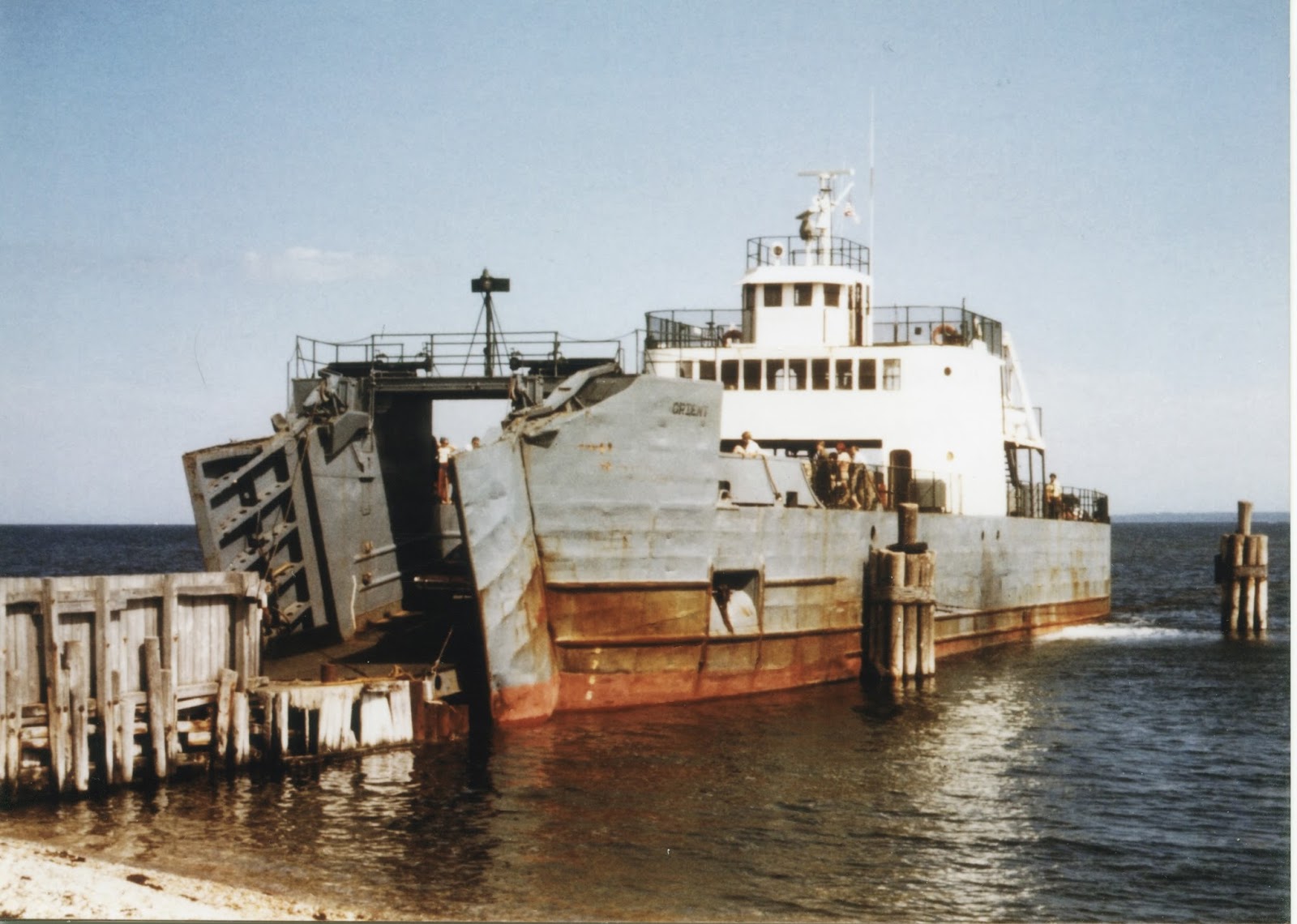
Next, returning to Long Island but going this time to its eastern end, we visit the ferry dock at Orient Point on an August day in 1976.  This predates my children by eleven years; in fact, I was still a teenager myself then.  A day trip by automobile with my parents took us to both the North and South Forks of Long Island, to both Montauk Point and Orient Point.  In something of a busman’s holiday, as I had just shortly before returned home from sea, we visited the waterfront and gazed out to sea.  Then we looked over the ferry facilities and took pictures of the ship in port.  I did not realize then how much of a role this ferry link to Connecticut would play in the family’s future, especially after the children arrived.  Here, then, is my favorite picture from that day:

The ferry Orient loads up at her terminal in Orient Point, Long Island, on a sunny day in August of 1976.  The battered hull plating and the generous allotment of rust indicate that the Orient has seen many years of service and has taken some punishment from a rough sea.  She has since gone to her reward, and newer vessels have taken her place.

In these and other waterfront locations, the beauty of the earth, sea, and sky are readily apparent in all weather conditions.  There is something about the sunlight in the way that it plays upon the water, the shore, and the ships that brings out the best in all of them.  And, without the responsibility involved in working aboard these ships, I have the leisure time to contemplate the majestic beauty around me.  At the end of the day, one of our hymns elevates this beauty to the supernal:

                                    Softly now the light of day
                                    Fades upon my sight away.
                                    Free from care, from labor free.
                                    Lord, I would commune with thee.[1]


[1] George W. Doane, “Softly Now the Light of Day,” in Hymns of The Church of Jesus Christ of Latter-day Saints, Salt Lake City: The Church of Jesus Christ of Latter-day Saints, 1985, p. 160.