Sunday, August 21, 2016

Watching the World Go By


At my age now, it’s sometimes nice to just sit back and relax and enjoy the show.  In the shipping business, the show goes on around the clock, day and night, every day of the year.  Some times are busier than others, of course, but there is almost always something to see. 

When the children were growing up, we frequently took them to watch the ship show.  This was always fun, educational, and inexpensive, and it always held the whole family’s interest, even for extended periods.  We had a few favorite spots where the traffic tended to be both concentrated and varied, and also where the scenery was beautiful.  Often we combined this entertainment with other activities, and we almost always brought a picnic lunch with us.  If we set out early enough, we brought a picnic breakfast as well.  We also always brought a camera, and sometimes a video camera, too.  I used up a lot of film on these excursions, believing that I could never have too many pictures of the ships and my children.

Several times each year, we took the children to Long Island to visit their grandparents.  There it’s always easy to watch the ship show because there are so many good vantage points close to home.  One of my favorites is in Brooklyn.  Alongside the Belt Parkway and in the shadow of the Verrazano Bridge lies a small park overlooking the Narrows, the main entrance to New York Harbor.  Several benches line a promenade and face the water.  Local residents relax on them, take in the view, and fish.  We went there to watch the fleet arrive and depart.

One such occasion in particular stands out in memory.  Arriving at 6:00am on a rainy and foggy Sunday, August 17, 2003, we did not need to wait long for the first ships of the day to appear.  Emerging from the drizzle hovering over the Lower Bay, three major vessels in succession entered the harbor.  Another left and went to sea, and others maneuvered through the fog in the anchorage.  Photographing these ships through the mist proved challenging, but I managed to get a few good shots.  We spent about two hours at this vantage point.  I would have been happy to remain all morning, but it was Sunday, and of course we had to go to church.  For now, I’ve selected the best of the pictures I took that day, and I’m happy to present them here:


The first arrival of the day.  In the very early morning of Sunday, August 17, 2003, the container ship P&O Nedlloyd Seattle has just sailed under the Verrazano-Narrows Bridge and now proceeds up the Narrows between Brooklyn and Staten Island.
Next comes the cruise ship Carnival Legend.  Very few passengers are out on deck at this early hour.
The container ship OOCL Faith of the Orient Overseas Container Line heads out to sea. She and the Carnival Legend passed port to port just north of the bridge.
The cruise ship Norwegian Dawn arrives next, bound for the renovated passenger piers on the West Side of Manhattan.
Finally, the Elizabeth Ann comes in with the barge 4001 on the hip.

 
Another of our favorite ship watching spots lies a few states away to the northeast.  The Spring Point Ledge Light stands at the end of a breakwater that extends from Spring Point in South Portland, Maine, into Portland Harbor.  It commands a superb view of Casco Bay, Portland Head, the harbor entrance, the city, and the surrounding islands.  We’ve taken the children there on several occasions, and they’ve all loved it.  One cloudy afternoon on Wednesday, August 7, 2002, proved to be a busy traffic time, as these photographs indicate:

A close-up view of the Spring Point Ledge Light, at the end of a 900-feet long jetty in Portland Harbor, on Wednesday, August 7, 2002.  At the very end of this jetty, and in the shadow of the lighthouse, we relaxed with our picnic lunch and watched the world of commercial shipping pass in front of us:
The oil tanker Nassau Spirit maneuvers past the lighthouse on her way to the adjacent Portland Pipeline Terminal, just to the west.

The ferry Island Romance heads from her terminal in downtown Portland to the Casco Bay Islands.
The pilot boat Portland Pilot returns to the city after delivering a pilot to an arriving ship.
The cruise ship Regal Empress arrives with a load of tourists.  The rounded merchant cruiser stern, the riveted overlapping strakes of shell plating, and the graceful curvature of the hull identify her as a fairly old vessel, but she is still running.
Finally, on Tuesday, June 26, 2001, we have a partial view of the tanker Rebecca moored at the Portland Pipeline Terminal.  The comparatively tiny catboat lying at anchor gives a good perspective of the massiveness of the Rebecca.

Next, returning to Long Island but going this time to its eastern end, we visit the ferry dock at Orient Point on an August day in 1976.  This predates my children by eleven years; in fact, I was still a teenager myself then.  A day trip by automobile with my parents took us to both the North and South Forks of Long Island, to both Montauk Point and Orient Point.  In something of a busman’s holiday, as I had just shortly before returned home from sea, we visited the waterfront and gazed out to sea.  Then we looked over the ferry facilities and took pictures of the ship in port.  I did not realize then how much of a role this ferry link to Connecticut would play in the family’s future, especially after the children arrived.  Here, then, is my favorite picture from that day:
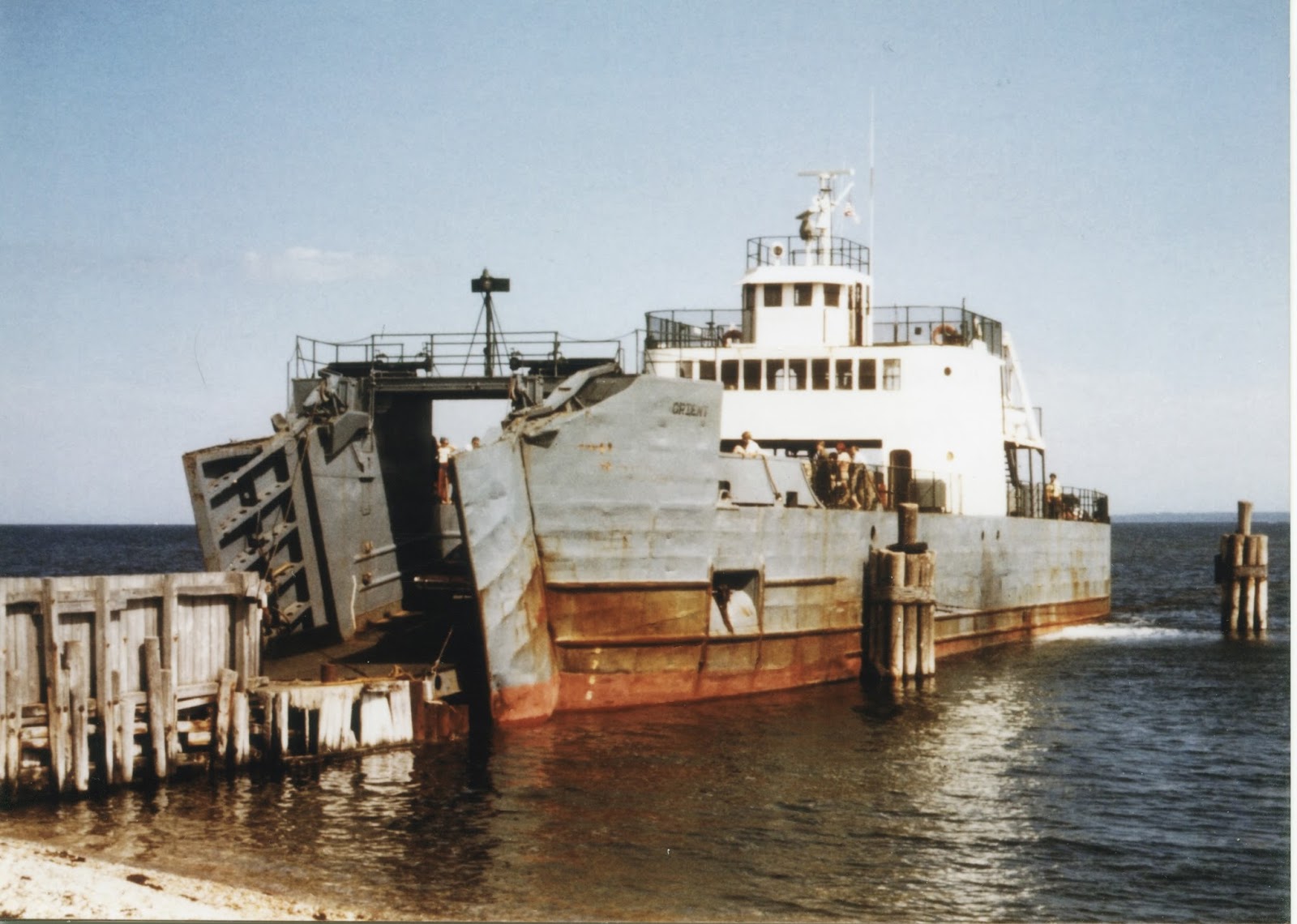
The ferry Orient loads up at her terminal in Orient Point, Long Island, on a sunny day in August of 1976.  The battered hull plating and the generous allotment of rust indicate that the Orient has seen many years of service and has taken some punishment from a rough sea.  She has since gone to her reward, and newer vessels have taken her place.

In these and other waterfront locations, the beauty of the earth, sea, and sky are readily apparent in all weather conditions.  There is something about the sunlight in the way that it plays upon the water, the shore, and the ships that brings out the best in all of them.  And, without the responsibility involved in working aboard these ships, I have the leisure time to contemplate the majestic beauty around me.  At the end of the day, one of our hymns elevates this beauty to the supernal:

                                    Softly now the light of day
                                    Fades upon my sight away.
                                    Free from care, from labor free.
                                    Lord, I would commune with thee.[1]


[1] George W. Doane, “Softly Now the Light of Day,” in Hymns of The Church of Jesus Christ of Latter-day Saints, Salt Lake City: The Church of Jesus Christ of Latter-day Saints, 1985, p. 160.


Sunday, August 7, 2016

The Old Fleet


Many years ago when I was young, the Delaware River and Bay Authority operated a fleet of four ferries between North Cape May, New Jersey, and Lewes, Delaware.  The vessels were headquartered at a large terminal facility at the western end of the Cape May Canal, and this site provided ready access to the open water of the Delaware Bay while also affording sheltered berths.  The service began operations in 1964, and it continues to the present time, although with a newer and more modern fleet.  The old ships, while now mostly gone, live on in photographs and memories, and they hold a special place in my personal chronicle of the sea.

My family vacationed every summer in Cape May during my teenage years in the late 1960s and early 1970s.  At first, we simply watched the ferries at the terminal in North Cape May and from Sunset Beach in Cape May Point.  After a while, though, just watching was no longer enough for me, and I pestered my parents about sailing on these big ships.  But my father balked at spending money for a mere joyride.  He had no desire to go to Delaware and did not see what the point would be.  He did inquire about the cost, however, and we learned that same-day, round-trip tickets for pedestrians were actually quite inexpensive.  My mother and grandfather also liked the idea of going sailing, and so we all went to sea with the fleet for the first time in August of 1972.

Our first voyage took place aboard the Delaware.  The weather was beautifully sunny and clear and the sea calm.  The Delaware rode placidly and comfortably across the mouth of her namesake bay to Lewes and back in about three hours.  It seemed to go by very quickly.  In my adolescent enthusiasm, I wandered all over the ship examining everything and feeling great delight in going to sea aboard such a capital vessel and in deep water.  With my adolescent lack of foresight, however, I took several pictures but not nearly enough, and I never thought to record the day’s events and voyage particulars in any kind of notebook.  While I regret that now, I am glad that I bought every postcard of these ships that I could find.

This initial voyage across the Delaware Bay proved to be so enjoyable for the entire family that we did it every summer for the next three years.  We made our subsequent voyages aboard the New Jersey, the Cape May, and I think the Cape Henlopen as well.  My grandfather, a former Captain of the ferry boat Henry Ludlow on the South Shore of Long Island, especially liked these longer crossings of the Delaware Bay.  He and I frequently walked around the ships together, and he often shared his expertise about various aspects of the ferry, the sea state, the weather, and the docking maneuvers with me.

One of my favorite aspects of these ferries was their paint scheme.  A very distinctive, multi-colored, and even unique design, it really made these ships stand out and be recognized.  It was so much more attractive, and it required so much more skill to apply, than the sprayed-on single color paint jobs of many vessels.  Over the years since, I’ve come to appreciate just how much a good paint scheme can contribute to a ship’s character and persona.

The four round-trip voyages that I made aboard the Delaware Bay ferries in my teenage years were all wonderful experiences.  They introduced me to the magnificent physical and spiritual  beauty of the sea and to the ineffable pleasure of going to sea.  They also helped me realize that seafaring was the career that I wanted to pursue.  After sailing across the bay several times, I next wanted to sail across the oceans, and eventually I did.  Now, many years later, I have fond memories of the old fleet of Delaware Bay ferries, and I’m happy to share some of my favorite photographs of them here:

An aerial view of the Cape May terminal.  This is actually in North Cape May, several miles from town, on the north shore and west end of the Cape May Canal.  This view is to the north.  On the left, to the west, is the Delaware Bay.  The ships present are, left to right, the Delaware, the Cape Henlopen, and the Cape May.

A stylized profile view of the Delaware, the largest vessel in the fleet.

The New Jersey.  She has just departed from the North Cape May terminal and is heading west out of the Cape May Canal.  In just a few minutes she will reach the open water of the Delaware Bay and then she will turn south.

The Cape Henlopen.  She has just entered the Cape May Canal from the Delaware Bay and is heading east toward the ferry terminal.  This is the same Cape Henlopen that now sails on the New London, Connecticut, to Orient Point, Long Island, route operated by Cross Sound Ferry.

An antique postcard portrait of the Cape May.  This was most likely a black and white photograph that was later hand painted in color.  A very interesting artistic style from a bygone era.
A real color photograph of the Cape May approaching the big terminal in August of 1971.
The Cape Henlopen (partly obscured) and the New Jersey at the docks in North Cape May in August of 1971.
The Delaware approaching the terminal in August of 1972.
Aboard a ship and at sea!  From the Delaware as she heads south toward Lewes, we see the northbound New Jersey, bound for Cape May, in August of 1972.
As the Delaware returns north from Lewes to Cape May, we see the Cape Henlopen heading south for Lewes.  Same day in August of 1972.

Sunday, July 31, 2016

The Middle Fleet

The three ships of The Bridgeport & Port Jefferson Steamboat Company daily cross the middle of Long Island Sound.  About midway along their route they pass the prominent Stratford Shoal Light, an important navigational aid built on a rock amid otherwise fairly deep water.  The line’s terminals in Bridgeport, Connecticut, and Port Jefferson, Long Island, provide convenient access to railroad stations.  Thus, I can travel by train from Boston to Bridgeport, enjoy an interlude at sea aboard the ferry, and then continue the rail journey to the family headquarters on Long Island.  The docks are not as conveniently situated for automobile access, at least for a family driving from New Hampshire.  For this reason, then, the Bridgeport ferry has served as a secondary route for us over the years.  Nonetheless, the several voyages we have taken with it have all been very pleasant and enjoyable occasions.

Nostalgic, too.  I had traveled these mid-sound waters in the summer of 1977 as an apprentice aboard the tugboat Charger.  She had routinely hauled the gasoline barge Interstate 35 past the Stratford Shoal Light to New Haven, Connecticut, and Providence, Rhode Island.  These and other vessels have all come and gone, but the lighthouse remains constant, standing as a mute witness to maritime history.  If the light could talk, what tales it would tell us!

Over several years, I have produced an amateur photographic record of maritime history when sailing with the mid-sound fleet, and sometimes, when just watching the ships from shore.  From this modest collection I have selected a dozen of my favorites:

Our two oldest children aboard the southbound Grand Republic on Sunday afternoon, August 8, 1993.  This vessel sailed between Bridgeport and Port Jefferson for 20 years.  In 2003 she was sold and became the Mary Ellen on the New London to Orient Point route.
The Park City is maneuvering into her berth in Bridgeport on Wednesday, August 25, 2010, in a light rain under a ceiling of nimbostratus clouds.  This view is from the elevated railroad station in Bridgeport, five minutes' walk from the ferry terminal.

The new Grand Republic arrives in Port Jefferson on Friday, August 27, 2010.
A close-up of the bridge of the new Grand Republic as she glides past us on the same arrival.
The pilot house of the Park City as she heads south from Bridgeport on Monday, September 16, 2013.

Ships that meet at sea.  From the southbound Park City we see the Grand Republic pass the Stratford Shoal Light on her way north to Bridgeport.

As the Park City approaches the dock in Port Jefferson we see the P.T. Barnum moored to the opposite side of the pier.  A maintenance crew is scaling her vehicle decks.

A view of the serene water of Long Island Sound.  We are looking eastward from the southbound P.T. Barnum on Tuesday, May 27, 2014.
From the P.T. Barnum we watch as the Park City passes by on her northbound voyage.
Following my disembarkation in Port Jefferson, the P.T. Barnum unloads vehicles.  The cars waiting in line will then board the ship for the next voyage to Bridgeport.


From the southbound Grand Republic, we see the Stratford Shoal Lighthouse on Tuesday, September 7, 2014.
The northbound Park City passes by to starboard.  This is unusual.  Mostly the ferries pass port side to port side, but the Grand Republic sailed more to the east than is customary in order to avoid a westbound tug and barge.

Finally, the view from the stern of the Grand Republic.  A peaceful place to rest and enjoy the beauty of the sea and sky and contemplate the majesty of Creation.


Sunday, July 24, 2016

A Parade of Ships


The ferry Susan Anne stood at the dock in Orient Point, Long Island, on Friday, July 15, 2016.  She was loading the last few vehicles and passengers for the 9:00am departure for New London, Connecticut.  We had a reservation for the 10:00am sailing, but we had arrived early because of better than expected traffic.  With about an hour to spare, then, I left the car and walked down to the narrow beach by the dock and started taking pictures.  The Susan Anne glowed in the bright sunlight.  A few minutes after 9:00, she sounded her whistle and eased away from her berth.  Once clear of the pilings she backed to starboard, put her engines ahead, and set an eastward course.  On her way out, she passed the incoming Mary Ellen, the vessel we would soon board for our scheduled 10:00am departure.  As I photographed the two ferries maneuvering, it occurred to me that I just might get pictures of the entire fleet that day.  At the very least, it would be worth a try.

Aboard the now docked Mary Ellen a few minutes later, I roamed the weather decks, camera in hand, and resumed my quest.  Soon the Caribbean Ferry arrived and backed into the adjacent berth.  Then the Sea Jet came along and waited patiently for the Mary Ellen to depart.  A traffic jam on the Orient Point waterfront—three ships vying for two docks!

At 10:00am the Master of the Mary Ellen appeared on the starboard bridge wing.  Gazing upon the assembly of shipping with his hand on the propeller and rudder controls, he looked almost god-like as he surveyed the scene around him and eased the ship away from the dock.  He did in fact look every inch the fully qualified and licensed Merchant Marine officer in his black trousers, white shirt, and four gold stripes on each shoulder board.  More importantly, he displayed great professional skill as he maneuvered the Mary Ellen on her departure.  An hour and a half later, he would display even more shiphandling skill in bringing the vessel to her dock in crowded New London.  For now, though, the Mary Ellen headed east on pristine blue water toward Plum Gut as the John H came in.  Another beautiful day on the sea, in my mind the pinnacle of all Creation.

The Mary Ellen and her running mates formed the parade of ships that spent the day crossing the eastern end of Long Island Sound, carrying automobiles, trucks, and passengers between New York and New England.  In our short voyage, we witnessed the workings of the whole fleet.  Beginning then with the Susan Anne, here are the day’s portraits of the ships of the Cross Sound Ferry:


The Susan Anne prepares for departure at the dock in Orient Point.

The outbound Susan Anne meets the arriving Mary Ellen a short distance off the beach at Orient Point.

The Mary Ellen approaches the dock at Orient Point.

The diminutive Caribbean Ferry approaches the dock at Orient Point, seen from the upper deck of the much larger Mary Ellen.

The Sea Jet waits for the Mary Ellen to depart.  Then she will dock in the space just vacated.

As the Mary Ellen sails toward New London, she first passes the John H bound in the opposite direction.  Here the John H has come through the Plum Gut and is passing the Plum Gut Light.

A close-up of the Plum Gut Light.

In open water, the Cape Henlopen is the next ferry sailing toward Orient Point.

Still in open water, the New London follows on her voyage to Orient Point.
Finally, we see the Susan Anne again, leaving New London now and heading back to Orient Point.

Sunday, July 3, 2016

The Meeting of the Mates


Such a rendezvous seemed more typically the stuff of spy stories and mystery novels than the activity of retired merchant seamen.  Two middle age men, who had met briefly three decades earlier and who would not recognize each other today, were both traveling to a prearranged meeting point in midtown Manhattan for a discussion over dinner.  The thought of it made me smile, and also remember the first James Bond book that I had read many years ago.  It was You Only Live Twice, by Ian Fleming.  I bought this book in a small shop on a side street in Napoli not far from the Stazione Maritima when the Rigel was docked there one day in the summer of 1979.  Subsequently, I read all of Ian Fleming’s James Bond stories aboard ship.  At the time, I considered this to be an important part of my education in the humanities.

Silly thoughts like these filled my mind on Monday, March 28, 2016, as I rode the train westward from Mineola into Manhattan.  More seriously, I wondered how we would recognize each other after so many years.  For this purpose, I wore my Waccamaw hat, something I don’t often do.  I had previously lost my Furman hat, and I did not want to risk losing another irreplaceable item of memorabilia.  But today was a special occasion.  Arriving in Penn Station, I disembarked and walked the short distance to our meeting point, the Rare Bar & Grill at 152 West 26th Street, just off Seventh Avenue.  I paused at the big sign in front.  After a quick exchange of text messages, my friend emerged from the restaurant and invited me inside.  Rendezvous accomplished.

Walter Burke and I had last met 32 years earlier aboard the oceanographic survey ship Bartlett in Port Everglades when I relieved him as second mate.

On Friday, October 12, 1984, I departed from La Guardia Airport in New York aboard an Eastern Airlines A-300 and flew over the Atlantic Ocean to Fort Lauderdale, Florida.  It was an uneventful nonstop flight, and it landed at the Fort Lauderdale-Hollywood International Airport on time at 3:00pm.  Boots James, a former shipmate from the Waccamaw who was now posted aboard the Bartlett, met me at the airport and drove me to the ship in a rental car.  The Bartlett rested alongside the wharf on the east side of the Port Everglades basin and adjacent to Burt and Jack’s, the famous high-style restaurant that overlooked the harbor.  I had a 45-days-old chief mate’s license, and I felt very fortunate to be getting a job as second mate so soon after passing the license exams.

Once aboard the Bartlett I was duly logged in and introduced to the shipboard luminaries.  Captain Kim L. Giaccardo was the Master.  Richard Carlson was chief mate.  Walter Burke was second mate.  Joe Bogusis was third mate.  Boots James was the purser.  Walter had been on board for a year and had travelled to South America and back.  Soon he would head home while I took his place.  I spent Friday afternoon and a large part of Saturday with Walter.  He showed me around the ship, told me what my new job would be like, and introduced me to everyone else on board.  It was a very pleasant occasion, filled with good food, amiable conversation, and high hopes for the future.   

Five days earlier, I had reached the age of 27.  I had just under three years left to achieve my goal of receiving the Master’s license before turning 30.  Despite the gradually deteriorating employment situation in the Merchant Marine, the future looked bright enough for me to have every expectation of realizing my goal.  To this end, I planned to remain aboard the Bartlett for a good long time and possibly relieve Mr. Carlson as chief mate when he went home on vacation.  If someone with prophetic capabilities had told me then how the future would really turn out, I daresay I would have dismissed his predictions as sheer nonsense.

My time with Walter was limited to these two days.  Then he left for his vacation.  He and I had crossed paths once previously.  When I had joined the Waccamaw in Augusta Bay, Sicily, in June of 1982, Walter was third mate on the Rigel with my classmate Owen Clarke as chief mate and Captain Rigobello as Master.  The two ships were tied up directly across the pier from each other, which made for easy visiting.  This served as a common memory for us during our brief acquaintance on the Bartlett.  Then, with the business of relieving him concluded, Walter went his way and I went mine.  I spent the next five and a half months as second mate aboard the Bartlett.  The ship made oceanographic survey voyages in the Caribbean Sea and the Gulf of Mexico.  Besides Fort Lauderdale, the ship made port calls in Key West, Florida, and Gulfport, Mississippi.  After experiencing some initial nervousness about beginning a new assignment, I became quite comfortable in my position.  The Bartlett was a good ship with a good crew, and I enjoyed sailing on her.  Now, many years later, I have happy memories of this time.

Such memories were what brought Walter and me together again.  Discussing the good old days at first via email, we found much common ground.  In many cases we had sailed on the same ships with the same Masters and the same mates, but at different times.  We had never sailed together, and our paths crossed only twice.  Like me, Walter had served aboard the Mercury, the Rigel, the Kane, and the Saturn.  Additionally, he had sailed aboard the Vega and the Truckee, two that I had missed.  He had also sailed with several of the great men of the fleet, including Captain Rigobello, Captain Iaccabacci, and the tragically late Captain Linardich.  And finally, we had both sailed aboard the Bartlett, one after another, with the now also sadly deceased Captain Giaccardo.

Unlike me, Walter had left the shipping business voluntarily in 1986 to pursue his second career on Wall Street.  I hung on to the end, when my illness and the failing job market combined to put me ashore in search of my own second career.  Now our ships are gone, many of our shipmates are gone, and our company headquarters in Bayonne is also gone.  But the memories remain.  And so, over a sumptuous dinner in a quiet corner of the Rare Bar and Grill in midtown Manhattan, we shared our memories and reminisced about the good old days.

They really were good days, too, although I recognize that more now than I did at the time.  Ironically, with the deteriorating vision that accompanies middle age, hindsight becomes twenty-twenty.  With this clear retrospective, Walter and I ate and talked.  The recollections transported us back through time and across the seas.  We talked of voyages we had made, places we had visited, colleagues we had known, and ambitions we had shared.  The people, the places, and the ships sailed back and forth across the table.  Two men in their fifties, who had known each other only slightly when in their twenties and who had not spoken to each other in three decades, discussed enough to fill a book.

We talked about coming ashore, our second careers, our families, and our homes.  Like so many of our shipmates, we had made the transition from the sea to the shore and had done well in our new professions.  We discussed the sad times, too.  Walter had been at work on Wall Street during the terrorist attack on the World Trade Center in 2001. We also mourned the loss of the freighter El Faro and her crew in 2015.  Graduates of both our schools lost their lives in this tragedy.

One thing which in hindsight particularly impressed us was the level of responsibility that we had borne aboard ship.  Our employer placed great faith in us and in many other young mates just like us.  We were so young then, not long out of our teens, and on watch aboard a ship at sea we carried a burden of responsibility largely unmatched by young men in jobs ashore.  A single mistake on our parts could have produced devastating results.  But our superiors had confidence in our capabilities and entrusted millions of dollars’ worth of ships and cargo as well as many men’s lives to us.    

Like a scene in a Conradian novel, our private party took place on a island surrounded by seawater and in a city that had once ranked as one of the world’s busiest seaports:  

This could have occurred nowhere but in England, where men and the sea
interpenetrate, so to speak—the sea entering into the life of most men,
and the men knowing something or everything about the sea. . . .We were
sitting round a mahogany table that reflected the bottle, the claret glasses,
and our faces as we leaned on our elbows. . . .Between the five of us there
was the strong bond of the sea, and also the fellowship of the craft.[1]

Despite the non-English location, I felt that we and the sea interpenetrated quite intimately; after all, we had come together because of the sea  And while we were two and not five, we certainly knew something of the sea and shared the “bond of the sea” and the “fellowship of the craft.”  These intangible qualities, incomprehensible to the layman and unheard of by the mainstream of a large and mostly inland country, unite in spirit men spread literally around the world aboard the ships that carry the world’s commerce.  United physically for the first time in decades, two of these seamen, like characters in Conrad’s novels, swapped stories, shared memories, and philosophized on the ways of men, ships, and the sea.  It was a very pleasant reunion.

After dinner Walter and I returned to Penn Station and boarded a train for the ride home.  He went to Huntington; I left him halfway there in Mineola.  Our conversation continued to the last possible minute.  Then we bade each other farewell, shook hands, and I disembarked.  Once again, he went his way and I went mine. 

On the walk home from the station, my mind raced with everything that had just taken place.  Thinking again in Conradian terms, I reflected on Walter’s kindness in inviting me to dine and toast the good old days with him.  I was very happy to have met him all those years ago, but sorry that I had never actually sailed with him.  Nonetheless, we belong to the same fraternity, having known the “exactions of the sea”[2] and having endured its “elemental furies.”[3] We had both “made many voyages,”[4] gained “a thorough knowledge of [our] duties,”[5] and had each “become chief mate of a fine ship.”[6]   Decades later, these experiences and memories are precious, even sacred, to both of us.

As I thought back upon this happy reunion I recalled the scriptural injunction, “I exhort you to remember these things. . .” (Moro. 10:27), for these voyages were “ordered for the illustration of life, that might stand for a symbol of existence.”[7]  This is most definitely true.  I simply cannot imagine going through life without going to sea.


[1] Joseph Conrad, “Youth,” in Tales of Land and Sea, Garden City, NY: Hanover House, 1953, p. 7-8.
[2] Joseph Conrad, Lord Jim, Garden City, NY: Doubleday & Company, Inc., p. 6.
[3] Ibid.
[4] Ibid.
[5] Ibid.
[6] Ibid.
[7] Joseph Conrad, “Youth,” op. cit., p. 8.

Sunday, June 5, 2016

Sunset At Sea


This series of photographs was taken aboard the ferry John H on our voyage from New London, Connecticut, to Orient Point, Long Island, on Friday, November 1, 2013.  This was the voyage on which I saw the green flash.  The atmospheric conditions provided perfectly for a magnificent late afternoon, sunset, and twilight on the water.  While I think the pictures turned out well, they nonetheless remain an insufficiently broad canvas to truly capture the vastness and the colors of the open sea and sky.  Also, I was unable to get a photograph of the green flash.  These points demonstrate that there is simply no substitute for actually being at sea.

As is my habit, I spent the entire crossing on the outside decks of the ship, insatiably imbibing the beauty of the sea and sky, and wishing that I were making either a transatlantic or a transpacific voyage instead of an all-too-short milk run.  Brief as it was, though, the crossing served as a wonderful respite from driving in the Friday night traffic, a momentary victory of the supernal over the secular.