Showing posts with label Alaska Railroad. Show all posts

Sunday, June 1, 2025

A Seaman Transplanted From the Sea

No visit to Anchorage would be complete without stopping by the large railroad station at the northern edge of the downtown area.  This station, along with the adjacent shops, offices, and freight yard, constitute the headquarters of the Alaska Railroad.  My son James worked on this railroad for several years before transferring to his present employment on the White Pass and Yukon Route.   Despite this change, however, he retains fond memories of the Alaska Railroad, and these include meeting one of my former shipmates.

Captain James Edward James, Jr., originally of Manteo, North Carolina, sailed as second mate aboard the freighter Rigel in the summer of 1979.[i]  I was then a brand new third mate, and I had the interesting and entertaining experience of sailing with him.  To call him a character would be the height of understatement.  This was a middle-aged man who sported long and tangled gray hair with a matching tangled beard, wore a winter coat and hat in the summer heat, smoked horribly stinky cigars that dripped ashes on his clothes, threw money in the water to appease the gods for good weather, and had a ready pithy witticism to suit every occasion.  More importantly, he was a highly competent seafarer and recognizably an expert in celestial navigation and nautical astronomy.  Also, as he told me, he was a veteran of the United States Coast Guard and a graduate of Harvard University.  He read Greek and Latin to a considerable degree and was conversant in several modern European languages.  Aboard the Rigel with him, I sailed across the Atlantic, spent the summer crisscrossing the Mediterranean, and then returned to Norfolk.  After that, he went his way and I went mine.  We never met again, but I heard news about him through the fleet grapevine, including that he had successfully passed all the examinations and had received the unlimited Master’s license.

Thirty-five years later, in the winter of 2014, my son James met James James aboard the Alaska Railroad.  He was then living with a female companion “off grid” in the forest north of Anchorage, a region without roads, airfields, electricity, or plumbing, and accessible only by trains that stopped when hailed by people along the track.  James James would catch a southbound train at a trailhead in the woods near his home and ride it fourteen miles to Talkeetna, the nearest town where he could purchase food and supplies.  When his business there was finished, he would return home on a northbound train.

Having heard sea stories during his childhood and adolescence, my son James came to wonder if this passenger James James was the same man that I had sailed with many years previously.  His good-humored but eccentric behavior aboard the trains seemed consistent with my descriptions of him aboard ship.  Always traveling with a gun, he willingly rode in the baggage car because firearms were prohibited in the coaches.  Always tight-fisted with cash, he laughingly engaged the conductors in endless debates over the fare structure.  Boarding the train and later disembarking from it always involved a clown show of off-beat antics and charades.  Much of this nonsense, better appreciated by watching it than by reading about it, was filmed and featured in the television series Railroad Alaska.[ii]  James James thus became a star of the Alaskan interior as well as a star of the sea.  And my son was privileged to be a part of this!

One day, after consulting with me about this unique passenger, my son James identified himself to James James as the son of a former shipmate and told him specifically that I had sailed with him aboard the Rigel to the Mediterranean and back in 1979.  On receiving this information, James James became awestruck and thoughtful.  He stared off into the distance for a moment, and then quietly remarked, “Wow.  That was a lifetime ago.”

Thirty-five years later and thousands of miles away, the past had caught up to the present.  It was one of those sobering moments that provided much food for thought but left little to say.  Both James and James James continued on their railroad journeys, but not for very much longer.  Sadly, James James became ill and eventually died of lung cancer in August of 2016.  Known long and well by many of the railroad employees, his passing seemed to mark the end of an era, and he was both fondly remembered and sorely missed.  As my son James wrote to me:


His reputation lives on at the Alaska Railroad.  Current and former employees who knew him continue to talk about him.  Among newer employees, he lives on as a character of legends.  His debates on the fare structure and antics on boarding and disembarking are still talked (and laughed) about.  He even comes up at union meetings!


The only time I spoke to him and he did not have a ready response or witticism of some kind was that time I mentioned the Rigel.  I don’t think he ever expected his past to catch up with him on the train! That response came only after several seconds of thoughtful silence.  He must have liked and remembered you, though, because he and I got along great after that.  He always asked how “everyone in New Hampshire” was doing and was happy to hear good reports.  He was always friendly with all the train crews, but he never asked anyone else about their families.[iii]


I’m very thankful that my son had this unique experience of meeting and traveling with one of my former shipmates.  It gave us a common ground that transcended the ordinary father-son relationship.  On further reflection, though, what were the chances of such a meeting ever taking place?  How could anyone possibly have predicted this?  I’ve never placed any stock in such long-shot coincidences; they always seemed the stuff of pulp fiction, mere contrivances that never happened in real life.  But this one proved that sometimes truth really is stranger than fiction.

Now, whenever I go to Anchorage, I stop by the Alaska Railroad Station downtown and smile inwardly as I think of my son James and my former colleague James James riding the rails together.  I don’t have any photographs of James James, but perhaps these two can serve as substitutes.  In the first, a train such as the ones he rode reposes at the downtown station before departing for points north on Friday, April 25, 2025:


Here, a street sign near my son’s house honors James James’ favorite star on Thursday, April 17.  In the mid-latitudes of the northern hemisphere in the spring and summer, Arcturus was always the first navigational star to become visible in the twilight following sunset.  As the Rigel sailed transatlantic, James James was always waiting with his sextant and stopwatch on the bridge wing at star time, ready for Arcturus to make its appearance.  He always started his round of stars with Arcturus, followed it up with three or four others, and then finished with Polaris.


[i] I wrote about James James previously in “Money for the Gods,” published in February, 2011.

[ii] My son James and his passenger James James were featured in several episodes of Railroad Alaska, which was broadcast between 2013 and 2016.

[iii] Extract from an email sent by my son James to me on May 27, 2025.

Sunday, June 5, 2022

Commuting to Alaska

With two of my grandchildren resident in Alaska, I must endure an uncomfortable imprisonment in the middle seat of an airplane for seemingly endless hours in order to visit them.  Actually, two middle seats aboard two airplanes, first from Boston to Seattle, and then from Seattle to Anchorage.  Miss Patty occupies the window seat; a stranger sits by the aisle.  Thus confined through the long and dark night, I sleep intermittently and occasionally study the on-screen navigational map.  Despite the discomfort, I realize what a blessing it is to be able to travel so far so quickly.  More importantly, I know that the reasons for this travel, our granddaughters Miss Katie and Miss Abby, are themselves the most sublime and supernal of all blessings.  It is always an honor to visit with them.

This point became all the more clear in church one Sunday morning.  As the speaker held forth on the importance of family, the two girls took turns climbing on laps, alternating between me and their Oma.  Their sweet innocence, unfeigned affection, and complete trust spoke volumes, “for of such is the kingdom of God” (Mark 10:14).

Our visits to the Alaskan grandchildren often involved opportunities to visit the Alaskan coastline as well.  The majestic beauty of Nature showed forth in a grand confluence of geology and oceanography as the snow-capped Chugach and Kenai Mountains intermingled with cold North Pacific waterways.  Far-flung seaport villages dotted this sparsely settled coast.  Two of them, Seward and Whittier, lay near enough to Anchorage to make day trips feasible.

On Monday, October 4, 2021, then, we drove to Seward on the Kenai Peninsula and visited the Alaska Sea Life Center.  This marvelous facility consisted of an aquarium, an aviary, a museum, and a research laboratory.  Birds, fish, and marine mammals abounded.  One sea lion in particular took a liking to Miss Katie and Miss Abby and put on an impromptu demonstration of diving, jumping, splashing, and making faces at them through the glass wall of the tank.  Naturally, the two girls loved the attention.

The back porch of the Sea Life Center overlooked Resurrection Bay.  This view was magnificent with the snow-capped Kenai Mountains nearly surrounding an expansive and placid fjord of Pacific seawater.  Local lore held that Captain James Cook of the Royal Navy discovered Resurrection Bay on Easter Sunday and named it in honor of the occasion.  The historical record indicated otherwise, however. This showed that it was actually named by Alexander Baranov, a Russian colonist and the first governor of Russian America.  His ship took refuge in the bay during a severe North Pacific storm and then emerged in calm weather on Easter Sunday.[1]  He also founded the port of Voskresenskii, which was later renamed Seward, on the bay’s western shore in 1793.[2]

The discrepancies between fact and folklore notwithstanding, our visit to the Alaska Sea Life Center and Resurrection Bay was a fascinating and unforgettable experience filled with breathtaking natural beauty evocative of “the works of the Lord, and his wonders in the deep” (Ps. 107:24).

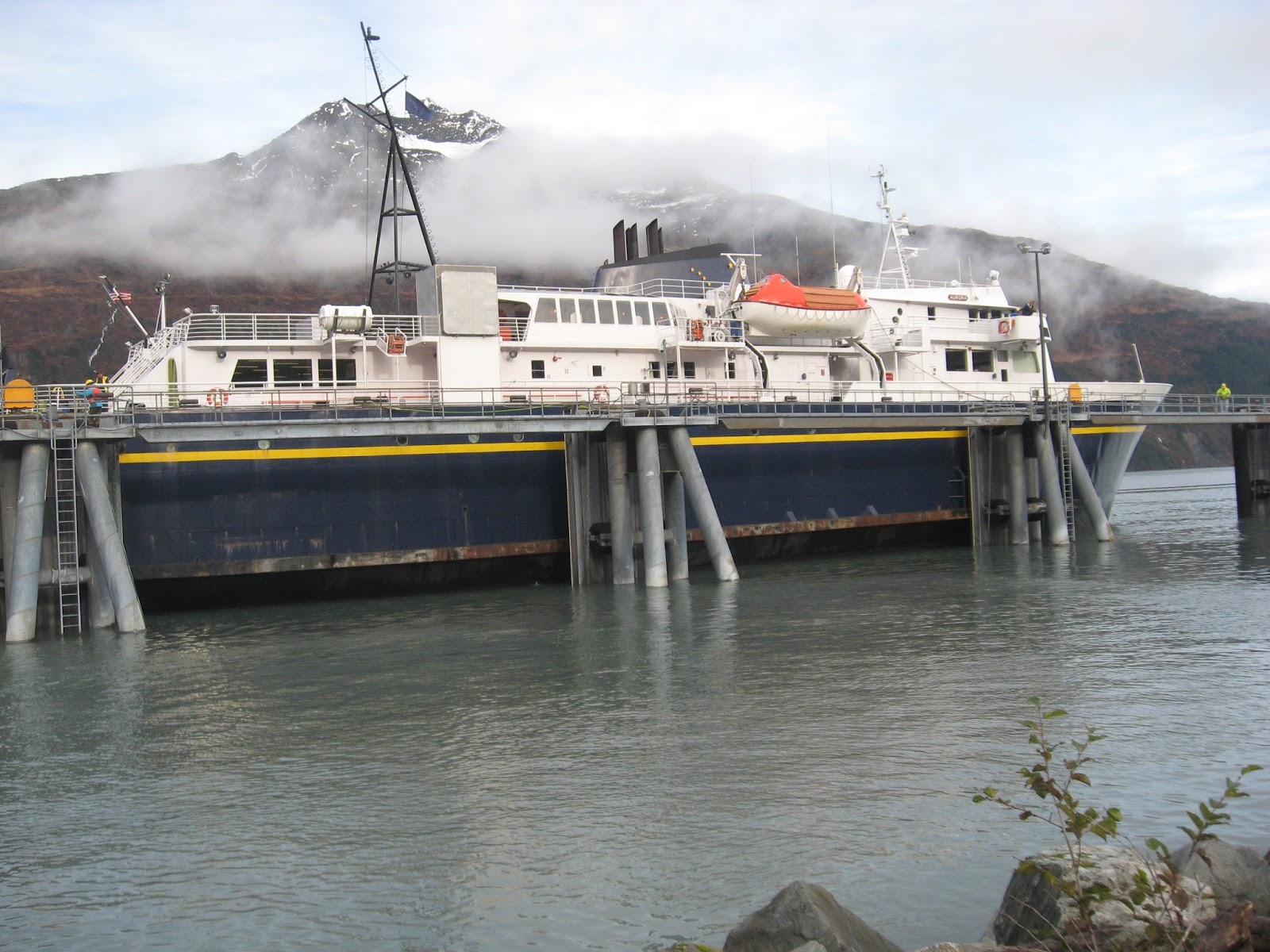
On Sunday afternoon, May 15, 2022, we drove to Whittier and visited the commercial shipping docks.  Two grand vessels were in port that day, the cruise ship Nieuw Amsterdam of the Holland America Line, and the ferry Aurora of the Alaska Marine Highway.  Both of these ships were part of our family history, and it was good to see them again.  Our family, then lacking grandchildren, had sailed aboard the Nieuw Amsterdam in the Caribbean in February of 2012, and I had seen the Aurora at her dock in Whittier on my first visit to Alaska in October of 2015.

Whittier stood on the south side of the Passage Canal, which was not a canal at all but an alcove adjoining the larger Prince William Sound.  Captain James Cook discovered this body of water in 1778, and it was subsequently named after the third son of King George III.[3]  In time, Whittier developed into a busy commercial, military, and fishing port with highway and railroad links to Anchorage.  The Nieuw Amsterdam docked there so passengers could make a convenient connection to the Alaska Railroad.  The Aurora docked there to load and discharge passengers and their private automobiles.  Surrounding both ships was a pristine oblong fjord nearly encapsulated by tall and jagged snow-covered mountains.  It was truly a view of the majesty of Creation, one that “let the beauty of the Lord be upon us” (Ps. 90:17).

The two granddaughters watched in rapt attention as the diminutive but elegant Aurora made her approach.  She passed directly in front of us as she turned and then backed down to her dock.  After the stern ramp was lowered the traffic started off the ship, and this, too, held the girls’ attention.  With her business concluded after only half an hour in port, the Aurora took in her mooring lines and got underway again.

The Nieuw Amsterdam, by comparison, was much larger and more stationary.  She would sail late in the evening, long after our return to Anchorage.  Meanwhile, she dominated the waterfront with her immense size and graceful lines, and yet she was dwarfed by the surrounding mountains that towered over her.  We found a small floating dock and attached gangway near her bow to be the best vantage point for viewing, photographing, and reminiscing.

On Thursday, May 19, 2022, I set out alone and on foot from the house during the granddaughters’ naptime.  Fifteen minutes of walking brought me away from the activity of the city to a pedestrian and bicycle trail paralleling the Cook Inlet.  This stretch of water extended from the open Pacific northeastward to the Anchorage International Airport and thence to downtown Anchorage.  The trail connected these two areas, covering a distance of several miles.  Scenic lookout spots, where one could sit quietly and imbibe the view, dotted the path.

My favorite of these lookout spots gave me unobstructed views in several directions.  To the northeast stood the modern skyscrapers of downtown with the Chugach Mountains behind them.  To the northwest and across the inlet from the city the Panamanian cargo ship Bunun Wisdom of the Wisdom Line[4] lay anchored near the opposite shore.  To southwest the airport occupied a peninsula from which every ten minutes or so an airplane took off into the northerly breeze.  Surprisingly, the distant roar of the jet engines did not seem intrusive, nor did the occasional sounds of locomotive horns from the freight trains on the nearby railroad tracks.  More quietly, though, spread out directly in front of me were the extensive low tide mud flats of the Cook Inlet backed by a much larger expanse of blue water.  It was a truly magnificent vista.  I could have stayed there all afternoon, but the granddaughters’ nap time would not last that long!

Of course, these granddaughters, along with our sons and daughters-in-law, were the reasons why Miss Patty and I had traveled to Alaska in the first place.  All the sightseeing was a nice bonus and an uplifting spiritual experience.  The family, however, was paramount.  With this family we had wonderful vacations, times that went by much too quickly, but also times that reminded us of how fortunate we were to have both children and grandchildren, as well as good children-in-law.

Two great spiritual events took place during these family reunions.  The first was Miss Katie’s baby blessing on Sunday, March 4, 2018.  Following the family tradition, she wore the christening gown which her great-great-grandparents, Robert Burns and Julia Murphy, had purchased in 1949 for their first grandson, and which has now been used by three generations of our family.

The second, and the true spiritual summit of our visits, took place in the evening of Wednesday, October 6, 2021, in the Anchorage Temple.  Miss Patty and I gathered in the sealing room with our two sons and daughters-in-law and carried out the requisite sealings for my deceased parents.  First they were sealed to their parents, then to each other, and finally to me.  Afterwards, we retired to the celestial room for an interval of quiet contemplation before leaving.

While one need not fly to Alaska in order to enjoy a happy family gathering and a meaningful religious experience, the investment of time, effort, and discomfort in traveling makes the trek seem like a pilgrimage, and thus it enhances the intensity of the occasion.  Such were my thoughts during my confinement in the awkward middle seats of the airplanes on the long nocturnal flights home.  Now, I look forward to going back and doing it all again!

Next, let’s look at some pictures:

At the Alaska Sea Life Center in Seward, a sea lion meets one of our granddaughters on Tuesday, October, 4, 2021.    

 
A view of Resurrection Bay from the rear balcony of the Sea Life Center on the same day.


The ferry Aurora of the Alaska Marine Highway arrives in Whittier on Sunday, May 15, 2022.


Same day; same ship.  The Aurora discharges passengers and their vehicles at the dock in Whittier.


Same day; different ship.  The Nieuw Amsterdam reposes quietly at the main commercial dock in Whittier.  She is a large vessel, but the mountains easily outsize her.

 
A view of the Cook Inlet in Anchorage on Thursday, May 19, 2022, with the anchored cargo ship Bunun Wisdom.


"And the light shineth in darkness" (John 1:5).  The steeple of the Anchorage Temple on Wednesday, October 6, 2021, following the completion of my parents' sealing ordinances.

Some lights shine just as well in the daytime.  The steeple of the meetinghouse of The Church of Jesus Christ of Latter-day Saints on West 40th Avenue in Anchorage, where my sons and their families attend church, on Sunday, May 15, 2022.

Neighbors.  Across the street stands Our Lady of Guadalupe Cathedral.  Built in the Spanish Mission Revival style, the cathedral has twin belfries, each topped with a Mediterranean-style red tile roof surmounted by a Latin cross.  A traditional symbol of Christianity, the cross reminds us of the brutality and suffering involved in the Atonement, a point we should always remember and appreciate.


[1] https://en.wikipedia.org/wiki/Resurrection_Bay. 

[2] https://en.wikipedia.org/wiki/Alexander_Andreyevich_Baranov.

[3] https://wikipedia.org/wiki/Prince_William_Sound.

[4] Information from marinetraffic.com.

Friday, November 20, 2015

Pictures from Alaska

An assortment of photographs taken on my visit to Alaska, October 8 to 10, 2015. As always, click on the photo for a larger view.


James' and Sarah's new house in Anchorage.

Statue of Captain James Cook, RN, in Resolution Park in downtown Anchorage.
James and the Aurora of the Alaska Railroad in the Anchorage station, preparing to depart for Fairbanks.  I rode this train to Wasilla, the first stop.
The Alaska state flag over the Wasilla station.  I particularly like the depiction of the constellation Ursa Major and Polaris, the North Star.  I used Polaris many times at sea for navigational purposes.
The ferry Aurora of the Alaska Marine Highway, just arrived in Whittier.
The railroad barge Anchorage Provider in Whittier, with railroad freight cars on the main deck and shipping containers stored in the upper works.
The bow of the Anchorage Provider.  Note the bulwarks situated to protect railroad cars and shipping containers from the rigors of the Pacific Ocean.
The ocean-going tugboat Gulf Titan, the towing vessel that hauls the Anchorage Provider between Whittier and Seattle.
Saint Nicholas Russian Orthodox Cemetery in Eklutna.  Very distinctive with the "houses" for the spirits of the deceased.
Saint Innocent Russian Orthodox Cathedral in Anchorage.  An impressive sight with its plethora of onion domes.
Saint Nicholas of Myra Byzantine Catholic Church in Anchorage.  The largest onion dome, over the main entrance.
The statue of the angel Moroni atop the Anchorage Temple of the Church of Jesus Christ of Latter-day Saints.

Monday, November 16, 2015

Twice By the Pacific


When I was in the shipping business, I went where my employer sent me.  Now that I’m in the family business, I go where my wife sends me.

Such were my thoughts in the evening of Wednesday, October 7, 2015, as the Alaska Airlines 737 maneuvered on its approach to the Seattle-Tacoma International Airport at the conclusion of a transcontinental flight from Boston.  This aerial voyage had taken me over Ontario, Manitoba, the Dakotas, Montana, Idaho, and Washington.  Finally, the aircraft descended and made a wide left turn which gave me a panoramic view of the region.  For the first time in 31 years I looked upon downtown Seattle, Puget Sound, the Olympic Peninsula, and the vast Pacific Ocean.  I had last seen this part of the world from the bridge of the freighter Comet in the spring of 1984.  After all this time, it felt good to be back.

But I would not remain long.  A connecting flight aboard another Alaska Airlines 737, this one a combination passenger and cargo airplane, conveyed me northwest from Seattle and out over the inky black Pacific to Anchorage, Alaska.  I had never been to Anchorage before; my employer had never sent me there.  Instead, my wife sent me there—to visit our son and daughter-in-law.  They had recently bought a house, and my assignment was to help them move their belongings.  At 3:45am on Thursday the 8th, the plane touched down.  A few minutes later, my oldest son James met me inside the terminal and drove me to his new home.

It felt disconcerting at first, after traveling thousands of miles, to arrive in a place where the people spoke American-accented English, used American money, and flew the American flag.  A journey of similar distance but in the opposite direction from Boston would have yielded a much different result.  Several years spent making transoceanic voyages had accustomed me to this.  Today it felt odd to still be in the United States.  Soon enough, however, I would see subtle differences and become aware of Alaska’s cosmopolitan background.

For a few hours every day, we moved James’ and Sarah’s belongings from their previous residence to their new home.  The rest of the time we spent traveling and sightseeing.

Starting in Anchorage on Thursday, James and I visited Earthquake Park.  Named for the infamous earthquake that struck the region on Good Friday in 1964, this site offered an open view to the west, north, and northeast.  Across the water of the Cook Inlet stood downtown Anchorage with the snow-capped Chugach Range behind it.  A spectacular view, even on a damp and cloudy day.  In the city proper, we visited Resolution Park, which faced the opposite direction.  A life-sized statue of Captain James Cook of the Royal Navy looked to the west over the Cook Inlet, the waterway that bears his name and connects Anchorage with the open Pacific.

Captain Cook is an iconic figure in the history of Alaska.  Justly famous for his voyages of exploration in the vast Pacific Ocean, he and his crews made extensive surveys and drew detailed maps of the Alaskan coastline.  They carried out much of their Alaskan explorations aboard the Resolution and the Discovery during the summer of 1778, at the same time that their military colleagues were attempting to put down an armed colonial uprising on the eastern seaboard of North America.  I found it ironic that Alaska would one day join the country that was formed out of this rebellion.  For his work, Captain Cook came to be honored not only with this statue, but with a downtown luxury hotel named for him and with numerous wall murals in its lobby portraying his ships, their crews, and the sites they explored.  In the long history of seafaring, very few seamen have been honored with statues, let alone with buildings and paintings.[1]

Friday’s sightseeing took place south of Anchorage.  On the road to Whittier James and Sarah and I skirted the waterway known as Turnagain Arm.  Named thus by Captain Cook because his two ships needed to turn around in it repeatedly to avoid danger, Turnagain Arm extends inland but does not lead to the seaport of Whittier.  Instead, to reach Whittier we drove through a 2½ mile long combination railroad and highway tunnel cut through solid rock beneath the 4,100 feet high Maynard Mountain.  Emerging in Whittier, we  came upon its small but important harbor, situated on the western end of Passage Canal.  This is not really a canal, but an arm of the much larger Prince William Sound.  Cruise ships, ferries, and railroad barges serve this port, which is surrounded on all sides by the snow-capped Chugach Mountains.

Arriving shortly after we did was the ferry Aurora of the Alaska Marine Highway, the state’s coastwise ferry line. The Aurora backed gracefully into her berth, discharged and loaded passengers and vehicles, and then quietly got underway again.  Moored nearby were the main attractions for us, the tug Gulf Titan and the barge Anchorage Provider, operated by Western Towboat and Alaska Marine Lines, respectively.

The Gulf Titan was an ocean-going tugboat that towed railroad barges such as the Anchorage Provider.  These vessels are two of the fleet that runs the supply route between Whittier, Alaska, and Seattle, Washington.  The Anchorage Provider’s main deck consists of railroad tracks, and her upperworks holds shipping containers.  A shoreside crane would load and remove the containers on the top level, and railroad locomotives would push and pull the freight cars onto and off the main deck.  As I studied this vessel’s configuration,  I became impressed by her size.  A non-motorized barge, she measures 450 feet in length and 85 feet in breadth, large enough to accommodate eight railroad tracks each 420 feet long.  Fully loaded, she can carry 50 railroad cars and a combined total of 20,000 tons of rail cars and shipping containers with a draft of only 18 feet.  James explained his role as a railroad employee in the process of loading and unloading rail cars.  A precision operation, it requires an exact alignment of the barge’s rails with the shoreside rails, tolerates a ramp elevation of no more than a few degrees, and requires that the barge be kept on a even keel at all times.  Wind and sea conditions, even in this sheltered harbor, can wreak havoc with this delicate process.

Despite these constraints, this tug and barge operation serves as Alaska’s lifeline.  Consumer products of almost every description including food arrive in Whittier by sea and are then trucked or railroaded to Anchorage and other destinations.  In the opposite direction, railroad tank cars bring petroleum products to the “Lower 48.”  A fleet of three tug and barge units carry the seaborne commerce between Alaska and Washington.  Additional vessels operated by Foss Marine and the Canadian National Railway carry cargo between Alaska and British Columbia.  By comparison, the cargo carried by Alaska Airlines is a tiny fraction of that carried by sea, and consists of mostly small items and mail that need to be delivered quickly.

We did not see this operation in process, though.  On this particular day, the cargo loading had already been completed, and the Gulf Titan and the Anchorage Provider reposed quietly at their dock.  What they were waiting for remained unknown.  It likely was not the weather, which was quite mild.  Besides, that would not stop them.  James explained that the one way voyage between Alaska and Washington normally requires six days; in poor to extreme sea conditions, though, it can take ten to fifteen days.  Sailing on the open Pacific is not always a pacific experience, as I had learned aboard the Comet many years previously.

On Saturday we followed a different course.  I took a ride on the Alaska Railroad’s weekend Anchorage to Fairbanks train Aurora.  I rode only from Anchorage to Wasilla, though, a 1¼  hour long journey.  James followed the train in his automobile, and Sarah returned to work.  After a pleasant ride out of the city and through the woods and wetlands and with the snow-capped mountains always looming in the distance, I disembarked at the Wasilla station.  James was waiting for me on the platform.  We then returned to Anchorage, but with stops.  The first of these was at a locomotive shop, where a volunteer crew was restoring and rebuilding an Alaska Railroad steam locomotive, Number 557.  An ambitious project of several years’ duration, it is gradually nearing completion.  James had spent many hours working on this locomotive, but was off duty today.  He kept himself occupied with me instead.

Continuing back toward Anchorage, we stopped first at Lake Eklutna, a fresh water lake high in the mountains that provides the drinking water for the Municipality of Anchorage.  Next we visited the Saint Nicholas Russian Orthodox Church and Cemetery in Eklutna.  A beautiful little building topped in the Russian fashion with onion domes and Eastern-style three-armed suppedaneum crosses, Saint Nicholas occupied a small site and served as a spiritual haven in a very quiet rural area.  Much of the property contained the cemetery, itself a sight to behold.  Miniature houses painted in bright colors covered the individual graves.  James explained that these served to house the spirits of the deceased in the Russian tradition.  James further explained that when the Russians came to Alaska, they brought Christianity with them, and they passed it on to many of the native inhabitants.  To this day Russian Orthodoxy remains one of the most prevalent denominations of Christianity among the native Alaskan population. 

After returning to Anchorage, we stopped at three more churches.  The first and largest of these was the Saint Innocent Russian Orthodox Cathedral.  A large and fairly new but nonetheless very ornate structure, it featured a multiplicity of onion domes and suppedaneum crosses.  Similarly, the smaller Saint Nicholas of Myra Byzantine Catholic Church and Parish Hall also displayed onion domes and suppedaneum crosses.  I especially enjoyed seeing these distinctive symbols of Christianity from far-off Eastern Europe.  Some may regard them simply as cultural icons, but to me they demonstrate the universality of the Christian faith and its acceptance by the diverse peoples of the Earth, the result of the early Apostles heeding the Lord’s instruction to “Go therefore, and teach all nations…” (Matt. 28:19).  Finally, we went to see the Anchorage Temple of The Church of Jesus Christ of Latter-day Saints.  Built in an architectural style vastly different from the Russian and Byzantine churches, it also expressed the spiritual character of its denomination, especially in the statue of the angel Moroni summoning the entire population of the world to enter its hallowed halls. 

Additionally, several Roman Catholic and Protestant churches stood in Anchorage, but with time in short supply, we unfortunately needed to prepare for my departure on Saturday night.  Three days in Alaska were quickly proving to be insufficient.  There remained so much more to see and do, including miles of rugged coastline and numerous sheltered harbors to explore.  But for now, I had the long aerial voyage home.

Shortly after midnight, I left Anchorage aboard an Alaska Airlines 737 bound for Portland, Oregon.  After takeoff the aircraft turned southeastward and flew over the Pacific Ocean.  Sitting by a window on the starboard side, I gazed down through the dark night at the dark sea.  It was faintly but definitely discernible.  As the airplane neared the Oregon coast, the gradual approach of dawn turned the vast Pacific from a dark to a medium gray.  From the air it appeared to be truly pacific, yet I thought of Robert Frost’s famous opening lines:

                        The shattered water made a misty din.
                        Great waves looked over others coming in,
                        And thought of doing something to the shore
                        That water never did to land before.[2]

And I thought of the thrashing the Comet had taken on her two-weeks-long return voyage from Japan in 1984.  She had made several port calls here on the American West Coast before and after sailing transpacific to and from the Far East.  I would love to make such a long voyage again, I daydreamed, perhaps aboard a Holland-America Line cruise ship!  For now, it simply felt good to be back, I reflected, as the aircraft turned east and headed overland to the Portland International Airport.

After a short layover, I left Portland early Sunday morning aboard another Alaska Airlines 737 bound across the continent for Boston.  Cloud cover hid the ground until the aircraft reached Montana.  There I saw for the first time this state where James had gotten his start in railroading. The farmlands of North Dakota, Minnesota, and Wisconsin followed.  Then the airplane passed over the Great Lakes.  Looking south, I enjoyed a breathtaking view of Lake Michigan, then Michigan itself, Lake Huron, and the Niagara Peninsula of Ontario with Niagara Falls and the Welland Canal clearly visible.  Lake Erie reached to the horizon in the south.  Finally, the aircraft passed over Lake Ontario and then upstate New York.  On the approach to Logan Airport in the late afternoon, the pilots took the airplane east over the Atlantic Ocean and then made a wide left turn to land into the northwest.  A long and bumpy descent over the bright blue and calm sea followed, and then the plane touched down.  Despite the inability to attend church, it was a restful and spiritual Sabbath for me, flying over and imbibing the magnificence of the Pacific, the Great Lakes, and the Atlantic all on the same day!

On the bus to New Hampshire, my thoughts returned to the Pacific.  I felt a sense of gratitude for all my experiences on the great waterways of the world.  Somehow, though, the Pacific was different, and ironically, I had never intended to go there.  When the Comet arrived in New Orleans in December of 1983, I spoke with the powers-that-be at company headquarters about returning to the Waccamaw in the Mediterranean, as had been the original plan when I went on vacation.  This plan was nixed, however.  I remained aboard the Comet, transited the Panama Canal, and crossed the great Pacific.  My initial disappointment about this went away quickly, and now I’m very grateful that I stayed the course.  And I wish I could do it again!

From Panama to Korea, from the Comet to the Anchorage Provider, and from Alaska Airlines to the Alaska Railroad, the Pacific has repeatedly opened up a world of new adventures for me.  I’m thankful for these unexpected but happy experiences, and I think  of the scriptural injunction to  “live in thanksgiving daily, for the many mercies and blessings which he doth bestow upon you” (Alma 34:38).

Between my employer and my wife sending me away on long voyages, I owe a lot in thanksgiving.


[1] I personally know of three other statues of seamen:  Captain Rafael Semmes of the Confederate States Navy in Mobile, Alabama, Admiral David Glasgow Farragut of the United States Navy in Madison Square Park in New York, and Capitano Cristoforo Colombo in Genova.  There may be others, though.
[2] Robert Frost, “Once by the Pacific,” in The Poetry of Robert Frost, New York: Holt, Rinehart and Winston, 1969, p. 250.