Showing posts with label Staten Island Ferry. Show all posts

Sunday, January 5, 2020

Cleaning Out the Archives


Every place of human habitation needs a good housecleaning every so often, and our home is no exception.  With plans to retire, relinquish the property, and relocate to a milder climate in the not-too-distant future, the time has come not only for a good housecleaning, but a major downsizing as well.  With this thought in mind, I’ve packed up and given away many household items in recent months, but of course, more still needs to go.  Nothing in the house, not even the family archives, may be exempt from inspection and possible ejection.

Last month’s project, then, involved a thorough examination of the children’s picture albums.  They had about a dozen of these, all filled mostly with mediocre photographs taken with toy cameras and with some duplicates of pictures taken with more sophisticated equipment.  It was a motley collection, but it did contain a few gems that I wanted to save.  The bulk of the collection was jettisoned, as we had much better quality photographs of the same subjects.  Redundancy is a wise course in both archival work and shipboard engineering systems, but it can sometimes be taken to unreasonable extremes.

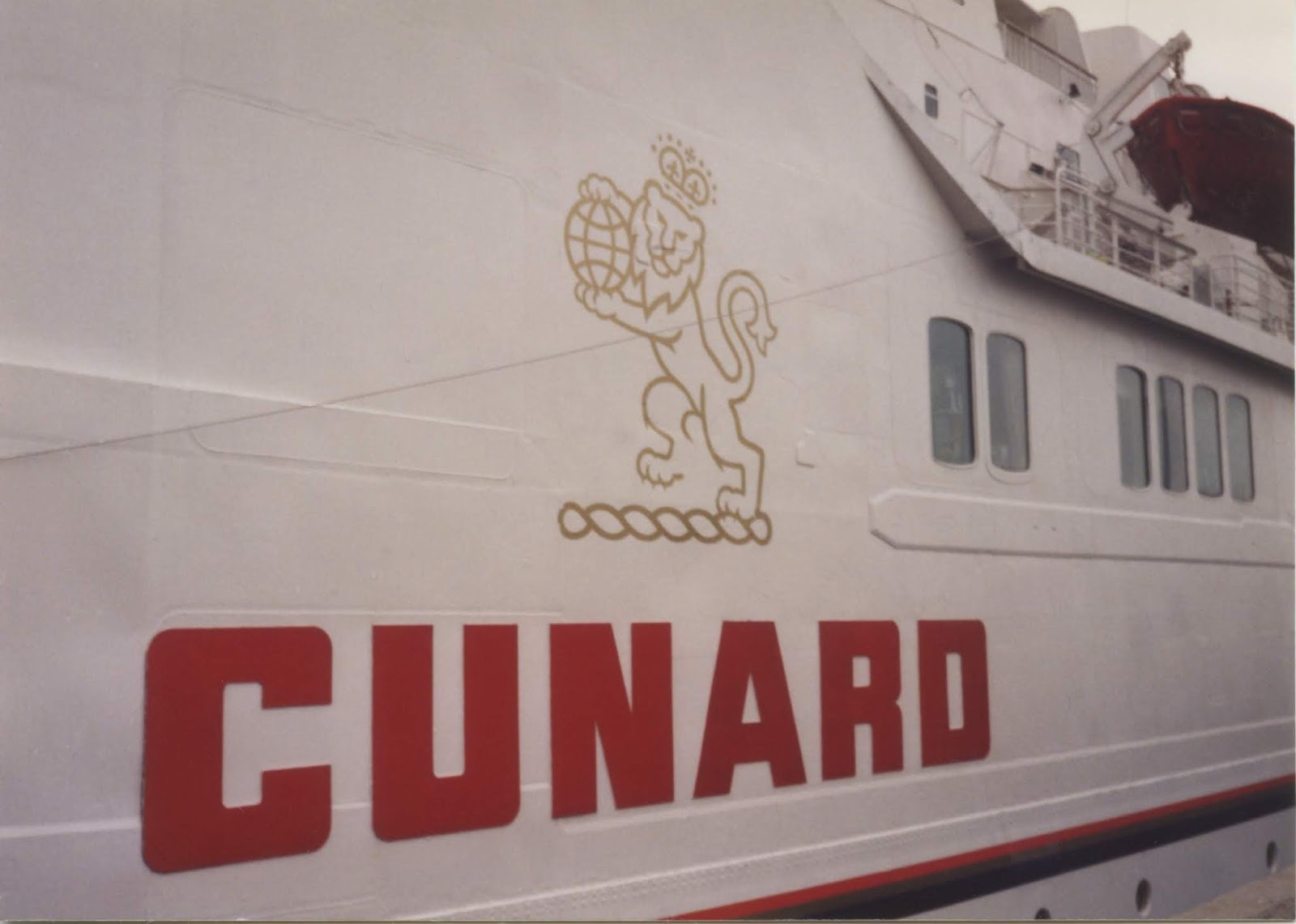
Not surprisingly, the photographs that I saved are of ships and ship-related subjects.  Some are quite good.  A few are not so good but unique.  All of them bring back memories, and I’m happy to present them here.  Let’s start with a visit to the Cunard Line’s Queen Elizabeth 2 as she reposes at the passenger ship piers on the West Side of Manhattan.

The bow of any large passenger liner is an impressive sight when viewed from the street.  Here, the great, curved, black steel port bow of the QE2 rises magnificently from the placid Hudson on Saturday, July 3, 1999.  It’s awe-inspiring to think that this great bow was designed to cut gracefully yet purposefully through the largest waves and swells of the Atlantic between New York and Europe.  Few, if any, of the ship’s pampered passengers would give this matter a thought.

 
This great bow, like every other part of the ship, requires regular maintenance.  Here, on the same day, we see two seamen on a camel rolling on a fresh layer of black paint.  Not a job for the faint of heart!

In these two photographs, taken on Sunday afternoon, September 1, 1996, from the top level of Pier 90, we have a close-up view of the Queen’s port side superstructure.  From this vantage point, we can look through the oversize windows into the ship’s public rooms and promenades and admire her luxurious accommodations.

Leaving the West Side piers now and taking the subway down to the Battery, we next embark on the Staten Island Ferry.  Always a family favorite, these half-hour voyages are great fun, and it’s easy to lose track of the time and spend half the day sailing back and forth.  The first picture here shows the pilothouse of the American Legion on an overcast Saturday, April 3, 1999.

A year later, we see the same view of the Gov. Herbert H. Lehman on a bright and sunny Saturday, March 4, 2000.  The blue sky and sunshine make all the difference in these two photos.

Switching vessels on the same day, here we view the southbound Gov. Herbert H. Lehman from the northbound American Legion as the two ships pass “at sea” on the Upper New York Bay. 
 From the ferries we watch the shipping world go by.  First, we see the anchored bulk carrier Amphitrite on Saturday, April 3, 1999. 

Next we see the anchored container ship Maersk Valentia on Saturday, March 4, 2000.
Later on the same day, we watch as another Maersk Lines container ship emerges from the Kills between Staten Island and New Jersey.  She is rounding Saint George and will soon pass through the Narrows and head out to sea.
Leaving New York now, we go next to Maine.  The Portland area is always a great place to see ships.  First, we admire the academy training vessel State of Maine as she rests alongside the Bath Iron Works pier in Portland on a cloudy and warm Saturday, July 11, 1998.
Next we enjoy a close-up view of the tanker Orkney Spirit at the Portland Pipeline pier in South Portland on a hazy Saturday, May 6, 2000.  The adjacent waterfront area and nearby breakwater are excellent vantage points from which we can watch everything that enters and leaves Portland Harbor.
Heading south now to Massachusetts, we watch the Dutch freighter Schippersgracht discharging cargo in Fall River on Monday, August 27, 2001.  Free to roam the pier and watch the ship unload, we did not know on this date that our unrestricted access to the docks would hereafter be curtailed as a result of the terrorist attacks that were only two weeks away.
Moving farther south to the Delaware Bay, we have an noontime view of the northbound New Jersey silhouetted in the sunlight from the southbound Delaware on Sunday, Christmas Eve of 1995.  When driving to Virginia to visit family, the voyage across the Delaware Bay comes as a welcome break from the holiday traffic!
Returning now to New England, let’s visit some lighthouses.  First we have the storied Portland Head Light in Cape Elizabeth, Maine, on Saturday, August 30, 1997.  A popular tourist attraction, this site commands a magnificent view of Casco Bay and the Atlantic Ocean.  One can spend many hours there and never tire of the scenery.
At the farther end of Maine, we have this view of the famed West Quoddy Head Light in Lubec on a cloudy and foggy Monday, June 23, 2003.  This site is often cloudy, foggy, windy, damp, and cold, and it has a rugged beauty.  It’s also peaceful and quiet, with very few visiting tourists, even at the height of the summer season.
In Massachusetts again, we see next the diminutive Plum Island Light at the mouth of the Merrimack River in Newburyport on Friday, June 23, 2000.  Blue sky and sunshine abound at this lovely site which is often overlooked by Boston area residents who flock to Maine instead.
In New York again, this time on the spring vacation from school, the children go with their grandparents to the iconic Fire Island Light on a brilliant April day in 2001.  My sons Steven and Michael pose on the boardwalk that leads through the dunes to the light.
Finally, we return once more to New England, specifically to the Piscataqua River that forms the boundary between New Hampshire and Maine.  The Memorial Bridge spanned this waterway for about a century before it was replaced with a more modern structure.  When the children were little, they were thrilled to walk across this bridge from New Hampshire to Maine and back and watch the tidal current rushing beneath their feet.  This view is taken from nearby Prescott Park on a beautiful but chilly Monday, October 8, 2001.
All these photographs from so many years ago bring back a sea of happy memories for everyone in the family.  We are indeed fortunate to have these memories, just as we were fortunate to go on so many family outings to the oceanfront when the children were younger.  Perhaps even more to the point, we were extremely fortunate to have a house full of happy and healthy children in the first place.  So many blessings, and so many reasons to be thankful!  The psalmist said it well when he asserted, “It is a good thing to give thanks unto the Lord” (Ps. 92:1), and when he exhorted, “Enter into his gates with thanksgiving, and into his courts with praise: be thankful unto him, and bless his name” (Ps. 100:4).

Tuesday, August 27, 2013

Merrily Reminiscing

My father always told me to take notes as I made my way through life. As a kid, I thought this idea was just adult nonsense. As an adult with children, however, I consider it to be wise counsel. Accordingly, then, I have taken notes my entire adult life, actually starting in my late teens. Since my children were born, though, the note-taking has accelerated. Just about everything they’ve done in their short lives is recorded. My basement library contains shelves upon shelves of children’s biographical materials—written notes, photograph albums, video tapes, mementoes, computer files, paper files, and so on.

I was recently looking through some of these materials in order to collect information for a spreadsheet that would tabulate all the voyages the children have made. I found everything that I needed, and I enjoyed reading the notes I had written and looking at the pictures I had taken. They brought back many happy memories. The children were so young then, and with the natural curiosity of youth they were learning about their world. The sea formed an important part of their travels and adventures, and I would like to think that they learned something from sailing across even small sections of it.

Most of their voyages took place aboard the vessels of the Cross Sound Ferry fleet between New London, Connecticut, and Orient Point, Long Island; many others took place aboard the Staten Island ferries in New York; and there were some occasional voyages on assorted waterways elsewhere in the eastern United States and Canada. It all started because at the age of six months Miss Karen could not tolerate the four-hour drive between her home in Nashua and her Nana’s house in New York. After two hours, she would loudly voice her frustration with the family car, and nothing could console her. Enduring her crying, sobbing, and screaming for half the journey quickly became intolerable for the rest of the family. So on Saturday, May 27, 1989, we made the two-hour drive to New London and embarked on the ferry New London for the hour-and-a-half voyage to Orient Point. After disembarking from the ship in Orient, we drove two more hours to Nana’s house. It worked out splendidly. When our little girl had reached the limit of her endurance for the automobile, it was time to get out, either aboard ship or at Nana’s house. No more crying, sobbing, or screaming. The sea restored peace to the family!

The sea also provided grist for my literary mill. In a series of spiral-bound notebooks that I call my Baby Books, I recorded details of the children’s lives, including their voyages on Long Island Sound and elsewhere. In June of 1990 I recorded James’ soliloquy as we arrived at the dock in New London:
Cars coming off ferry. Man open gate and cars come off ferry. Big truck come off ferry. Big truck make big bang. Where all the cars going? Man put hose together. Other man bring garbage. Man put garbage in dumpster. Man have to get more garbage.
The observations of a three-year-old! With the ship unloaded and ready to receive traffic for the next voyage, James continued:
Cars going on ferry. Daddy drive on ferry. All the cars have to go on ferry.
This narration continued as long as there was something for the children to watch. All the way to Long Island, James remarked on everything he and his comparatively quiet baby sister saw—lighthouses, buoys, fishing boats, cargo ships, and the vast expanse of the sea itself which seemed to intrigue them both. In later years this nautical realm would intrigue Steven and Michael, too, and all four of the children would make many happy voyages. A case in point is a crossing of the Delaware Bay aboard the Delaware enroute to their uncle’s house on Sunday, December 24, 1995:
The ferry left Cape May at 11:40am. This was the high point of the morning for the children, and it was their first time on the Delaware Bay. In commemoration of this occasion, they received free ferry coloring books.

All the children loved the ferry voyage. I took them on walking tours of the outside decks. The bay was quite choppy and full of whitecaps, with the wind and seas coming from the west. The ferry rolled quite a bit for the entire crossing. We really knew we were at sea! The kids loved it! They had fun trying to walk straight with the vessel swaying beneath them, and they laughed and giggled at their seeming clumsiness.

They wanted to see everything that was on the water. These sights included the Cape May Point lighthouse, several tankers anchored at Big Stone to the southwest, the open ocean to the east, the breakwaters off Lewes and Cape Henlopen, and the rough sea itself. The voyage lasted an hour and a half, and we all agreed it was much too short.
Closer to home, we made a night voyage from New London to Orient Point aboard the John H on Friday, March 1, 1996, with Steven and Michael:
This was the first time we had gone on the ferry at night. Our vessel left New London at 7:30pm. When Steven had finished his sandwich, I took him out on the weather deck for a look around the ship. He was fascinated by the night on the waterfront. He looked around carefully at everything and asked several questions. While we were outside, the ferry departed. As the ferry turned south toward the Sound, Steven noticed the flashing lights on the buoys marking the channel and the lights marking the turnpike and railroad bridges. As the vessel came to the open water of the Sound, he saw the two lighthouses that mark the entrance to New London Harbor. These fascinated him. He watched their strong bright lights for several minutes. Then he turned his attention to the great black mass of sea and sky that was beginning to surround the vessel.

Steven was intrigued by all he saw aboard the John H, and I thought Michael might share his interest. But this backfired. Poor Michael was nervous. Perhaps all the surrounding darkness disturbed him. I took him around the ship hoping he’d get over his fright and enjoy the voyage, though it became clear that he was very nervous about everything. He decided early that he’d seen enough. He repeatedly said, “Let’s go back inside and see Mommy,” who was amused by her baby’s reaction to the nocturnal voyage.

Steven came back outside for more sightseeing. He wasn’t nervous at all. It was a lovely night on the water. There was a slight southwesterly breeze and a low southerly swell that gave the ferry a gentle motion. The sky was partly cloudy with a waxing gibbous moon. Several stars were visible even in the nearly full glow of the moonlight. The sky overall appeared a medium gray. The water was a very dark gray, nearly black. Steven gazed quietly but intently into this darkly magnificent atmosphere.
A year later, on Friday, July 18, 1997, amid electrical storms on another night crossing from New London to Orient Point aboard the North Star, Michael overcame his nervousness:

A full moon shone through the clouds in the southeast. A low swell came from the same direction, and the North Star rolled gently. As the sky darkened, lighting became visible over both Connecticut and Long Island. Electrical storms seemed scattered throughout the region, and they intensified as the ship approached Orient Point. The flashes of lightning increased in frequency. With each flash the surrounding land and water became eerily illuminated nearly as bright as day, but only for a split second. The mystical black-and-white beauty of these illuminations was striking, but not frightening. There was no audible thunder. Steven and Michael found this display fascinating. They oohed and ahhed at the most spectacular lightning strikes, and they asked many questions.
A year after that, on Friday, May 15, 1998, another night crossing from New London to Orient Point aboard the New London yielded a lesson on running lights:
At 9:00pm the New London departed and sailed south into the increasing blackness of the night. James and Steven were excited to be at sea at night, and the weather was so good that we remained outside. At James’ insistence I explained how the running lights worked, what their colors meant, and how to determine another vessel’s course by the appearance of its lights. Both boys eagerly studied the lights on the ferries bound from Orient to New London as they passed us port-to-port.

James and Steven found these lights truly intriguing, hence the impromptu lesson. They learned about the red and green sidelights, the white masthead lights, and the white stern light, their arcs of visibility, and their positions relative to each other. They caught on quickly, too, as they observed passing vessels’ lights in addition to my explanations. Several other passengers also became interested in this subject and stood close by to watch and listen, too.
A couple of months later, on Friday, July 17, 1998, on a foggy crossing from New London to Orient Point aboard the North Star, Steven met the great man:
Just before sailing, Steven had the honor of meeting the Captain. Seeing him walk across the deck towards the bridge in his Merchant Marine officer’s uniform complete with an anchor insignia and four stripes, Steven ran over to him, caught up to him, and said hello and paid his respects. The Captain cheerfully returned Steven’s greetings, saying, “Hi there, Buddy! How are you doing?”

We sailed at 8:00pm. The fog remained over the water, and the ferry sounded its foghorn for most of the voyage. We remained outside on the upper deck. Steven and Michael were quite interested in everything going on aboard the ship. Both boys were impressed with the density of the fog and the severe limitation it placed on visibility. They liked hearing the foghorns of our ship and others and the fog signals of the buoys and lighthouses. They also got to peek into the bridge and see the picture on the radar screen.
As if meeting one great man wasn’t enough, Steven arranged to have all his siblings and me meet the Captain of the ferry Champlain on a voyage across Lake Champlain from Port Kent, New York, to Burlington, Vermont, on Monday, July 2, 2001:
During this eastbound crossing the Captain invited us up to the bridge. The children and I went up the narrow steps and gathered in the pilothouse and had a pleasant conversation with the Captain. His name was Steve Pond. He told the children how everything worked, about the lake and the ferry, and they asked many questions. He was very nice to them. When our visit to the bridge was concluded, the children all said “Thank you” and shook hands with Captain Pond. They were very polite. I was proud of them. I was also very pleased to be back on the bridge of a ship that was underway and going somewhere.
Captain Steve Pond also posed for a photograph with James, Miss Karen, Steven, and Michael on the bridge of the Champlain. A wonderful keepsake!

Farther south and closer to their Nana’s house, the children made many voyages aboard the ferries linking Manhattan with Staten Island. When they were little we would make one round trip of an hour’s duration, and then move on to something else. As the boys grew into their pre-teen and teen years, their interest levels also grew, and we often made three or four round trips in succession. These expeditions filled entire mornings. As one such outing on Saturday, March 4, 2000, demonstrates, they were time well spent:
We spent three hours riding the ferries back and forth between New York and St. George. We made three voyages aboard the Governor Herbert H. Lehman and three aboard the American Legion. The weather on the bay was exceptionally good for this time of year: blue sky, a few cirrus clouds, a northwesterly breeze, very clear visibility, and a mild temperature.

James was fascinated. He thoroughly enjoyed all aspects of the vessels’ operations. He asked many questions, observed everything very carefully, and used up an entire roll of film taking pictures. Steven and Michael also enjoyed these voyages. The three boys studied the loading and unloading of the ferries, watched the wake and propeller wash, watched all the harbor traffic, and saw all the famous sights. The maneuvering of the ferries and the variety of harbor traffic interested them the most. They enjoyed close-up views of several tugs and oil barges, dozens of smaller barges, and two large container ships of the Maersk Line. One of these was the Maersk Valentia. She was coming into port, bound for New Jersey, and she and the Governor Lehman passed at fairly close quarters. Later, another large vessel of the Maersk Line came out of the Kills and proceeded seaward. The boys found all of this very interesting. James took pictures, and they all asked questions about these grand vessels.
Two years later, on Saturday, April 27, 2002, we did the same thing in the same city, but there were differences:
We arrived just in time to board the American Legion. At the boys’ request, we went all the way forward on the vehicle deck so that we had front row seats, so to speak, for the crossing. This was great. We made four voyages aboard the American Legion, i.e., two round trips. We alternately stood on the bow, on the stern, and on the upper deck. But the boys and I all liked the vehicle deck best, whether forward or aft, because of its proximity to the water. Michael became transfixed by the sight of the water rushing past the hull. I, too, have always liked this, and I shared Michael’s enjoyment.
But changes had come to the city and the ferries in a terrible way. The vehicle parking decks had been fenced off, and the boats no longer carried cars and trucks for fear of a car bomb attack. Then there were police and police dogs everywhere. They patrolled the boats and the terminals and kept a wary eye on all the passengers, especially those carrying packages. The worst thing lay ashore, though:
The biggest change of all was the alteration in the skyline of Lower Manhattan. The World Trade Center was conspicuously absent. This was clearly visible from the ferry. It was impossible to not notice this. The boys asked me to point out to them exactly where the twin towers had stood, and I did. It seemed unreal, even though we were looking right at the buildings of Lower Manhattan and could plainly see that the World Trade Center was no longer there. A very sad note in an otherwise pleasant day.
Whatever may happen ashore, though, there is one thing that happily does not change. I have remarked in my Baby Books numerous times that:
It was great to be at sea again. It felt wonderful to stand on the deck of a ship again and feel the vibration of the engines under my feet and smell the salt air blowing across the water and feel it running through my hair. The exhilaration of going to sea again, even if just across the Upper New York Bay and back, is difficult to express. Suffice it to say that I found it a very pleasant sensation. Few things in life can beat a sea voyage.
While this will of course always be true, there remains the one voyage that was truly unique. On Thursday, June 24, 2004, during the ambitious family vacation we took in Newfoundland, we set sail to see something none of us had ever seen before:
We sailed at 1:00pm aboard the excursion boat Iceberg Quest. The Captain steered the boat north out of Twillingate Harbor and then turned eastward, past some headlands, and then across open water. An iceberg lay ahead of us, and the Iceberg Quest headed for it. A larger iceberg sat in the water to the northeast several miles from Twillingate, but that was too far to go in a two-hour voyage.

The children were all very excited to be at sea again, this time in search of icebergs. We stayed on the outer decks of the vessel, on the stern and on the house top. There was lots of motion—pitching and rocking.

The boat approached the iceberg, and it grew larger in our view. The crew estimated it to a hundred feet high. Eventually the boat reached the berg and slowed down and circled it at a close but safe distance so everyone could see it. The children were thrilled. We took lots of pictures because this was a unique experience for us. We spent some time admiring this iceberg, and then it was time to head back to Twillingate.

We had an anticlimactic but peaceful and enjoyable voyage back to port. The rocking and pitching got a bit rough in some swells coming in from the open ocean to the north. Much of the fog had gone away and the overcast had broken up. For a little while the sun came out.
Whether or not the sun was shining, going on a voyage with the children was always a wonderful experience. No matter what the weather conditions, sea state, or duration of the crossing, everyone in the family loved to sail. With the children all grown up and on their own now, I turn to my Baby Books and picture albums to merrily reminisce about the good old days. I am very thankful for the blessings of the written word, the photographic art, and the happy memories they preserve. Most of all, I am thankful for the blessing of four magnificent children. When I think of them, I think of Mother Teresa’s famous statement: “Every child is a gift from God.” How true!

Perhaps the last thought should go to Baby Michael, who now commutes to work in Boston by ferry. On Wednesday, August 17, 2005, after several hours aboard the new Staten Island ferries Samuel I. Newhouse and Andrew J. Barberi, I wrote:
Michael enjoyed this voyaging so much he wanted to do it all day. I agreed with him.

Saturday, October 13, 2012

Pictures of Ships and Family

Some pictures of the family visiting the waterfront on various occasions between 1955 and 2012.   I took all but one of these photographs.  I think they convey a sense of the family's attachment to the sea and the ships that sail on it.  Click on each picture for a larger view.

The picture that started it all.  My grandparents, Robert Burns and Julia Murphy, aboard the American Export Lines' Independence at Pier 84 in New York on Monday morning, October 31, 1966, just prior to departing on their final transatlantic voyage.
The next generation.  The four children with their Mommy and Nana watch from Battery Park in Lower Manhattan as the Queen Elizabeth 2 proceeds to sea.
Steven, Michael, James, and Miss Karen visit the schoolship State of Maine at the State Pier in Portsmouth, New Hampshire, on July 1, 1999.
Steven and Michael with the cable ship Global Mariner also at the State Pier in Portsmouth, New Hampshire, on August 5, 2001.
My three sons with the Cunard Line's Caronia at the Block Falcon Cruise Terminal in Boston, Massachusetts, on August 13, 2001.
The three boys pose with the Dutch freighter Schippersgracht at the State Pier in Fall River, Massachusetts, on August 27, 2001.
Underway aboard the ferry Governor Herbert H. Lehman, the boys watch the outbound tanker Falcon and the inbound container ship Zim Mediterranean pass each other off St. George, Staten Island, New York, on a hazy August 23, 2002.
The next day, August 24, 2002, the three boys pose in the rain in front of the fabled United States at Pier 82 in Philadelphia, Pennsylvania.
Before my time.  My grandparents sailed from New York for Le Havre, France, aboard the United States on June 24, 1955.  My father took this photograph of them with my mother and older brother on sailing day.
Back to the younger generation.  Michael and Steven stand on the stone beach at Orient Point, Long Island, New York, on a cold April 26, 2003.  They have disembarked from the ferry Susan Anne after completing a voyage from New London, Connecticut.
The million dollar view.  Sunrise over Campobello Island, New Brunswick, seen from Eastport, Maine, on June 23, 2003.  The children arose very cheerfully at 3:15am in order to see this.  
A wedding aboard ship.  James poses in the Crow's Nest Lounge of the Holland America Line's  Nieuw Amsterdam in Port Everglades, Fort Lauderdale, Florida, on Sunday, February 5, 2012.  Behind him the container ship Melbourne Strait is departing.

Sunday, March 18, 2012

Riding With the Pilots

The tanker New Jersey Sun weighed anchor after the pilot had come aboard early in the morning of Monday, May 16, 1977. A small motor launch had delivered him to the ship. From this vessel he climbed a rope ladder with wooden rungs which hung down the tanker’s starboard side. When he reached the main deck, he was welcomed aboard by the third mate and two able seamen. The third mate escorted the pilot to the bridge, and then joined the bosun on the bow. The two ABs stayed behind and hauled in the pilot ladder and stowed it away pending future use. On the bridge the pilot was greeted by Captain Jack Taylor and chief mate Joe Reilly. When the introductions were complete the mate recorded the pilot’s name in the bell book, the written record of the ship’s transit through the harbor. The pilot’s name1 was Pizzatolla, and he had come aboard to bring the New Jersey Sun into the harbor of Galveston, Texas.


For Captain Pizzatolla, this morning’s arrival was a fairly routine operation. Standing on the port bridge wing next to Captain Taylor, he issued the engine and rudder instructions necessary to maneuver the ship out of the anchorage, into the channel, through the narrow inlet between the barrier beaches, and then through the port itself toward the Todd Shipyard on Pelican Island. This destination, a sprawling industrial complex across the stream from Galveston proper, would be the New Jersey Sun’s home for the next several weeks while she underwent an extensive overhaul. But getting the large vessel into this facility required some effort. Captain Pizzatolla called ahead on his walkie-talkie and arranged for a rendezvous with two tugboats as the ship approached the shipyard.

From his perch on the port wing, Captain Pizzatolla surveyed the scene before him and decided on his course of action. He explained his plan to Captain Taylor, who nodded and gave his consent, and then began issuing instructions to the tugboats via the walkie-talkie and engine and rudder commands to the chief mate and helmsman. With one tug pushing on the starboard bow and the other on the port quarter, with the rudder hard left and the engine going slow astern, the pilot turned the New Jersey Sun ninety degrees in the channel. She was now positioned so that she could back down into her berth with her port side to her assigned pier. But this was a tight spot. The pilot dismissed the tug on the port quarter. The second tug remained and held the New Jersey’s bow steady. Then, with the engine going slowly astern and the rudder amidships, the pilot eased the great ship into the narrow space between her pier and the adjacent floating drydock. There was no room for error here, and the operation had to be taken slowly.

The New Jersey Sun carried one rudder and one propeller. Rudders are simple enough tools, but propellers come in different varieties. They can be right hand or left hand, meaning they turn clockwise or counterclockwise when the ship is going ahead, and the propeller blades are shaped and pitched accordingly in order to get a good bite on the water and push it astern. A single engine ship like the New Jersey carried a right hand propeller. This was fine for going ahead, but when going astern, a right hand propeller caused the stern of the ship to “walk” to port. Likewise, a left hand propeller would produce a walk to starboard. By contrast, a ship such as the Waccamaw with two propellers would have one right hand and one left hand; they would be mirror images of each other, and when going astern, the opposite walking effects would cancel each other out.

As the New Jersey Sun backed alongside the pier, the walking effect produced by her right hand propeller became an important factor. Both Captain Taylor and Captain Pizzatolla eyed the stern carefully from the bridge wing as the ship eased slowly alongside the pier. Neither one of them wanted the propeller to walk the stern of the ship into the pier. When this motion of the stern toward the pier became evident as the ship moved farther into her berth, the pilot called for a quick burst ahead on the engine with the rudder hard left. The resulting propeller wash to port countered the walking effect and prevented the ship from colliding with the pier. In a backing move of over a thousand feet at slow speed, the pilot did this three times. Had there been no floating drydock moored to the next pier, a tugboat could have steadied the New Jersey’s stern and made the job much easier. The pilot really earned his fee on this arrival.

With the New Jersey Sun finally backed all the way into her berth, the crew tossed the mooring lines ashore, winched them in, and made her fast. Next they rigged the gangway. On the bridge, Captain Taylor ordered the engine rung off and the helm secured. He thanked Captain Pizzatolla for his services, signed his paperwork, and bade him farewell. The chief mate then escorted him down to the main deck and the gangway. The pilot stepped off the ship and into a waiting automobile. The driver would deliver him to his next assignment, most likely an outbound cargo ship. A routine day at the office.

For her part, the New Jersey Sun remained in the Todd Shipyard in Galveston for six weeks. When the time came for her to leave, another pilot was driven to the pier to meet her. He then performed the same duties as Captain Pizzatolla had, except in reverse. When the ship was safely outside the port, he climbed down the rope ladder with the wooden rungs to a waiting launch, and was whisked away to his next assignment, most likely an inbound merchant ship. And so the cycle continued.

This cycle of piloting merchant ships in and out of port goes on continuously in every harbor. Each port has its association of pilots, licensed Merchant Marine officers who are specialists in the waterways on which they serve. Possessed of an intimate knowledge of the port and everything in it, pilots know everything there is to know about the local tides, currents, weather patterns, navigable channels, shoal areas, anchorages, bottom topography, bridges, tunnels, and all aids to navigation including buoys, lights, and daybeacons. They know every pier and wharf and how best to approach and depart from them in all conceivable conditions. Pilots are expert shiphandlers. They simultaneously give instructions for engine and helm settings and tugboat positioning and maneuvering, often orchestrating solutions to the most complex situations so that it all looks like an art form. Their level of proficiency and the value of their services cannot be overstated. Outside of the seafaring profession, though, pilots rarely receive any recognition for their work.2

The Coast Guard examinations for pilots’ licenses are famously difficult. Many pilots already hold unlimited Master’s licenses from years of deep sea experience. While an unlimited license is valid over the limitless oceans, a pilot’s license is specific to a certain place. A man with pilotage for Galveston, for example, cannot bring a ship to Houston. There are also pilots who cover wider areas than single seaports. This would include pilots who bring ships through major inland waterways such as Long Island Sound or Chesapeake Bay. The transit times in such areas are many hours long, and typically at the end of the run a docking pilot comes aboard and relieves the original pilot. Sometimes called coastal pilots or bay pilots, they, like the harbor pilots, must also pass rigorous and demanding examinations, as well as complete a comprehensive apprenticeship. For a while I considered pursuing a pilotage endorsement for the port of Norfolk, Virginia. I thought this might be a nice addition to my license once I had reached the level of unlimited Master, and I had sailed in and out of Norfolk so many times on several ships that I came to know the port and the lower Chesapeake quite well. This idea never came to fruition, though.

Norfolk was a short pilotage run, about two hour’s transit time from the Virginia Capes. By comparison, Baltimore was a twelve hour transit from the capes. On my next-to-last day aboard, the New Jersey Sun travelled this long route. She picked up a pilot from the Maryland Pilots’ Association at the Chesapeake Bay entrance at 12:00 noon on the Fourth of July, 1977, a bright sunny day with excellent visibility. Both the Eastern and Western Shores of the bay were clearly visible as the ship headed north. The bay itself was punctuated at intervals by lighthouses that were built on steel skeleton foundations, webs of metal that rose up out of the water. After darkness fell, brightly colored fireworks shot up at many locations along both shores. Through this festivity the pilot brought the ship almost the length of the Chesapeake to the Francis Scott Key Bridge on the outskirts of Baltimore. There a docking pilot came aboard. He and two tugboats conveyed the New Jersey Sun the remaining distance to the Hess pier. She was made fast at midnight. A long day’s work for the Chesapeake Bay pilot. He had taken his lunch and dinner on the bridge and ate as he worked. After the docking pilot relieved him, he slept on a settee just aft of the bridge until he was able to go ashore.

Another pilotage run of twelve hours that the New Jersey Sun made took her between the Gulf of Mexico and the oil docks of Garyville, Louisiana. She went upstream on June 28 and 29, spent seventeen hours alongside the pier, and returned downstream on June 30 with the oil that she subsequently brought to Baltimore. Two long runs on a winding and curving river channeled between high levees. Except for New Orleans and the delta, most of it looked the same. The pilots knew all the subtle differences in the riverscape, though, and hence always knew exactly where we were.

Several years later the Comet rode the Mississippi to New Orleans from the Gulf. This was a pleasant transit on a warm Saturday, January 7, 1984. Arriving at the entrance to Southwest Pass at midday, the Comet proceeded up the narrow channel to Head of Passes, the meeting point of all the tributaries of the Mississippi River Delta. She changed pilots at nearby Pilottown. The first pilot left the ship there and would subsequently take another vessel down to the Gulf. The pilot who relieved him then took the Comet the rest of the way upstream to New Orleans. A peaceful and picturesque place, the marshes of the Mississippi Delta stretched for miles in all directions, bisected only by the dredged channel and its low bordering levees. These pristine wetlands contained vast acres of low-lying lush green foliage interspersed with brownish river and gulf water topped by a leaden gray sky that stretched to all horizons. It was very pretty, but in an unusual way. And it was very peaceful. 

This serenity was breached only on arrival that evening in New Orleans. One very brash young officer looking for adventure demanded, “Hey, Pilot, where’s the action in this town?”

The pilot, far older and wiser than his interlocutor, advised him to be extremely careful about looking for action in New Orleans. “Y’all kin git yahself killed raht outside the gate heah,” he cautioned. Explaining that he knew the city as well as he knew the river, this gentleman counseled the young mate to be careful and avoid the vice dens of the city. Following the scriptural injunction that “every man should take righteousness in his hands. . .and lift a warning voice unto the inhabitants of the earth’ (D&C 63:37), he provided moral as well as navigational direction.

The Comet herself had to be careful on her way back down the river three weeks later. Caught in a blinding winter rainstorm with dense fog six hours below New Orleans, she anchored off Duvic, Louisiana, at 2:30pm on Thursday, January 26. Unable to see more than two hundred feet, she remained at anchor sounding fog signals until 10:30 the next morning. After listening to the Comet’s fog signal for twenty hours, the residents of quiet little Duvic must have been very happy to see her leave!

As the Comet transited the Southwest Pass enroute to the open Gulf, her pilot did something unusual. In a very narrow stretch of waterway, he stepped over to the helmsman and said jovially, “Why don’t you take a break for a few minutes, young man?” Then the pilot himself took the helm and personally steered the ship down the center of the channel for the next ten minutes or so. With a look of intense concentration on his face, he deftly handled the wheel, making short, sharp corrections to keep the ship on course. When the pass widened out again, he relinquished the wheel to the helmsman, who seemed very grateful to have his job back. By way of explanation, the pilot mentioned to both the mate and the helmsman that no one had done anything wrong; it was just a very tight spot in the pass and he always found it easier to steer the ship himself than to be constantly calling for minute corrections in the ship’s heading.

During my time on board, the Comet made several long pilotage runs. On each of her two transatlantic voyages she picked up an English coastal pilot off Brixham, England. These pilots assisted with navigation through the English Channel and the North Sea and rode the ship to Trondhein and Bremerhaven in November and December of 1983. Local harbor pilots then maneuvered the ship in and out of both these ports. Returning westward, the coastal pilots again assisted in the traffic lanes until they disembarked off Brixham.

In Panama, an American canal pilot brought the Comet through the locks, across Gatun Lake, and through the narrow confines of the Culebra Cut. This transit took eight hours on a very hot Tuesday, January 31, 1984. In the cut, with the ragged edges of mountains rising out of the water on both sides of the ship, the pilot turned to the bridge watch and remarked, “This is the part that God did not intend to be a canal!” In between helm instructions, he then described the difficulties encountered in digging through this mountain range during the canal’s construction. Partly inspired by this man’s casual conversation, I later read the great book about the Panama Canal in my leisure time on the Bartlett.3

On the other side of the world, the Comet made a very long pilotage run first through the narrow strait that separates Honshu and Kyushu, and then through the Inland Sea of Japan enroute to Iwakuni. Three separate pilots came aboard for this long route: the first for transiting the strait, the second for the nearly nine-hours-long voyage through the heavily trafficked Inland Sea, and finally a docking pilot. This operation, along with a six-hour period of loading cargo in Iwakuni, filled the entire 24 hour cycle of Tuesday, March 13, 1984.

Such long runs are exceptional, though. Most pilotage routes take up only a fraction of these transit times and cover much shorter distances. The shortest in my experience is Port Everglades in Fort Lauderdale, Florida. Typically, the passage from arrival at the sea buoy to mooring at the pier took only 45 minutes. Furthermore, the weather was always good. This was not always the case elsewhere. Holy Loch, Scotland, stood at the opposite extreme. The pilotage run there took perhaps an hour, but the weather made it feel much longer. The anchor detail and the linehandlers on the Victoria always dressed for drenching rain, thick fog, and cold winds, and they often got all three. The Scottish pilots were always completely unfazed by these conditions.

Closer to home, New York has long been one of my favorite seaports. In the 1970s and 80s, I sailed in and out of there on the State of Maine, the Charger, the Vandenberg, and the Comet, and served as night mate aboard the Vanguard and the Hayes. Additionally, I always enjoyed riding the ferries between Manhattan and Staten Island. After the children arrived, they joined me on these short voyages across the harbor. One of the greatest shows on Earth, New York almost always had something going on. Merchant ships of all descriptions dotted the water and the shoreline, filled the anchorages, shifted between berths, passed beneath the bridges, and arrived and departed through the Narrows between Staten Island and Brooklyn. This great movement of commerce called for pilots to bring the ships into, through, and out of the port. Aboard the ferries, more pilots wended their vessels’ ways through the traffic. The children always found this activity fascinating. They watched carefully and asked many questions. One day, something very special took place.

On a warm and hazy Friday, August 23, 2002, James, Steven, and Michael sailed with me from Manhattan aboard the ferry Governor Herbert H. Lehman. As the ferry got underway from the city, we gathered at the bow and spotted a large container ship inbound in the Narrows. A few minutes later, we saw a large tanker emerging from the Kills, the small channel that separates Staten Island and New Jersey. Estimating that they would meet off St. George, our ferry’s destination on the northeast corner of Staten Island, we watched and waited. Then the northbound ferry Andrew J. Barberi got underway from the St. George terminal and quickly crossed ahead of both ships. Through the binoculars we identified the inbound container as the Zim Mediterranean of Valletta and the outbound tanker as the Falcon of Piraeus. The Governor Lehman approached closer to both of them as their course changes carried them to the now-obvious meeting point in front of the St. George ferry docks. The binoculars were no longer necessary. Even using the camera proved awkward as both ships became too big to fit in the viewfinder.

James, Steven, and Michael watched closely as the shipping drama played out in front of them. The Governor Lehman maintained a steady course but cut her engines to reduce speed as both the Zim Mediterranean and the Falcon adjusted their courses to pass safely port-to-port in front of the ferry. The Lehman coasted to a stop with the Zim’s starboard side perhaps 400 feet in front of her and the Falcon less distance than that from the Zim’s port side. The Falcon became momentarily obscured from our view by the larger Zim. From where we stood on the Lehman, the Falcon and the Zim were first bow to bow, then side by side, and finally stern to stern as they passed each other on their reciprocal courses. No sooner did water open up where their sterns had been than the Governor Lehman rang up full ahead and resumed her voyage to St. George. The Zim turned more to port to enter the Kills, evidently enroute to the big container docks in Newark and Elizabeth, New Jersey. We gained a clear view of her broad transom stern piled six-high and thirteen-across with containers which would soon be off loaded onto trailer trucks and freight trains. We had a similar view of the somewhat smaller but still impressive Falcon as she turned to starboard to pass beneath the Verrazano-Narrows Bridge and into the Ambrose Channel. With these two vessels now safely past and well on their way, the Governor Lehman eased anticlimactically into her berth in St. George.

All these vessels’ movements in this congested situation were carefully controlled by pilots. No doubt they had all spoken to each other on channel 16 on the bridge-to-bridge VHF radio and had agreed upon a safe and convenient place to meet. With their intimate knowledge of the harbor, their expertise in shiphandling, and their years of experience, these pilots were eminently qualified to direct these large merchant ships worth hundreds of millions of dollars in circumstances where there was almost no margin for error. A routine day at the office.

James, Steven, and Michael were suitably impressed. They seemed to intuitively recognize that bringing such massive vessels around sharp corners and into narrow channels and through congested harbors required an expertise above and beyond the ordinary. Unfortunately, this goes largely unnoticed and unremarked by those with no connection to the sea. Once in a while, though, word does get out.

The new Queen Mary 2 of the Cunard Line arrived in New York on her maiden voyage on a misty Thursday morning, April 22, 2004. Because of the historical significance of the Cunard Line and the Queen ships, the city took notice. The following day, The New York Times reported on this event with special attention to Captain Robert D. Jones, the harbor pilot who brought the new Queen Mary into port:

Standing on the ship’s bridge with a walkie-talkie in one hand and a pair of binoculars within reach of the other was Captain Jones. He is not the captain of the Queen Mary 2, but the harbor pilot who guided it on the last few miles of its maiden voyage to New York.
Through it all, Captain Jones never touched the throttles, never turned the wheel. But his was the last word on where to steer the ship, how fast it could go, and where the trouble spots lay in the harbor’s complicated underwater geography. He long ago memorized where the navigational buoys are—knowledge that helps when, as was the case yesterday, he cannot see them for the early-morning fog.
So he knew when and where, off Brooklyn, the ship had to make two crucial turns on its way to Manhattan.4

The Times noted that Captain Jones had previously piloted the Queen Elizabeth 2 in and out of New York, one of over 8,000 ships he had boarded in his long career. Additionally, the paper recorded his assessment of both Queens’ maneuvering capabilities and acknowledged the tremendous efforts required for safely docking the new Queen Mary. Alluding to the risks inherent in such an operation and the ever-present possibility of something going wrong, the Times graciously left the last word to the pilot:
After 45 years as a harbor pilot, Captain Jones, 69, will retire today. “You’re only as good as your last job,” he said, “and this was pretty good.”5

In the early evening of Sunday, April 25, 2004, the Queen Mary 2 and the Queen Elizabeth 2 sailed from New York in tandem, bound for England. Darkness had just fallen as the two ships were piloted down the Hudson River from their midtown piers. As they approached the Statue of Liberty, fireworks erupted into the sky and cascaded downward onto the surface of the water. The sky and the sea sparkled in celebration of these grand vessels. My sons and I watched from Battery Park in Lower Manhattan, and we all agreed that it was “pretty good.”

But the Queen Elizabeth 2 was embarking on her last transatlantic voyage. Soon afterwards, she would be withdrawn from service and retired. On the night we saw her, she was crossing the bar for nearly the last time. Likewise, all the ships of my youth had also crossed the bar and put to sea for the last time, most of them bound for dismantling in a scrap yard. All of us, too, will metaphorically cross the bar and put to sea for the last time, bound for the grave yard, no doubt hoping as we depart that it was all “pretty good.”

Then we will meet our Pilot, the One whose navigational instructions during the voyage of life we will have hopefully followed. Like the pilots who board our ships, the Supreme Pilot holds all the necessary and detailed knowledge that we need for a safe transit. All we need do is consult him, for we are assured, “Ask, and it shall be given you” (Matt. 7:7). Our Pilot will give us moral guidance, just as the Mississippi River pilot on the Comet gave to the young mate looking for “the action” in New Orleans. He will be completely unfazed by adverse conditions, like the Scottish pilots aboard the Victoria, and his calmness will soothe our souls. Like the Panama Canal pilot who knew the intent of God concerning the isthmian mountains, he will not leave us to wander aimlessly through an artificial world. But we must first take him aboard:

Draw near unto me and I will draw near unto you; seek me diligently and ye shall find me. Whatsoever ye ask the Father in my name it shall be given unto you, that is expedient for you (D&C 88:63-64).

Our Pilot will convey his directions to us via the Spirit, through the still small voice, through inspiration, and through the leadership of the Church, not only when we are transiting pilotage waters, but throughout our long voyage. In the end, we may anticipate a happy conclusion to our travels when we meet our Pilot in propria persona:

For though from out our bourne of Time and Place
The flood may bear me far,
I hope to see my Pilot face to face
When I have crossed the bar.6

And when we meet our Pilot we will find that it is not just “pretty good,” but very, very good.


1 I regret that I cannot remember the names of many of the pilots who boarded the ships I sailed on, but for some odd reason I recall Captain Pizzatolla’s name and perhaps a half-dozen others with particular clarity.
2 See Matt Jenkins, “Running the Bar,” Smithsonian, February, 2009, pg. 62-69. This is a very informative description of the work done by the harbor pilots serving Portland, Oregon.
3 David McCullough, The Path between the Seas: The Creation of the Panama Canal, 1870-1914, New York: Simon & Schuster, Inc., 1977.
4 James Barron, “A Queen Arrives in New York, and Even in the Jaded Big City, Jaws Drop,” The New York Times, April 23, 2004, available at www.nytimes.com.
5 Ibid.
6 Alfred, Lord Tennyson, “Crossing the Bar,” in The Norton Anthology of Poetry, New York: W.W. Norton and Company, Inc., 1970, p. 756.