Showing posts with label Cape May. Show all posts

Monday, September 11, 2023

Staring at the Ocean


During my teenage years in the 1970s, my family vacationed every summer in Cape May, New Jersey, a seaside resort at the southern tip of the state.  With the Delaware Bay on one side of the peninsula and the Atlantic Ocean on the other, Cape May was all but surrounded by water.  It was thus the perfect location for folks who loved the sea, as my family did.

My grandfather, Robert Burns, accompanied us on these excursions.  When a friend in New York asked him once why he was going to Cape May, he replied, “to look at the ocean.”  And that was a large part of what we did there.  Of course, we did other things, too.  We went swimming.  We strolled along the boardwalk.  We played mini golf.  We sailed on the ferries to Delaware and back.  But we spent a lot of time just looking at the ocean.

We stayed at the Coachman’s Motor Inn at 205 Beach Drive, directly across the street from the beach and the ocean.  My grandfather and I frequently sat together in the canvas chairs on the second floor balcony that overlooked the beach and the water.  From this vantage point we enjoyed an unobstructed view seaward.  To my inexperienced and unenlightened teenage mind, it was simply a nice view.  To my grandfather, however, it was so much more, and he often shared his observations and insights with me.

As a scientific man, my grandfather thought in patterns of observation, analysis, and conclusion.  While watching the Atlantic from the Coachman’s balcony, he studied the conditions of the sea and sky with attention to the wave action, wind speed and direction, cloud cover, range of visibility, and air quality.  He understood oceanography and meteorology, and as a former ocean traveler and recreational boater, he knew well the effects of the sea and sky on waterborne commerce.  As he and I kept watch together, he often pointed out to me aspects of the surf, the play of the wind on the water, the formation of distant clouds, the longshore current, and the rise and fall of the tide.  It was a wonderful educational experience for me.  In retrospect, I wish I had written down all that he said.  Such a collection of notes would now be a family heirloom.

In the years since these happy times in Cape May, I have spent countless hours in school, aboard ship, and ashore, studying the sea and sky.  Of necessity, it became an important professional habit.  A ship at sea is surrounded by two things, water and air, and the interaction of these elements determines the safety and comfort or the danger and discomfort of the voyage.  I took meteorological observations for transmission to the National Weather Service.  I analyzed the clarity of the horizon to assess the accuracy of navigational sights.  I studied the cloud cover and compared it to the weather forecasts.  I paid particular attention to the sea surface and noted patterns and changes in the wave and swell systems.  All of this was for the safety of the ship and to estimate how rough or smooth the voyage would be.

Later in life, when visiting the oceanfront with Miss Patty and our children, I continued to observe and analyze the sea and sky in addition to enjoying and appreciating their tremendous natural beauty.  Sometimes, however, I just sat there and stared at the ocean, content to simply enjoy it without undertaking a professional evaluation of everything.  I can still do this for hours on end—it never grows tiresome—and I often wonder, how can anyone not like this?  How can anyone not marvel at this?

Actually, many people do like and marvel at the sea.  They find in it comfort, solace, and even a glimpse of Divinity.  Something about the sea speaks to the human soul of higher and greater things, recalling for us the Lord’s words to Isaiah:

For as the heavens are higher than the earth,

so are my ways higher than your ways, and

my thoughts [higher] than your thoughts (Isa. 55:9).

The supernal quality of the sea and the counsel of Isaiah remind us of our place in the cosmos and inspire us to raise our minds to a more sublime level.  In so doing, we grow in knowledge, wisdom, and the Spirit.  Thus, we become able to apprehend more than just a fleeting glimpse of Divinity when we gaze upon the sea.

Sometimes when I am staring at the ocean from a spot on the New England coast, I think of my family’s vacations in Cape May.  If only it were possible to sit with my grandfather again and look seaward with him!  No longer as an ignorant adolescent but as a seasoned merchant seaman would I speak with him.  As we recounted experiences, shared insights, compared observations of the sea and sky, and analyzed recent oceanographic and meteorological discoveries, we would have so much to discuss!  I’m certain that it would be a very long, pleasant, and inspirational conversation.

Next, let's look at some photographs:


An evening view of the Coachman's Motor Inn from a postcard.  The street, boardwalk, beach, and Atlantic Ocean lie in back of the photographer.
 
 
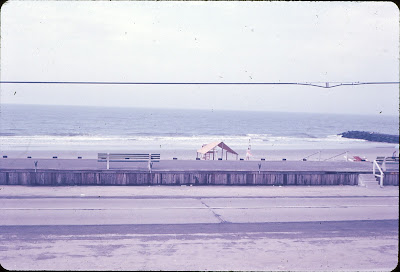
Two views of the Atlantic in front of the Coachman's, taken by my father on an overcast day in the summer of 1967, on our first visit to Cape May.  This was actually a few years before my adolescence and before the times that my grandfather accompanied us on our vacations.
 
Many years later, on Easter Sunday, April 4, 2010, we see the open Atlantic from the beach in Wells, Maine, a wonderful place to contemplate the sublime mystery of this very special day.
 
Finally, we sail aboard the ferry John H from Long Island to Connecticut on Saturday, October 8, 2022, an exceptionally gorgeous day on the water.


Sunday, September 4, 2016

The Concrete Ship


A few hundred feet offshore from Sunset Beach in Cape May Point, New Jersey, rest the visible remains of the cargo ship Atlantus.  She and several similar vessels were constructed as experiments in concrete shipbuilding during the First World War.  Their careers were short lived, however, as the extreme weight of the concrete made it impractical for shipbuilding for several reasons.  Under new ownership after the war, the Atlantus arrived at her final resting place by accident in 1926.  In the ninety years since then, she has enjoyed a second career as a tourist attraction.

Summer vacationers have long traveled to Cape May and its environs to enjoy the sea.  Situated at the southern tip of New Jersey, Cape May is surrounded by the waters of the Atlantic Ocean, the Delaware Bay, and the Cape May Canal.  For someone who enjoys the ambiance of the sea, Cape May is an ideal location.  Sunset Beach forms part of this ambiance. Facing west on the Delaware Bay, it is famous for its views of the sunsets, the ferries sailing between New Jersey and Delaware, and the concrete ship Atlantus.  A novelty, a curiosity, and a relic of history, the Atlantus is almost never referred to by her actual name.  She is simply called “the concrete ship.”  And while she does attract tourists, it is all very low key.  Sunset Beach lies several miles west of the more populated Atlantic beaches and therefore is never very crowded.  People go there to sightsee, to fish, and to browse in the small gift shop.  There is no swimming and only limited wading because of the strong tidal current.  Photographers  sometimes gather and take pictures of the concrete ship as if it were a famous lighthouse.

In the years that my family vacationed in Cape May, it was not always easy to obtain any serious information on the concrete ship, its history, or its reason for running aground there.  With the arrival of the internet, this has changed.  The concrete ship now boasts its own Wikipedia article[1] and is included on a website devoted to the history of concrete vessels.[2]  My research into the subject started with collecting all the picture postcards that featured the ship.  Eventually there were four of these, and I’m pleased to present them here:

This is my favorite portrait of the Atlantus.  The view dates to the 1930s and is an artistic rendering made with some artistic license.  The little rowboat provides a good sense of scale, but the Atlantus is not really as close to the beach as she seems to be.  The painting also gives the ship a remarkably clean and neat appearance. 
I believe this photograph was taken about 1960 or so.  The painted-on advertisement for boat insurance was a local joke and not in very good taste. 
This picture shows the condition of the Atlantus when I saw her in the early to middle 1970s.  The sign was new then.  Clearly the ship had deteriorated a great deal by the time I came along.
A new sign and a further deteriorated hulk.  This view postdates my family's visits to Cap May.  The before and after scenes offer a good basis for comparison. 
In addition to the postcards, the local gift shop eventually offered a capsule summary of the concrete ship’s history printed on a small sheet of note paper.  I daresay this came out in response to endless inquiries from vacationers seeing the concrete ship for the first time.  For a few pennies, then, I added this item to my collection.  Until recently, it was my only source of information about the concrete ship, but it remains a good one, and I’m happy to share it here:

 
Finally, we have several pictures of the concrete ship that we took on our family vacations.  Most of them are amateur photographs of very mediocre quality, but a few of them turned out well.  These are the two best:

My father took this photograph of the Atlantus on the family's first visit to Sunset Beach in the summer of 1967.  I was a young child then, and this shipwreck was an intriguing sight.  Faintly visible on the horizon through the haze is the northbound ferry New Jersey, soon to dock at the terminal in North Cape May.
My father took this picture of the Atlantus from a nearby jetty in August of 1971.  This view looks northward, with Sunset Beach on the right.  We returned to this spot every summer through 1975.

More recent photographs posted on the internet show an even more deteriorated and broken up hull.  Much of the concrete is crumbled, and the steel reinforcing rods are exposed and rusting.  Most of the ship lies beneath the surface of the water now, and no doubt much of it has sunk into the sand of the bay bottom.  All this decay in 90 years.  In another 90 years, it’s likely that none of the concrete ship will be visible above the water.  Perhaps a buoy will be placed over it to mark the site as a fish haven.  Ashes to ashes and dust to dust, as it returns to Nature the concrete ship is going the way of all material things. 

As we also must eventually do.  But in our case, though our mortal bodies must die and decay, our immortal souls will live on.  Our lives will thus continue despite physical death.  We are assured many times “that God hath given to us eternal life” (1 John 5:11), and further “that the spirits of all men, as soon as they are departed from this mortal body . . . are taken home to that God who gave them life” (Alma 40:11).  When the concrete ship is completely withered away, it will be gone forever.  Unlike this inanimate object, we will be gone only temporarily, until the resurrection, when “the spirit and the body shall be reunited again in its perfect form” (Alma 11:43).  Life will indeed go on, a happy prospect to consider.

Meanwhile, as the deterioration of the concrete ship remains a work in progress, we may rest assured that the Master and Chief Engineer of the universe is in charge of it all, and that his work is also in progress.  His Creation knows this, too, as one of our hymns states:

                                    Be still, my soul; The waves and winds still know
His voice who ruled them while he dwelt below.[3]


[1] See https://en.wikipedia.org/Wiki/SS_Atlantus.
[3] Katharina von Schlegel, “Be Still, My Soul,” tr. Jane Borthwick, in Hymns of The Church of Jesus Christ of Latter-day Saints, Salt Lake City: The Church of Jesus Christ of Latter-day Saints, 1985. p. 124.  A more literal rendering of the German (Dein Heiland wird zeigen,/ Wie vor ihm Meer und Gewitter muss schweigen) would be: Your Savior points out how before him sea and thunderstorm must be silent.