Showing posts with label Brooklyn. Show all posts

Sunday, June 27, 2021

The Mirror of the Sea

As is my custom now in the summer weather, I make the twenty-five minutes’ hike from the house to the boat ramp behind Greeley Park in Nashua in the predawn darkness on Sunday mornings.  Twilight has started to fill the neighborhood by the time I arrive.  The perfectly flat surface of the Merrimack River reflects the multi-colored sky above, acting as Nature’s mirror and displaying the beauty of the sky a second time.  I sit on my favorite fallen tree trunk as I watch the colors of the sky change and the twilight brighten into full daylight.  Except for my own breathing, there are no sounds of human activity.  Birds chirp, ducks quack, fish splash, and occasionally something drops from a tree branch and plops into the water.  These sublime sounds of silence generate an other-worldly atmosphere that serves as a welcome respite from the usual daily fare of canned music, blaring televisions, and incessant blabber from folks who have mostly nothing to say.


Going to the boat ramp once a week is like going on retreat.  In the time that I have before the first boaters arrive, I like to think quietly and reflect on whatever comes into my mind.  Usually this involves remembering time spent at sea, and I admit that I may tend to idealize, perhaps even romanticize, these years of my youth.  One recent morning, though, two early morning boat launchers caused me to reconsider this.


After thirty or forty minutes of peace and quiet and solitude, a pickup truck towing a trailer rattled noisily down the dirt road to the boat ramp.  One man got out and began directing the driver as he backed the trailer with the boat down the ramp.  In a voice as strident and stentorian as a drill sergeant’s, the traffic director barked orders at the driver: “Go straight back!!  Fifteen feet!!  Don’t turn it!!  Five more feet!!  Go straight!!  Don’t turn!!  Stop!!  You’re in the water!!”  With impressive military efficiency, the two men launched the boat, parked the pickup truck and trailer, and then accelerated upstream with a deafening roar from their oversized outboard motor.  Of course, my treasured peace and quiet and solitude were temporarily shattered by this invasion.


When I was left alone again after their departure, it occurred to me that what I had just witnessed mirrored to some degree life aboard ship.  Going to sea was not always peaceful.  I was not always quietly taking star sights from the bridge wing.  I was not always quietly plotting the next transatlantic voyage in the chart room.  On every ship, some crewman got into mischief, and in the newly restored serenity of the boat ramp, a few such episodes came to mind.


On Thursday evening, December 13, 1979, the General Hoyt S. Vandenberg was shifted from one of the piers to the drydock at the Todd Shipyard in Brooklyn.  A pilot came aboard to direct this operation, and he worked with a tugboat to guide the ship.  Drydocking is a routine enough procedure, but it does require precise workmanship with everyone involved paying strict attention to business.


As the ship was getting underway, there were difficulties with the linehandlers on the stern.  Communicating with the bridge personnel via walkie-talkies, the third mate in charge there became increasingly incoherent and nonsensical.  This useless and distracting verbiage confused the pilot and infuriated the Master, Captain C. H. Harriman, a no-nonsense, iron-willed legend from the old school.  At length, one of the deckhands got the walkie-talkie away from the third mate.  He informed us that he was taking charge aft because his boss, the mate, was so hopelessly intoxicated that he simply could not do his work.  On hearing this news, Captain Harriman exploded in a fit of rage and let loose an unprintable stream of invective that I was certain all of Brooklyn could hear.  The pilot, however, remained completely calm, and with the linehandling situation resolved, he expertly brought the General Vandenberg into the drydock with no further problems.


I had been on duty since 8:00 o’clock that morning.  The move to the drydock started at 5:00 in the afternoon.  The third mate directing the linehandlers was scheduled to be on duty from 4:00pm to midnight, at which time I would relieve him.  The chief mate and second mate, as I recall, had gone ashore earlier and were not due back on board until the next day.


With no one else to turn to, then, Captain Harriman apologetically asked me if I would remain on board and fill in for my inebriated colleague.  He assured me that I would be paid overtime for it and added that it should be a quiet night.  I accepted his invitation, and so I worked a twenty-four hour shift.  By morning the next day, I was very, very tired.


Five years later, in January of 1985, I was the second mate on the four to eight watch aboard the oceanographic survey ship Bartlett in the Gulf of Mexico.  Engaged in a routine operation, the Bartlett was proceeding back and forth through her designated area.  With warm weather, a slight swell, no traffic, and a gradually brightening twilight, it was a very pleasant morning.  I walked out onto the port bridge wing to check on something, and I noticed Gordy, one of the steward’s boys, manhandling an exceptionally large cardboard box on the stern.  This was an odd sight.  Wondering what exactly he was up to, I waited and watched.


The stern section of the Bartlett consisted of a wide expanse of open deck space with removable railings not far above the waterline.  This area was used for launching, monitoring, and recovering survey equipment.  Along the port and starboard sides stood several fuel tank ventilators.  These did not interfere with the survey operations, but with the possible presence of fuel vapors, one did not clown around near them.


Gordy set the box down on the deck and then reached inside it.  In an instant, he pulled his hand out and a giant fireball erupted from the open box.  Then he picked up the flaming box and awkwardly threw it overboard.  I gaped in astonishment as this brilliant conflagration danced on the waves astern of the ship.  Gordy remained in place and gazed at the spectacle, too.


I dispatched one of the deckhands on my watch to go aft and bring this pyromaniac up to the bridge wing.  He arrived with a very sheepish expression on his face.  “What do you think you’re doing?!”  I asked him.  “What’s the big idea?!  You could have incinerated yourself with that stunt!!  You could have thrown yourself overboard with that box!!”


He replied that he just happened to think of it, and it seemed like it would be fun.  He didn’t mean any harm.  He did not know that flames at sea are an internationally recognized distress signal, nor did he realize that a pilot seeing them from an airplane would radio a report to the FAA, who would then relay it to the Coast Guard, who would then send ships and aircraft to the scene.  He was nineteen years old, uneducated and irresponsible, and he just did not foresee the possible consequences of playing with fire.  When I finished reprimanding him, he apologized profusely and promised to never do it again.


News of this event traveled around the ship quickly.  Captain Kim Giaccardo came up to the bridge an hour later to say hello and check on things, as was his daily custom.  He had already heard the news in the chow hall.  “Six in the morning and this is how I start my day,” he commented sardonically, and added that the Chief Engineer was especially annoyed about it because of the fuel tank vents.


When I got off watch and went below to eat breakfast, Gordy was on the job, serving food and clearing dishes.  Normally a very cheerful and upbeat shipmate, this morning he seemed uncharacteristically subdued.


In the restored peace and quiet of the Nashua boat ramp, I remembered these and other episodes that punctuated my seafaring years.  They certainly made life interesting.  More importantly, they contained valuable lessons.  “Happy is the man that findeth wisdom” (Prov. 3:13).  Aboard ship we often discerned wisdom through its absence in the annoying and occasionally dangerous behavior of others.  The tumultuous boat launchers, while not drunkards or firebugs, mirrored benignly some of the commotion and consternation of shipboard life.

Sunday, May 23, 2021

Sailing Through Coronavirus

In the brave new world created by the coronavirus, I unwillingly joined the afflicted multitude with a very minor head cold that surprisingly caused me to test positive.  The cold itself lasted two and a half days; the vacation required by my employer lasted two weeks.  In the frigid second half of January, then, I sought relief from my medically imposed home confinement by going outside and hiking around the neighborhood twice every day.  Bundled from head to toe in multiple layers, I marched through the snow-plowed residential streets and pretended that I was actually going somewhere.  As my feet dutifully tramped along the pavement, my mind wandered off to its customary destinations of the sea, the ships that sailed it, and the ports they visited.  One series of memories in particular lodged itself in my consciousness.  As I looked upon houses, snowbanks, and bare trees, I saw salt water, big ships, and motley crewmen from a winter four decades past.


The General Hoyt S. Vandenberg arrived at the Military Ocean Terminal in Bayonne, New Jersey, in the late afternoon of a raw and overcast Wednesday, November 21, 1979.  Chilled to the core by the weather, I suddenly realized how easily I had become accustomed to the comparative comforts of the South Atlantic and Caribbean.  Back in the real world of the American Northeast now for an extended period of shipyard repairs, it seemed like a long winter lay ahead of me.  But mitigating this circumstance was the fact that I had returned to my childhood home, a welcome respite from my normal vagabond life.


At 5:00pm on the Friday after Thanksgiving, during which I saw my parents and grandfather briefly, the General Vandenberg left the Bayonne headquarters and went to the shipyard.  Since many of the crew, including the Master, had departed for a long weekend ashore, this shift of berths was carried out with a reduced workforce.  Captain Glenn Sowash, one of the office folks, came aboard with the pilot for the uneventful passage across the Upper Bay to the Erie Basin. He was thus my boss for about two hours.  After the ship was secured to one of the Todd Shipyard piers in the Red Hook section of Brooklyn, a chauffeured automobile collected Captain Sowash and the pilot.  They kindly gave me, the junior third mate, a ride to the nearest subway station, and then I found my way to the Flatbush Avenue Terminal and caught a train home.


Beginning the next day, I commuted to the General Vandenberg via trains to downtown Brooklyn and then by bus to Red Hook.  The Todd Shipyard, fronting on Beard and Halleck Streets, was conveniently situated at the end of the bus line.  This arrangement was necessitated by the shutdown of the ship’s engineering plant.  There would be no heat, no hot water, and no food service during the shipyard overhaul.  The skeleton crew that remained with the ship was placed on “S & Q,” that is, subsistence and quarters, for the duration.  This meant that the company gave us cash and told us to use it for room and board ashore.  I was fortunate.  Staying at the nearby family headquarters was much more palatable than putting up in a waterfront flophouse!


This arrangement lasted through December and most of January.  We worked on rotating shifts: 12:00 midnight to 8:00am, 8:00am to 4:00pm, and 4:00pm to 12:00 midnight.  With these schedules, I commuted to and from the General Vandenberg at both normal and off-peak hours.  The trains and buses ran all day and all night, though, so this was not problematic except for one brief transit strike.  Otherwise, it went well, and I became quite familiar with several of the old landmarks of downtown Brooklyn as I made the connections between buses and trains.


This part I found quite interesting.  I had always enjoyed sightseeing by walking around town in the seaports I visited, and Brooklyn was no exception.  Borough Hall, the Municipal Building, Cadman Plaza, the Flatbush Avenue Terminal, and the Brooklyn Law School all became well known to me by both day and night.  In two months’ time, I hiked many miles through downtown Brooklyn and got plenty of fresh air and exercise.  I always felt comfortable and safe, and never had any trouble with or felt threatened by anyone.  This was true at the end of the bus line in Red Hook as well, despite that neighborhood’s less than stellar reputation.  The bus stop was only a short walk from the shipyard entrance, and I came and went there in the early morning, late afternoon, and midnight without any difficulty at all.


Some of the General Vandenberg’s deckhands felt differently about this, though, as I learned later.  These fellows gathered late at night at Sam’s Bar and Grill on Beard Street, diagonally across from the shipyard and close to the bus stop, and they frequently saw me walking between the shipyard and the bus stop.  I noticed the lights and heard the music from Sam’s, and sometimes saw men loitering by the front door, but otherwise, I scarcely gave the place a thought.  Of much greater interest to me was the Brooklyn Law School, at the corner of Fulton Street and Boerum Place downtown.  When I walked by this iconic structure and saw the students studying at the big library tables inside, I thought that maybe I should look into it for myself.  Even then, I realized that the shipping business would likely not last forever.


Misgivings like this notwithstanding, the General Vandenberg’s overhaul at the Todd Shipyard was a busy time.  Major repairs were done in the engine room, the crew’s accommodations, and on the weather decks.  The ship was drydocked, and the entire hull sandblasted and repainted.  Finally, all lifesaving and firefighting equipment was inspected, tested, and repaired as necessary.  Day shifts were thus filled with commotion; night times were comparatively quiet with reduced activity.  One interesting fringe benefit was the view.  The Erie Basin itself was not much to look at, but the skyscrapers of Lower Manhattan, two and one quarter miles away to the northwest, were clearly visible both day and night over the rooftops of Red Hook.


All this came to an end on Monday, January 28, 1980.  Following some last-minute work on the sewage pumps, the General Vandenberg left Brooklyn three hours late at 3:15pm and sailed south toward Florida.  I went with mixed feelings.  The shipyard period had proved a bonanza for me with a return to my childhood home and time spent with my family. Most significantly, in early December I met Miss Patty, the girl who would one day become my wife.  That day stood off in the distance, as did the day I would sail with a General Vandenberg crewman on another ship.


One of the deckhands who patronized Sam’s Bar and Grill was Steve Zander, an ordinary seaman and often the overnight security patrolman on the General Vandenberg.   Steve was a quiet, introverted, and bright young man.  He did not talk very much, but when he did he spoke thoughtfully and philosophically.  It was through him that I learned that I had unwittingly been the star of the show at Sam’s.


In the latter part of 1980, I sailed with Steve aboard the Wilkes.  One warm and quiet night in mid-Atlantic, he told me the story of Sam’s.  Some of the guys from the General Vandenberg who watched me coming and going at midnight became convinced that I would sooner or later be “rolled,” that is, attacked, robbed, beaten up, and left for dead in the dark alleyway next to Sam’s.  They passed a calendar around the bar, and everyone picked a date for my expected demise and put money on it.  One fellow was chosen to safeguard the cash, and later he would award it to the winner when the inevitable happened.


By the time the General Vandenberg sailed in late January, I had safely made my commute many times.  I never did get rolled.  The boys at Sam’s were reportedly happy for my safety, but disappointed that no one had won the jackpot.  The custodian of the cash gave all the money back, and the lottery concluded uneventfully.  In discussing how it could have ended this way, the guys reasoned that I was either a whole lot tougher than I looked and therefore safer than they thought, or that since I was a native New Yorker I instinctively knew how to get along in the city without getting into trouble.  Whatever, I thought with a laugh!


Four decades later, I was walking around Nashua, patiently waiting to go back to work after my coronavirus quarantine.  I have returned to downtown Brooklyn a few times over the years, but I never rode the bus back to Red Hook.  The Todd Shipyard there closed down in 1986.  Then the property passed through several owners.  Finally, all the shipyard buildings and facilities were demolished in 2006.  An Ikea store now occupies much of the site.  Adjacent to this structure sits a parking lot, built on top of the now filled-in drydocks. Only a few vestiges of the Todd years remain.[1]


I don’t know if Sam’s Bar and Grill is still there.  I’m inclined to doubt it, though, because without the shipyard, Sam would stand to lose a lot of business.


The General Vandenberg is long gone.  She went out with a bang, quite literally, when explosives were detonated in her lower holds in order to sink her as an artificial reef near Key West, Florida, on Wednesday, May 27, 2009.[2]


For my part, I never did look into attending the Brooklyn Law School or any other law school.  Instead, I sailed as long as I could, got married, bought a house in New Hampshire, and had a family.  Perhaps if I had gone to law school I would now be a big shot attorney or a distinguished federal appeals court judge.  But I’m content where I am.  I’d rather play with my grandchildren than do paperwork in a law office or settle disputes in a courtroom.


As my feet marched and as my mind sailed through my coronavirus exile, I thought in Conradian terms and turned “for sustenance to memories,”[3] and these memories carried me a long way.  At such a distance of time, they were most of what was left.  The far reaches of the past were “Only a moment; a moment of strength, of romance, of glamour—of youth!”[4]  Yes, I was young once, and in a world which was very different from the one that we inhabit now.


[1] Information from www.shipbuildinghistory.com, www.ltvsquad.com, and Google Maps. 

[2] This event is depicted in several YouTube videos.  The full episode is at https://www.youtube.com/watch?v=0fI8JsunVQ0 but partial versions can be found elsewhere.  

[3] Joseph Conrad, in Jerry Allen, The Sea Years of Joseph Conrad, Garden City, NY: Doubleday & Company, Inc., 1965, p. xii/ 

[4] Joseph Conrad, in M. Harriet M. Capes, Wisdom and Beauty from Conrad, New York: Doubleday, Page & Co., n.d., p. 131.

Sunday, August 21, 2016

Watching the World Go By


At my age now, it’s sometimes nice to just sit back and relax and enjoy the show.  In the shipping business, the show goes on around the clock, day and night, every day of the year.  Some times are busier than others, of course, but there is almost always something to see. 

When the children were growing up, we frequently took them to watch the ship show.  This was always fun, educational, and inexpensive, and it always held the whole family’s interest, even for extended periods.  We had a few favorite spots where the traffic tended to be both concentrated and varied, and also where the scenery was beautiful.  Often we combined this entertainment with other activities, and we almost always brought a picnic lunch with us.  If we set out early enough, we brought a picnic breakfast as well.  We also always brought a camera, and sometimes a video camera, too.  I used up a lot of film on these excursions, believing that I could never have too many pictures of the ships and my children.

Several times each year, we took the children to Long Island to visit their grandparents.  There it’s always easy to watch the ship show because there are so many good vantage points close to home.  One of my favorites is in Brooklyn.  Alongside the Belt Parkway and in the shadow of the Verrazano Bridge lies a small park overlooking the Narrows, the main entrance to New York Harbor.  Several benches line a promenade and face the water.  Local residents relax on them, take in the view, and fish.  We went there to watch the fleet arrive and depart.

One such occasion in particular stands out in memory.  Arriving at 6:00am on a rainy and foggy Sunday, August 17, 2003, we did not need to wait long for the first ships of the day to appear.  Emerging from the drizzle hovering over the Lower Bay, three major vessels in succession entered the harbor.  Another left and went to sea, and others maneuvered through the fog in the anchorage.  Photographing these ships through the mist proved challenging, but I managed to get a few good shots.  We spent about two hours at this vantage point.  I would have been happy to remain all morning, but it was Sunday, and of course we had to go to church.  For now, I’ve selected the best of the pictures I took that day, and I’m happy to present them here:


The first arrival of the day.  In the very early morning of Sunday, August 17, 2003, the container ship P&O Nedlloyd Seattle has just sailed under the Verrazano-Narrows Bridge and now proceeds up the Narrows between Brooklyn and Staten Island.
Next comes the cruise ship Carnival Legend.  Very few passengers are out on deck at this early hour.
The container ship OOCL Faith of the Orient Overseas Container Line heads out to sea. She and the Carnival Legend passed port to port just north of the bridge.
The cruise ship Norwegian Dawn arrives next, bound for the renovated passenger piers on the West Side of Manhattan.
Finally, the Elizabeth Ann comes in with the barge 4001 on the hip.

 
Another of our favorite ship watching spots lies a few states away to the northeast.  The Spring Point Ledge Light stands at the end of a breakwater that extends from Spring Point in South Portland, Maine, into Portland Harbor.  It commands a superb view of Casco Bay, Portland Head, the harbor entrance, the city, and the surrounding islands.  We’ve taken the children there on several occasions, and they’ve all loved it.  One cloudy afternoon on Wednesday, August 7, 2002, proved to be a busy traffic time, as these photographs indicate:

A close-up view of the Spring Point Ledge Light, at the end of a 900-feet long jetty in Portland Harbor, on Wednesday, August 7, 2002.  At the very end of this jetty, and in the shadow of the lighthouse, we relaxed with our picnic lunch and watched the world of commercial shipping pass in front of us:
The oil tanker Nassau Spirit maneuvers past the lighthouse on her way to the adjacent Portland Pipeline Terminal, just to the west.

The ferry Island Romance heads from her terminal in downtown Portland to the Casco Bay Islands.
The pilot boat Portland Pilot returns to the city after delivering a pilot to an arriving ship.
The cruise ship Regal Empress arrives with a load of tourists.  The rounded merchant cruiser stern, the riveted overlapping strakes of shell plating, and the graceful curvature of the hull identify her as a fairly old vessel, but she is still running.
Finally, on Tuesday, June 26, 2001, we have a partial view of the tanker Rebecca moored at the Portland Pipeline Terminal.  The comparatively tiny catboat lying at anchor gives a good perspective of the massiveness of the Rebecca.

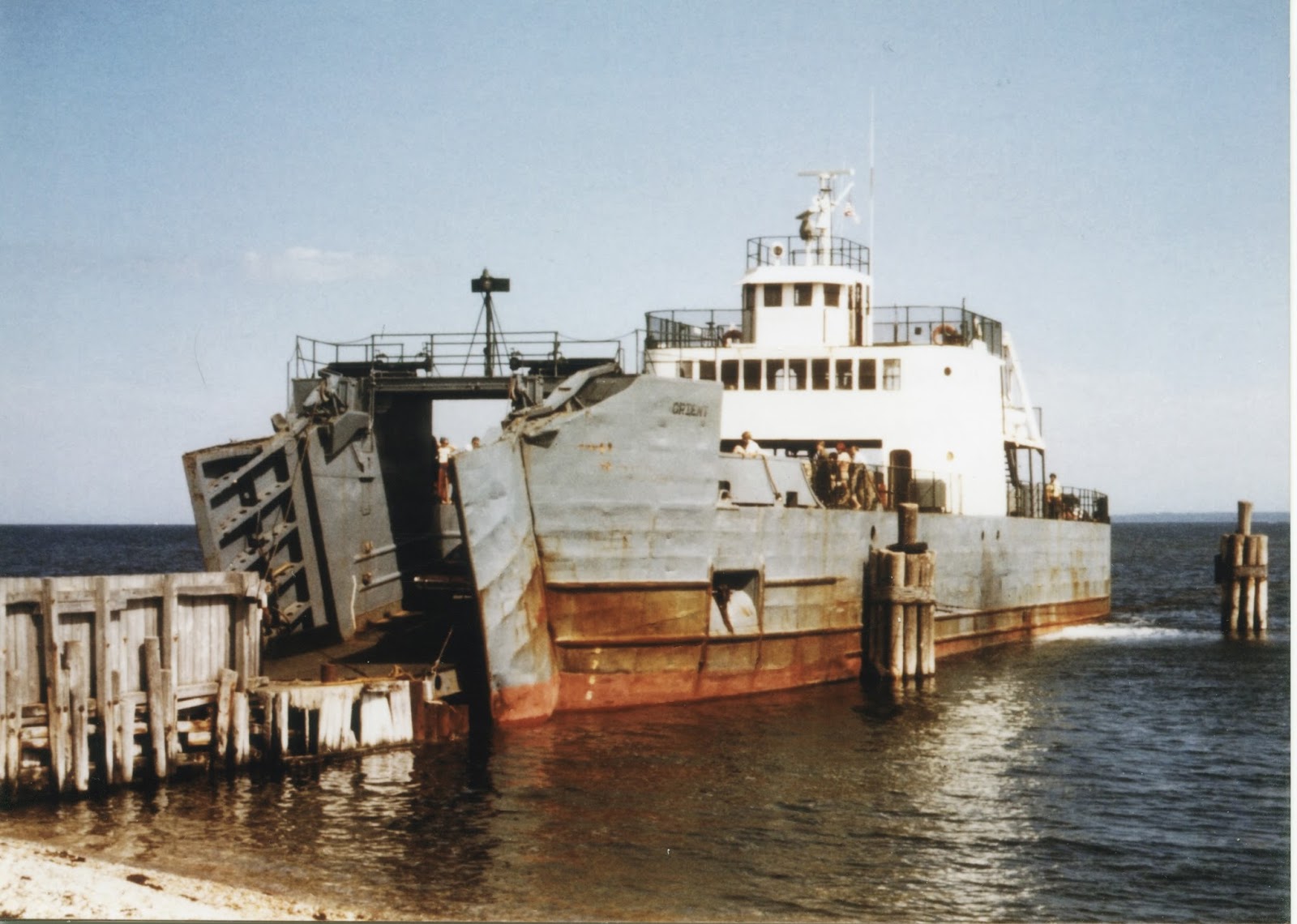
Next, returning to Long Island but going this time to its eastern end, we visit the ferry dock at Orient Point on an August day in 1976.  This predates my children by eleven years; in fact, I was still a teenager myself then.  A day trip by automobile with my parents took us to both the North and South Forks of Long Island, to both Montauk Point and Orient Point.  In something of a busman’s holiday, as I had just shortly before returned home from sea, we visited the waterfront and gazed out to sea.  Then we looked over the ferry facilities and took pictures of the ship in port.  I did not realize then how much of a role this ferry link to Connecticut would play in the family’s future, especially after the children arrived.  Here, then, is my favorite picture from that day:

The ferry Orient loads up at her terminal in Orient Point, Long Island, on a sunny day in August of 1976.  The battered hull plating and the generous allotment of rust indicate that the Orient has seen many years of service and has taken some punishment from a rough sea.  She has since gone to her reward, and newer vessels have taken her place.

In these and other waterfront locations, the beauty of the earth, sea, and sky are readily apparent in all weather conditions.  There is something about the sunlight in the way that it plays upon the water, the shore, and the ships that brings out the best in all of them.  And, without the responsibility involved in working aboard these ships, I have the leisure time to contemplate the majestic beauty around me.  At the end of the day, one of our hymns elevates this beauty to the supernal:

                                    Softly now the light of day
                                    Fades upon my sight away.
                                    Free from care, from labor free.
                                    Lord, I would commune with thee.[1]


[1] George W. Doane, “Softly Now the Light of Day,” in Hymns of The Church of Jesus Christ of Latter-day Saints, Salt Lake City: The Church of Jesus Christ of Latter-day Saints, 1985, p. 160.