Showing posts with label Queen Elizabeth 2. Show all posts

Sunday, January 5, 2020

Cleaning Out the Archives


Every place of human habitation needs a good housecleaning every so often, and our home is no exception.  With plans to retire, relinquish the property, and relocate to a milder climate in the not-too-distant future, the time has come not only for a good housecleaning, but a major downsizing as well.  With this thought in mind, I’ve packed up and given away many household items in recent months, but of course, more still needs to go.  Nothing in the house, not even the family archives, may be exempt from inspection and possible ejection.

Last month’s project, then, involved a thorough examination of the children’s picture albums.  They had about a dozen of these, all filled mostly with mediocre photographs taken with toy cameras and with some duplicates of pictures taken with more sophisticated equipment.  It was a motley collection, but it did contain a few gems that I wanted to save.  The bulk of the collection was jettisoned, as we had much better quality photographs of the same subjects.  Redundancy is a wise course in both archival work and shipboard engineering systems, but it can sometimes be taken to unreasonable extremes.

Not surprisingly, the photographs that I saved are of ships and ship-related subjects.  Some are quite good.  A few are not so good but unique.  All of them bring back memories, and I’m happy to present them here.  Let’s start with a visit to the Cunard Line’s Queen Elizabeth 2 as she reposes at the passenger ship piers on the West Side of Manhattan.

The bow of any large passenger liner is an impressive sight when viewed from the street.  Here, the great, curved, black steel port bow of the QE2 rises magnificently from the placid Hudson on Saturday, July 3, 1999.  It’s awe-inspiring to think that this great bow was designed to cut gracefully yet purposefully through the largest waves and swells of the Atlantic between New York and Europe.  Few, if any, of the ship’s pampered passengers would give this matter a thought.

 
This great bow, like every other part of the ship, requires regular maintenance.  Here, on the same day, we see two seamen on a camel rolling on a fresh layer of black paint.  Not a job for the faint of heart!

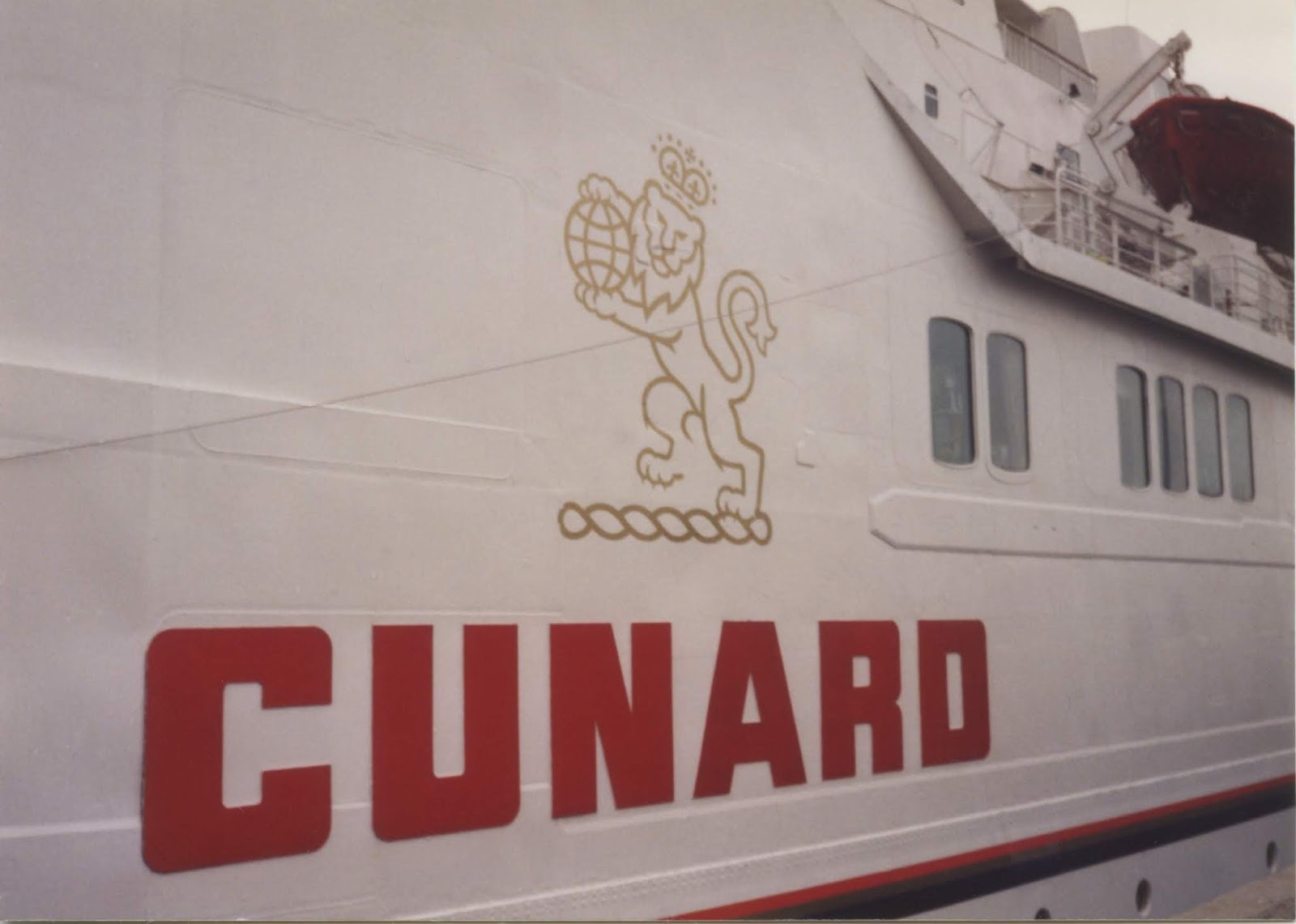
In these two photographs, taken on Sunday afternoon, September 1, 1996, from the top level of Pier 90, we have a close-up view of the Queen’s port side superstructure.  From this vantage point, we can look through the oversize windows into the ship’s public rooms and promenades and admire her luxurious accommodations.

Leaving the West Side piers now and taking the subway down to the Battery, we next embark on the Staten Island Ferry.  Always a family favorite, these half-hour voyages are great fun, and it’s easy to lose track of the time and spend half the day sailing back and forth.  The first picture here shows the pilothouse of the American Legion on an overcast Saturday, April 3, 1999.

A year later, we see the same view of the Gov. Herbert H. Lehman on a bright and sunny Saturday, March 4, 2000.  The blue sky and sunshine make all the difference in these two photos.

Switching vessels on the same day, here we view the southbound Gov. Herbert H. Lehman from the northbound American Legion as the two ships pass “at sea” on the Upper New York Bay. 
 From the ferries we watch the shipping world go by.  First, we see the anchored bulk carrier Amphitrite on Saturday, April 3, 1999. 

Next we see the anchored container ship Maersk Valentia on Saturday, March 4, 2000.
Later on the same day, we watch as another Maersk Lines container ship emerges from the Kills between Staten Island and New Jersey.  She is rounding Saint George and will soon pass through the Narrows and head out to sea.
Leaving New York now, we go next to Maine.  The Portland area is always a great place to see ships.  First, we admire the academy training vessel State of Maine as she rests alongside the Bath Iron Works pier in Portland on a cloudy and warm Saturday, July 11, 1998.
Next we enjoy a close-up view of the tanker Orkney Spirit at the Portland Pipeline pier in South Portland on a hazy Saturday, May 6, 2000.  The adjacent waterfront area and nearby breakwater are excellent vantage points from which we can watch everything that enters and leaves Portland Harbor.
Heading south now to Massachusetts, we watch the Dutch freighter Schippersgracht discharging cargo in Fall River on Monday, August 27, 2001.  Free to roam the pier and watch the ship unload, we did not know on this date that our unrestricted access to the docks would hereafter be curtailed as a result of the terrorist attacks that were only two weeks away.
Moving farther south to the Delaware Bay, we have an noontime view of the northbound New Jersey silhouetted in the sunlight from the southbound Delaware on Sunday, Christmas Eve of 1995.  When driving to Virginia to visit family, the voyage across the Delaware Bay comes as a welcome break from the holiday traffic!
Returning now to New England, let’s visit some lighthouses.  First we have the storied Portland Head Light in Cape Elizabeth, Maine, on Saturday, August 30, 1997.  A popular tourist attraction, this site commands a magnificent view of Casco Bay and the Atlantic Ocean.  One can spend many hours there and never tire of the scenery.
At the farther end of Maine, we have this view of the famed West Quoddy Head Light in Lubec on a cloudy and foggy Monday, June 23, 2003.  This site is often cloudy, foggy, windy, damp, and cold, and it has a rugged beauty.  It’s also peaceful and quiet, with very few visiting tourists, even at the height of the summer season.
In Massachusetts again, we see next the diminutive Plum Island Light at the mouth of the Merrimack River in Newburyport on Friday, June 23, 2000.  Blue sky and sunshine abound at this lovely site which is often overlooked by Boston area residents who flock to Maine instead.
In New York again, this time on the spring vacation from school, the children go with their grandparents to the iconic Fire Island Light on a brilliant April day in 2001.  My sons Steven and Michael pose on the boardwalk that leads through the dunes to the light.
Finally, we return once more to New England, specifically to the Piscataqua River that forms the boundary between New Hampshire and Maine.  The Memorial Bridge spanned this waterway for about a century before it was replaced with a more modern structure.  When the children were little, they were thrilled to walk across this bridge from New Hampshire to Maine and back and watch the tidal current rushing beneath their feet.  This view is taken from nearby Prescott Park on a beautiful but chilly Monday, October 8, 2001.
All these photographs from so many years ago bring back a sea of happy memories for everyone in the family.  We are indeed fortunate to have these memories, just as we were fortunate to go on so many family outings to the oceanfront when the children were younger.  Perhaps even more to the point, we were extremely fortunate to have a house full of happy and healthy children in the first place.  So many blessings, and so many reasons to be thankful!  The psalmist said it well when he asserted, “It is a good thing to give thanks unto the Lord” (Ps. 92:1), and when he exhorted, “Enter into his gates with thanksgiving, and into his courts with praise: be thankful unto him, and bless his name” (Ps. 100:4).

Sunday, September 9, 2018

All the Girls


The oceanographic survey ship Bartlett rested quietly alongside the wharf in Port Everglades, Fort Lauderdale, Florida, on Friday, January 4, 1985.  She was preparing for a two-weeks-long voyage in the Gulf of Mexico and would sail on Monday, the 7th.   Late this Friday afternoon, the day’s work was winding down, but it would resume promptly the following morning.  Nearly at the end of my own duties for the day, I went up to the bridge and glanced out the windows in the direction of the inlet that connects Port Everglades with the open Atlantic, and there I beheld a great sight.

Entering port through this narrow inlet was the Cunard Line’s famous passenger ship Queen Elizabeth 2.  I watched as this magnificent vessel slowly and gracefully glided in from the sea, turned around in the basin, and eased alongside her berth.  Her mooring lines then snaked ashore, and she was made fast directly across the wharf from the comparatively diminutive Bartlett.  Next, I wrote up the log, went off duty, and had my dinner.  Afterwards, I went ashore for a closer look at the great Queen.

Almost a thousand feet in length, the Queen took up nearly the entire dock space on the east side of the Port Everglades basin.  To look this ship over carefully involved a lot of walking.  This great sight was worth every step, though, for the Queen Elizabeth 2 was clearly the most interesting  thing in Fort Lauderdale that day.  Several of my shipmates felt the same way, and a group of us roamed the pier admiring the Queen.

In the early evening twilight, the passengers aboard the Queen began to stream ashore to enjoy a night on the town in Fort Lauderdale.  They came out by the dozens, and they made for a somewhat odd sight.  The vast majority came ashore as couples.  Without exception, the men were much more advanced in age than the ladies.  This was clearly evident in their balding heads, gray fringes, sagging jowls, and pot bellies.  The ladies, by contrast, were tall and slender with long flowing hair and radiantly beautiful faces.  They were dressed in evening gowns, and the men wore tuxedos.

After stepping off the gangway, each couple walked a few steps to a waiting lineup of limousines.  The drivers, also attired in tuxedos, hurried with lavish gesticulation to open the doors for the young ladies.   Several of the older men gruffly interrogated the drivers about their vehicles:  “Do you have a wet bar?  Do you have a TV?  Do you have a phone?”  If a particular limousine failed to meet these expectations, the older man turned his nose up in the air and led his young lady away to a more worthy conveyance.  Once embarked in their limousines, the couples were chauffeured away into town. 

This spectacle continued for quite a long while.  There were just so many of these superbly dressed but oddly matched couples coming ashore from the Queen and then being whisked away by this enormous fleet of luxurious limousines.  This ostentatious display of wealth astonished me almost as much as each couple’s blatant disparity in age.  Yet there it all was, and doing a very brisk business.

Later in the evening, their shore excursions completed, these same couples returned to the Queen in their limousines.  The tuxedoed chauffeurs again held the doors for the young ladies, received their tips from the older gentlemen, and then drove their now empty vehicles away.  At dawn the next morning, Saturday the 5th, the Queen Elizabeth 2 took in her lines and went to sea again.  The Bartlett remained behind and continued preparations for her own upcoming voyage.

My initial reaction on seeing this parade of old men and young girls was bewilderment.  Somehow it just didn’t seem kosher.  In thinking about it, I figured that they were probably not fathers and daughters, nor uncles and nieces, nor grandfathers and granddaughters.  I did not hear any of the girls call any of the men “Daddy,” or “Uncle,” or “Grandpa.”  The thought of such innocent pairings-up seemed too idealistic and unlikely, not to mention naïve.  By process of elimination, I concluded that I was most likely seeing what was euphemistically called an escort service.  These old men obviously had money, and they were willing to spend it on young, pretty girls.  And they no doubt expected returns on their investments. 

Fearing that I was becoming too cynical while still in my twenties, I was relieved to hear an older colleague remark, “These girls are making hay while the sun shines.”  It was expensive hay, too, much more than anyone on the Bartlett could afford.  Yet the Bartlett was crewed mostly by young men, about the same ages as these girls.  That seemed like a more natural source of attraction than old men so far past their prime.  But some such men still salivate over young, pretty girls, and some girls love what money can buy.  Otherwise, I could not imagine what they would have in common socially.  I wondered, though, when the sun stopped shining and the thrill of sailing on the Queen wore off, how would these girls then feel about their careers as “escorts?”

With their many warnings against moral decadence and degeneracy, the ancient scriptures attest that the lechery of old men is not a new phenomenon.  These senior citizens embarked on the Queen would have done well to heed the proverb’s counsel, “Lust not after her beauty in thine heart; neither let her take thee with her eyelids” (Prov. 6:25).  They were not the only ones, though.

Many years later while working ashore, my employer feared that I had suffered a hernia and sent me to be examined by a physician.  Miss Patty accompanied me.  As we and numerous other people sat quietly in the waiting room, an odd spectacle developed.  The administrative area behind the receptionist was open by both sight and hearing to the waiting room.  Everything that happened there was easily visible and audible to the waiting patients.  When we first arrived, all was quiet.  But then an obviously older man (receding hairline, grayish-white fringe, sagging jowls, and pot belly) approached a much younger lady (slender, long blond hair, and pretty face) working at a desk.   At first we thought nothing of it, but after a moment, the one-sided conversation caught our attention.

As a room full of patients waited for the physician, this sixty-plus-year-old man flirted publicly, loudly, and shamelessly with this approximately twenty-year-old girl.  He laughed at his own inappropriate jokes while she sat silently and looked extremely uncomfortable with it all.  This performance continued unchecked for several minutes.  As we watched in amazement, I remarked to Miss Patty, “I wonder who that guy is?”

“I don’t know,” she replied  “Maybe he’s the office manager.”

After a few more minutes, the show ended and then we were called into an exam room by a nurse.  She took care of the preliminaries with us and then left saying, “The Doctor will be right in.”

A minute later, the old man who had just been carrying on with the young lady entered the room.  He caught us both by surprise, and Miss Patty blurted out, “You’re the Doctor?!

He then introduced himself.  Miss Patty and I exchanged inquisitive glances with raised eyebrows, and the Doctor saw this.  The medical checkup that followed was carried out in what we thought was an unprofessional and condescending manner.  This man had been caught, and he clearly did not like it.  My employer was paying him, so I did not protest.  If it had been my dime and my time, however, I would have left and gone elsewhere.  But the good news was that I did not have a hernia, only a mild muscle strain.

Afterwards, I read the Doctor’s posted credentials in the waiting room.  He was a board certified surgeon, had medical licenses in two states, and held academic degrees from two of this country’s most prestigious universities.  With all these lofty qualifications, I would have expected more professional behavior.  Instead, I thought of Shakespeare’s famous lament, “How ill white hairs become a fool and jester!”[1]

On a happier note, a portrait of the Queen arrived in the mail some time after my encounter with her in Port Everglades.  This was part of an advertisement for a travel agency.  It was a beautiful photograph of a beautiful ship, and it proved that not all junk mail is junk!  I’m happy to share it here: 


[1] King Henry IV, Part II, V:v:51.

Monday, August 29, 2016

A Broader Canvas


Since childhood, I’ve collected pictures of ships.  Mostly postcards, these portraits were easily affordable and portable during travels.  The collection started with the passenger liners on which my grandparents sailed, and then continued with whatever seemed relevant to the family or historically noteworthy.  The result is an eclectic assortment, a little of this and a little of that, with a little from here and a little from there.

Each image has its own story, and in several instances, its own connection to our family.  With no further ado, then, let me present a dozen or so of what I think are the best and most interesting photographs:

The place where it all started.  An aerial view of the passenger piers on the West Side of Manhattan.  Shown at left are three Cunard ships, including the Queen Elizabeth in the center.  At right are the America of United States Lines and one of the twins Constitution and Independence of American Export Lines.  Note the overhanging fantail tern on the American Export ship.  This is a long gone aspect of the shipbuilder's art, a lovely finishing touch on a very attractive vessel.
The Constitution and the Independence were my grandparents' favorite ships.  They made unhurried voyages between New York and several Mediterranean ports, and while certainly first class operations, they did not engage in the movie star sophistication of some of the more famous liners.  This is my favorite portrait of the Constitution, one of a half-dozen that my grandparents collected.  She appears to be at anchor, probably off a Mediterranean port, judging by the shadows cast by a high summer sun.  
Twice my grandparents sailed aboard the Cristoforo Colombo of the Italian Line in the late 1950s.  They mailed this portrait of the ship home from Italy following a voyage from New York to Napoli in October of 1959.
When the Cristoforo Colombo arrived in Napoli, she docked here at the Stazione Maritima.  Monte Vesuvio looms in the background across the bay.  The American Export ships also docked here.  Note the multi-colored twin stacks of either the Constitution or the Independence rising above the building.  Many years after my grandparents' travels, the Rigel docked here during my time aboard here in 1979.  More recently, the Nieuw Amsterdam, on which my oldest son got married, has docked here while on her summer cruises.
During my transatlantic travels of the 1970s, I happened across this souvenir log of the United States, which I gave to my grandfather.  He and my grandmother had made one voyage on this ship in 1955, and I thought he would find this item interesting.  He did.  He told me, however, that the United States went too fast--New York to England in three days--and he preferred a slower, longer, and more leisurely crossing.  The voyage data on the back of this card brag about speed, speed, and speed.  I've come to agree with my grandfather.  The ships I later sailed on typically took ten days to reach Europe.
The troop transport Upshur is about to sail under the Golden Gate Bridge, most likely after departing from the Military Ocean Terminal in Oakland, California.  For years this vessel carried American military personnel, their families, and their belongings between the West Coast and the Far East.  She also carried South Korean troops during the Korean War.  Long afterwards, as the school ship State of Maine, notices stenciled in Korean remained on the bulkheads in the troop compartments.  I made two summer voyages on this ship as a teenager in the mid 1970s.  I also sailed under the Golden Gate Bridge several times, not on the State of Maine, but while aboard the Mercury and the Comet in the 1980s.
The ferry R. S. Sterling of the Texas Highway Department.  I rode this ferry on Monday, May 30, 1977, during the time of my apprenticeship aboard the tanker New Jersey Sun.  While she was drydocked at the Todd Shipyard in Galveston, I wandered around town on Memorial Day and found entertainment in free ferry rides between Galveston and Port Bolivar, Texas.
The aircraft carrier Lexington moored in her home port of Pensacola, Florida.  On another side trip during my time aboard the New Jersey Sun, my brother and I took a tour of this ship on Saturday, May 21, 1977.  Years earlier, as a student pilot, he had landed on and taken off from the Lexington at sea in the Gulf of Mexico.  I remember him remarking that the flight deck seemed pretty small.
A winter view of the first Queen Elizabeth at the Ocean Terminal in Southampton, England.  While such snow is unusual in southern England, the Queen Elizabeth and her sister the Queen Mary called at this spot regularly for decades.  Years after they reached the end of their careers, the oceanographic survey ship Wilkes docked at this same berth several times with me on board in the winter of 1980 and 1981.
Cunard's new flagship Queen Elizabeth 2 leaves Southampton for the first time in 1967.  The QE2 and I have followed each other along the American East Coast.  I saw her a few times in Fort Lauderdale when I was posted on the Bartlett and the two ships tied up across the pier from each other.  Years later, I took the children to see the Queen several times in New York and once in Portland, Maine.
An aerial view of the passenger ship piers in San Juan, Puerto Rico, in the 1970s.  I acquired this postcard in Roosevelt Roads, Puerto Rico, in early November of 1979 when I was sailing aboard the General Hoyt S. Vandenburg.  I wanted very much to visit San Juan and see the old colonial city, but that would have to wait a few years.
The nearly identical twin sisters Caribou and Joseph and Clara Smallwood of Marine Atlantic.  These were two of the four vessels that connected North Sydney, Nova Scotia, with Argentia and Port-aux-Basques, Newfoundland.  We sailed aboard the Joseph and Clara Smallwood from North Sydney to Argentia on Monday, June 21, 2004.  At the time, it was the longest voyage the children had made--fourteen hours--and they loved every minute of it.  I did, too.  I remember that it felt absolutely wonderful to sail out of sight of land and onto the open Atlantic again!
The cruise ship Nieuw Amsterdam of the Holland-America Line appears in a computer-generated image.  While the line of foam alongside the ship would lead us to believe she is underway and making way through the water, there is no bow wave, no side wave, no stern wave, and no wake.  There are also no passengers or crew out on deck.  My guess is that this is an artist's rendering made while the vessel was under construction in 2010.  Still it's a good likeness of a fine ship.  Our oldest son, James, was married aboard the Nieuw Amsterdam in Fort Lauderdale on Sunday afternoon, February 5, 2012.  Three days later, with the whole family aboard, the Nieuw Amsterdam docked at the cruise ship piers in San Juan.  A dream come true, I happily spent the day exploring this beautiful city.  In one further family history connection, my grandparents' final voyage was a winter cruise to the Caribbean in January and February of 1968.  Sailing one last time aboard the Constitution, they visited San Juan and docked at the same piers as the Nieuw Amsterdam.

Since my childhood, then, ships have been important means of transportation as well as the centerpieces at family gatherings on many occasions.  From the bon voyage celebrations at the West Side piers to the wedding aboard the Nieuw Amsterdam and numerous voyages in between, these vessels have have served us very well.  Now, even though most of these ships are long gone, they live on in the photographic arts and in the family archives, and they bring back many happy memories.  The family and the ships thus form a dual blessing, and we are expected to “receive it from the hand of the Lord, with a thankful heart” (D&C 62:7).  In looking back on these happy times aboard these great ships, how could anyone not feel thankful?

Sunday, December 8, 2013

The Ship Shrine

My daughter coined the phrase, but it’s really more of a display than a shrine. I had the idea several months ago of buying some inexpensive plastic frames for enlargements of a few of my favorite photographs of ships and children. Nothing fancy, just a few showpieces for old time’s sake. I selected the pictures, bought the frames, and set everything up on the dresser in Miss Karen’s old bedroom. I admired this little gallery every day. She saw it when she came home for Thanksgiving and laughingly called it my ship shrine.

Starting on the left and proceeding in chronological order, I have a picture of the ferry Orient at the dock in Orient Point, Long Island, in August of 1976. I was still a teenager then. After my first voyage aboard the State of Maine and before I returned to school, my parents and I took a road trip out to the East End of Long Island. We visited the lighthouse at Montauk Point and the state park at Orient Point. We also stopped to admire the old ferry loading passengers and automobiles for transport to Connecticut.

The Orient was quite a sight. An old landing craft from the Second World War, she had been repainted in civilian colors and now sported a gray hull with white superstructure. Her age showed in her battered bow, her rusty shell plating, and her squat, box-like hull. She was not a graceful looking vessel, but with the bright afternoon sun shining on her port side, she was quite attractive in a difficult-to-describe sort of way. Little did I realize that this chance encounter with the aged Orient would prove to be a harbinger of voyages to be made with children yet to be born. When I stood on the adjacent beach and took her photograph I was unmarried and childless, still just a kid myself, and unable to even imagine the many voyages I would make aboard the Orient’s successors with my family in the years ahead. The picture I took of her has since become one of my favorites, and it holds first place in the ship shrine.

Next come two photographs of the tanker New Jersey Sun in drydock at the Todd Shipyard in Galveston, Texas, in May of 1977. Then follows a portrait of the tug Charger docked in Newark, New Jersey, in July of 1978. These pictures represent many happy memories of my formative adolescent years when I was learning the craft of the sea and working toward my license. Those were the good old days!

Next in line is the cable carrier Furman departing Portsmouth, New Hampshire, and passing the Portsmouth Light in New Castle on Saturday, March 15, 1986. This picture represents a turning point. My seagoing career was drawing to a close, but the proverbial new day was dawning. The following year the first of our four children was born. Henceforth in my photography the ships would share the limelight with the children.

And so the next picture shows Miss Patty with a very young James and an even younger Miss Karen standing on the beach at Orient Point watching the new ferry John H arrive. It was Friday, August 17, 1990. The same place where I had looked upon the old Orient now became the younger generation’s viewing platform, and over the years all the children have enjoyed many happy hours both on the beach at Orient Point and aboard the ferries between Long Island and Connecticut.

They travelled elsewhere, too, though. Accordingly, the next photograph in line shows the whole family—all four children with their Mommy and their Nana—in Battery Park in Lower Manhattan, watching the transatlantic liner Queen Elizabeth 2 depart from New York on a voyage to Southampton, England. That was a special day, Monday, August 19, 1996. Besides providing an exciting time for the children, it brought back memories for my mother and me, memories of watching my grandparents sail from New York for Europe in the 1960s when I was a small child myself.

The next photograph portrays James diligently scanning the horizon with a pair of binoculars aboard the ferry Delaware on her namesake bay enroute from Lewes, Delaware, to North Cape May, New Jersey, on Tuesday, August 18, 1998. Finally, the lineup of pictures concludes with another favorite—all the children assembled with Captain Steve Pond in the wheelhouse of the ferry Champlain enroute from Port Kent, New York, to Burlington, Vermont, on Monday, July 2, 2001.

On two small shelves higher up and next to the mirror on Miss Karen’s dresser, I have two additional pictures. One shows James, Miss Karen, and Steven on Sunday afternoon, June 20, 1993, all dressed up in the vintage American Export Lines souvenir tee shirts that my grandmother had long ago brought home for my brother and me. The second is a photograph taken of a painting aboard the cruise ship Nieuw Amsterdam. This depicts the Holland-America Line’s earlier Nieuw Amsterdam passing the lightship Ambrose on her way outbound from New York. I had become enraptured by this painting during our voyage aboard the new Nieuw Amsterdam following James’ wedding in February of 2012, and I regretted that I could not bring it home with me! This little copy seems the next best thing.

Not part of Miss Karen’s ship shrine but nonetheless relevant are three professionally done portraits that I did bring home from the Nieuw Amsterdam. The first of these portrays the newly married couple, James and Sarah, radiating happiness on their shipboard honeymoon. The second shows our younger sons, Steven and Michael, also looking very happy, and perhaps even a bit mischievous despite being dressed in their formal attire. The third is a family portrait. In commemoration of the wedding, Miss Patty and I posed together with all the children and our new daughter-in-law in the grand atrium of the Nieuw Amsterdam. The ship’s photographer created a family heirloom appropriate to the occasion. All three photographs are now framed and displayed together in Miss Patty’s sewing room in what we may perhaps call a wedding shrine.

There remains one more to examine. In my family history room I have another portrait taken by another photographer aboard another ship. While enroute from New York to ports in the Mediterranean aboard the Independence in November of 1966, my grandparents, Robert Burns and Julia Murphy, posed for the cameraman in their evening attire at the Captain’s cocktail party. An exceptionally good likeness of them, this heirloom holds a place of honor in my family archives. I look at it often.

I look at the portraits from the Nieuw Amsterdam and the snapshots in the ship shrine often, too. But I think this collection is not so much a shrine to ships; rather, it is a mini-archive of our family history. Ships have played important roles in our family’s history, serving as transportation for business meetings, vacations, family reunions, and sometimes just plain joyriding. Also, for many years they provided a career and livelihood for me. But while they serve the family’s needs, these vessels are not part of the family. Like other inanimate objects, they are discarded when no longer useful or profitable. Inevitably, they end their careers in a scrapyard. Occasionally a famous ship may be preserved as a museum piece, such as the Queen Mary in California or the Cutty Sark in England, but this is rare. Most of the time the old ships are refashioned into razor blades and automobile parts.

The family, however, always maintains its integrity. As the Proclamation on the Family tells us,
The divine plan of happiness enables family relationships to be perpetuated beyond the grave. Sacred ordinances and covenants available in holy temples make it possible for individuals to return to the presence of God and for families to be united eternally.1
When I consider the five generations of my family that I have known in this life—my great-grandmother, my grandparents, my parents, my wife and myself, and our children—this sounds like a great idea! When I consider the extended family that I have known here and the deceased family members for whom I have done research and temple ordinances, this great idea seems even better. But of all these folks, the four for whom I admit to having a special soft spot are my own children. I realize that they’re all adults now, but they’ll always be children, even babies, to me.

Unlike discarded merchant ships, my children will never end their careers in a scrapyard and be transformed into something else. They will remain my children and I will remain their father. The ships I sailed on in my youth provided me with a livelihood, but my children have given me far more. This includes both happy and sad memories, both restful and sleepless nights, both great responsibility and great pleasure, both worry and relief, but above all an abiding and transcendent feeling of satisfaction that is difficult to describe.

As I look at the photograph of the aged ferry Orient in the ship shrine and think of the many voyages that I made on that route over the years with my children, I feel the sense of satisfaction that comes from having given them life and raised them from infancy to adulthood. President Gordon B. Hinckley expressed it very simply and succinctly when he told Mike Wallace:
Look, when all is said and done, you as a parent have no greater responsibility in this world than the bringing up of your children in the right way, and you will have no greater satisfaction as the years pass than to see those children growing in integrity and honesty and making something of their lives, adding to society because they are part of it.2
This is true. As important as ships have been in my life, my children are infinitely more important. The photographs of my favorite ships on Miss Karen’s dresser may comprise a ship shrine, as she calls it, but these vessels’ significance is eclipsed by my children and also by my grandparents and new daughter-in-law. Thus, it is not really a ship shrine but a family shrine.


1 In Gordon B. Hinckley, Discourses of President Gordon B. Hinckley, Volume 1: 1995-1999, Salt Lake City: Deseret Book Co., 2005, pp. 32-33. This Proclamation was included in an address made at the General Relief Society Meeting on September 23, 1995.
2 Op. cit., p. 486. This statement is an excerpt from an interview of President Hinckley by Mike Wallace on the television program 60 Minutes on December 18, 1995.