Showing posts with label Joseph and Clara Smallwood. Show all posts

Sunday, July 9, 2023

Come Sail Away

A strange memory occurred to me recently.  About twenty years ago, Miss Patty and I were planning a family vacation to Nova Scotia.  One day after work, I went to the AAA office here in Nashua to pick up some road maps and travel brochures.   The clerk who assisted me asked if we wanted to take the international ferry between Portland, Maine, and Yarmouth, Nova Scotia.  When I replied that we hadn’t decided yet, he made his recommendations.


“If you do take the ferry,” he began, “take it going to Nova Scotia and not coming back.  It leaves Maine at 6:00pm and goes overnight.  You can sleep, then, and get to Nova Scotia early the next morning. You won’t waste any time.  Coming back to Maine, it goes during the day.  You’re stuck on the boat for twelve hours with nothing to do but look at water.  It’s boring as hell.”  Here he rolled his eyes and shook his head disgustedly to emphasize his point.  “I made that mistake once,” he continued.  “I was bored out of my mind.  Never again!”


On hearing this, I nearly burst out laughing!  If only he knew who he was talking to, I thought.  Twelve hours of looking at water sounded like a great day to me.  I wished I had brought my Merchant Marine license to show him.  I would have told him that I looked at water to earn a living for several years, and I would gladly do it again.  I would most definitely not be bored!


This man certainly caught my attention and provided some amusing entertainment for me with his memorable remarks.  Two decades later, I still remember this monologue vividly, and I can’t think of it without laughing.  But I did not laugh then.  Instead, I politely thanked him for the road maps, the travel brochures, and his professional advice regarding the international ferry.


As things turned out, we did not take the ferry between Maine and Nova Scotia.  But in two summers of vacationing in New Brunswick, Nova Scotia, Prince Edward Island, and Newfoundland, we did make several voyages aboard the several ships that connected these provinces. These voyages ranged in duration from one hour to fourteen hours, and none of us were bored.  On the contrary, we all agreed that even the fourteen-hour journey was too short and went by too quickly.  I was impressed that four teenage children would unanimously agree with their middle-aged parents on this point.


Our first voyage took place on Tuesday, June 24, 2003, aboard the Princess of Acadia.  This lovely old vessel sailed across the Bay of Fundy from Saint John, New Brunswick, to Digby, Nova Scotia, in a leisurely three hours.  We all enjoyed this passage tremendously, and the children were especially intrigued by the extreme drop in tide that we saw on arrival in Digby.


Two days later, on Thursday, June 26, we sailed from Caribou, Nova Scotia, to Wood Island, Prince Edward Island, aboard the Holiday Island.  This was a shorter voyage across the Northumberland Strait on a hazy, hot, and humid day.  The comparatively cool breeze on the water was refreshing.


Two days later, on Saturday, June 28, we recrossed the Northumberland Strait from Prince Edward Island to New Brunswick via the new Confederation Bridge.  While we recognized the Confederation as a marvel of modern civil engineering, we would have been just as happy to sail aboard the historic ferry that it had recently replaced.


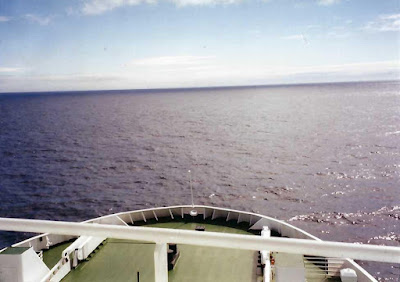
Returning a year later, we sailed aboard the Joseph and Clara Smallwood from North Sydney, Nova Scotia, to Argentia, Newfoundland, on Monday, June 21, 2004.  This grand voyage took fourteen hours and thirty minutes across open ocean.  I had been concerned that our four teenagers’ interest would not last for this duration, but it did.  They all loved it and wanted to do it again.


A week later, we did do it again.  On Sunday, June 27, we sailed aboard the Lief Ericson from Port-aux-Basques, Newfoundland, to North Sydney, Nova Scotia.  A shorter voyage of only six hours, it seemed slightly anticlimactic but was nonetheless a wonderful way to spend a large part of the day.


In recalling these events of twenty years ago, I also remember a popular song from over forty years ago, when I first went to sea, and which I recently heard again:


I’m sailing away.

Set an open course

For the virgin sea.

I’ve got to be free,

Free to face the life

That’s ahead of me.[1]


As a teenager looking ahead to a seemingly endless and limitless future, I felt impatient to leave home and go away and get on with life, a life of following the sea wherever it took me.  The sea to me meant freedom.  It gave me the freedom to “search for tomorrow on every shore,” and to learn and grow from the experience.  This experience, acquired both at sea and in port, inspired me to upgrade my license and advance professionally, and later, to pursue higher education in the humanities in college.  Now, at retirement age,


I look to the sea.

Reflections in the waves

Spark my memories.


These memories of my seafaring experiences, “some happy, some sad,” have to a large degree formed my character, guided my thinking, and shaped my outlook on life, and they continue to provide a foundation for philosophical inquiry, reasoned analysis, and the eternal search for lux et veritas, light and truth.  In this way, I have found many tomorrows on many shores.


Not content to remain ashore, though, I have taken many opportunities to return to the sea and again partake of the inspirational beauty and majesty of this unique element of Creation.  When the opportunity arose to sail among the eastern provinces of Canada, my family and I jumped at the chance.  Now we all have fond memories of these voyages.


In all the years that I have felt drawn to the sea, I have frequently sensed the presence of the Divine.  This is usually difficult and sometimes impossible to articulate, but despite its inherent ineffability, the spiritual aspect of the sea remains undeniable.  It is often as if


A gathering of angels

Appeared above my head.

They sang to me this song of hope,

And this is what they said.


They said:

“Come sail away.  Come sail away. 

Come sail away with me now.

Come sail away.  Come sail away.

Come sail away with me.”


Whether standing on the shore and looking out to sea, or boarding a ship and going to sea, the experience is always sublime, and there is never any occasion for boredom!


Now let’s look at a few photographs of Canadian ships:
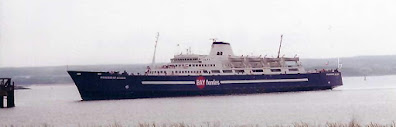
The Princess of Acadia approaches her dock in Saint John, New Brunswick, on Tuesday, June 24, 2003.


The Confederation, as seen from her running mate, the Holiday Island, as the two vessels ply the route between Caribou, Nova Scotia, and Wood Island, Prince Edward Island, on Thursday, June 26, 2003.

 
The view from the bridge of the Joseph and Clara Smallwood on her voyage from North Sydney, Nova Scotia, to Argentia, Newfoundland, on Monday, June 21, 2004.


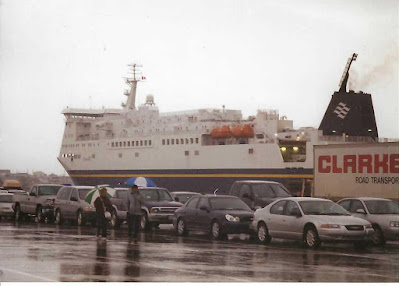
The Leif Erickson rests at her berth in the fog in Port-aux-Basques, Newfoundland, prior to loading passengers and cargo early on Sunday morning, June 27, 2004.

The Abegweit sails beneath the new Confederation Bridge that took her place on the route between Prince Edward Island and New Brunswick on June 1, 1997, in this postcard view.


[1] This and all subsequent quotations are from Dennis De Young, “Come Sail Away,” in Styx, The Grand Illusion, A&M Records, 1977.  Found on www.AZLyrics.com, et al.; punctuation and grammar normalized.

Monday, August 29, 2016

A Broader Canvas


Since childhood, I’ve collected pictures of ships.  Mostly postcards, these portraits were easily affordable and portable during travels.  The collection started with the passenger liners on which my grandparents sailed, and then continued with whatever seemed relevant to the family or historically noteworthy.  The result is an eclectic assortment, a little of this and a little of that, with a little from here and a little from there.

Each image has its own story, and in several instances, its own connection to our family.  With no further ado, then, let me present a dozen or so of what I think are the best and most interesting photographs:

The place where it all started.  An aerial view of the passenger piers on the West Side of Manhattan.  Shown at left are three Cunard ships, including the Queen Elizabeth in the center.  At right are the America of United States Lines and one of the twins Constitution and Independence of American Export Lines.  Note the overhanging fantail tern on the American Export ship.  This is a long gone aspect of the shipbuilder's art, a lovely finishing touch on a very attractive vessel.
The Constitution and the Independence were my grandparents' favorite ships.  They made unhurried voyages between New York and several Mediterranean ports, and while certainly first class operations, they did not engage in the movie star sophistication of some of the more famous liners.  This is my favorite portrait of the Constitution, one of a half-dozen that my grandparents collected.  She appears to be at anchor, probably off a Mediterranean port, judging by the shadows cast by a high summer sun.  
Twice my grandparents sailed aboard the Cristoforo Colombo of the Italian Line in the late 1950s.  They mailed this portrait of the ship home from Italy following a voyage from New York to Napoli in October of 1959.
When the Cristoforo Colombo arrived in Napoli, she docked here at the Stazione Maritima.  Monte Vesuvio looms in the background across the bay.  The American Export ships also docked here.  Note the multi-colored twin stacks of either the Constitution or the Independence rising above the building.  Many years after my grandparents' travels, the Rigel docked here during my time aboard here in 1979.  More recently, the Nieuw Amsterdam, on which my oldest son got married, has docked here while on her summer cruises.
During my transatlantic travels of the 1970s, I happened across this souvenir log of the United States, which I gave to my grandfather.  He and my grandmother had made one voyage on this ship in 1955, and I thought he would find this item interesting.  He did.  He told me, however, that the United States went too fast--New York to England in three days--and he preferred a slower, longer, and more leisurely crossing.  The voyage data on the back of this card brag about speed, speed, and speed.  I've come to agree with my grandfather.  The ships I later sailed on typically took ten days to reach Europe.
The troop transport Upshur is about to sail under the Golden Gate Bridge, most likely after departing from the Military Ocean Terminal in Oakland, California.  For years this vessel carried American military personnel, their families, and their belongings between the West Coast and the Far East.  She also carried South Korean troops during the Korean War.  Long afterwards, as the school ship State of Maine, notices stenciled in Korean remained on the bulkheads in the troop compartments.  I made two summer voyages on this ship as a teenager in the mid 1970s.  I also sailed under the Golden Gate Bridge several times, not on the State of Maine, but while aboard the Mercury and the Comet in the 1980s.
The ferry R. S. Sterling of the Texas Highway Department.  I rode this ferry on Monday, May 30, 1977, during the time of my apprenticeship aboard the tanker New Jersey Sun.  While she was drydocked at the Todd Shipyard in Galveston, I wandered around town on Memorial Day and found entertainment in free ferry rides between Galveston and Port Bolivar, Texas.
The aircraft carrier Lexington moored in her home port of Pensacola, Florida.  On another side trip during my time aboard the New Jersey Sun, my brother and I took a tour of this ship on Saturday, May 21, 1977.  Years earlier, as a student pilot, he had landed on and taken off from the Lexington at sea in the Gulf of Mexico.  I remember him remarking that the flight deck seemed pretty small.
A winter view of the first Queen Elizabeth at the Ocean Terminal in Southampton, England.  While such snow is unusual in southern England, the Queen Elizabeth and her sister the Queen Mary called at this spot regularly for decades.  Years after they reached the end of their careers, the oceanographic survey ship Wilkes docked at this same berth several times with me on board in the winter of 1980 and 1981.
Cunard's new flagship Queen Elizabeth 2 leaves Southampton for the first time in 1967.  The QE2 and I have followed each other along the American East Coast.  I saw her a few times in Fort Lauderdale when I was posted on the Bartlett and the two ships tied up across the pier from each other.  Years later, I took the children to see the Queen several times in New York and once in Portland, Maine.
An aerial view of the passenger ship piers in San Juan, Puerto Rico, in the 1970s.  I acquired this postcard in Roosevelt Roads, Puerto Rico, in early November of 1979 when I was sailing aboard the General Hoyt S. Vandenburg.  I wanted very much to visit San Juan and see the old colonial city, but that would have to wait a few years.
The nearly identical twin sisters Caribou and Joseph and Clara Smallwood of Marine Atlantic.  These were two of the four vessels that connected North Sydney, Nova Scotia, with Argentia and Port-aux-Basques, Newfoundland.  We sailed aboard the Joseph and Clara Smallwood from North Sydney to Argentia on Monday, June 21, 2004.  At the time, it was the longest voyage the children had made--fourteen hours--and they loved every minute of it.  I did, too.  I remember that it felt absolutely wonderful to sail out of sight of land and onto the open Atlantic again!
The cruise ship Nieuw Amsterdam of the Holland-America Line appears in a computer-generated image.  While the line of foam alongside the ship would lead us to believe she is underway and making way through the water, there is no bow wave, no side wave, no stern wave, and no wake.  There are also no passengers or crew out on deck.  My guess is that this is an artist's rendering made while the vessel was under construction in 2010.  Still it's a good likeness of a fine ship.  Our oldest son, James, was married aboard the Nieuw Amsterdam in Fort Lauderdale on Sunday afternoon, February 5, 2012.  Three days later, with the whole family aboard, the Nieuw Amsterdam docked at the cruise ship piers in San Juan.  A dream come true, I happily spent the day exploring this beautiful city.  In one further family history connection, my grandparents' final voyage was a winter cruise to the Caribbean in January and February of 1968.  Sailing one last time aboard the Constitution, they visited San Juan and docked at the same piers as the Nieuw Amsterdam.

Since my childhood, then, ships have been important means of transportation as well as the centerpieces at family gatherings on many occasions.  From the bon voyage celebrations at the West Side piers to the wedding aboard the Nieuw Amsterdam and numerous voyages in between, these vessels have have served us very well.  Now, even though most of these ships are long gone, they live on in the photographic arts and in the family archives, and they bring back many happy memories.  The family and the ships thus form a dual blessing, and we are expected to “receive it from the hand of the Lord, with a thankful heart” (D&C 62:7).  In looking back on these happy times aboard these great ships, how could anyone not feel thankful?