Sunday, August 11, 2019

The Last Train Home


In my present employment, I have the dubious opportunity to hear canned music for much of my workday.  Most of this stuff simply goes in one ear and then promptly out the other, but occasionally a line of lyrics becomes lodged in my mind.  One such verse is, “Buy me a ticket on the last train home tonight.”[1]  Hearing this line repeatedly leads to memorizing it, but more significantly, it sets a train of thought in motion.

Many times in the last several years have I taken “the last train home tonight.”  This last train left Boston South Station at 9:30pm every evening, made most of the stops along the way, and arrived in New York Penn Station at 2:30am.  I rode this train several times each year when I returned to my childhood home to visit and check up on my aging parents.  After a long and busy workday, I rode the Boston Express bus into South Station and then got on the train, and this schedule worked out quite well.  The bus was always a great soporific.  When it left Nashua, I fell asleep, but I always woke up just in time as it neared South Station.  The Amtrak train was even more comfortable.  I slept most of the way to New York, but I always awakened briefly at key points along the Shore Line that brought back memories for me.

The first of these spots was along the shore of Narragansett Bay in Rhode Island.  As the train rushed along, I sleepily glanced out the window at the black sky and blacker water and momentarily remembered sailing on this great bay aboard the tugboat Charger as she hauled the gasoline barge Interstate 35 toward Providence.  Then I went back to sleep.

The second wake-up took place as the train stopped in New London, Connecticut.  Once again gazing sleepily out the window, I noticed most of the Cross Sound Ferry fleet tied up for the night at the floodlit piers.  The larger vessels  John H and Cape Henlopen always stood out because of their size, but after a moment the Susan Anne and the Mary Ellen and others came into view as well.  As the train loaded and discharged passengers, I recalled the many voyages the family had made aboard these vessels when driving between New Hampshire and Long Island.  Then, with my mind comfortably at sea, I went back to sleep as the train eased away from the station.

The third seaside wake-up spot was in Bridgeport, Connecticut, and this one was always very brief.  Following the station stop, the train rolled past the dock used by the Bridgeport and Port Jefferson ferry.  Often one of this line’s three ships was spending the night there.  I usually woke up slightly for a moment, just long enough to peer out the window and maybe see the Grand Republic or the Park City and recall the occasional voyages I had made on this mid-Sound route.  Then I quickly fell asleep again.

At last, after a quiet and restful journey, the train reached the Hell Gate Bridge in New York.  Wide awake at this point and getting ready to disembark, I took in the grand view of the East River from this landmark span.  To the west the water led to the skyscrapers of Manhattan; to the east it wended its way toward Fort Schuyler and beyond into Long Island Sound.  I remembered that I had sailed this route numerous times aboard the Charger-Interstate 35 combination many years ago  Next, and it always seemed too soon, the train pulled into the subterranean caverns of the Pennsylvania Station, and the peaceful and pleasant nocturnal railroad voyage ended.

Penn Station at 2:30 in the morning was everything the ride along the Shore Line was not.  Incessantly crowded and noisy, hot and humid in summer, cold and raw in winter, it always proved that New York really is the city that never sleeps, although a few passengers, myself included, sometimes dozed off between trains.  Fortunately, the wait for the Long Island train was never very long.  After an anticlimactic ride to Mineola, I usually disembarked amid a horde of late night party-goers.  Separating myself from this crowd and threading my way through the labyrinth of modern high-rises and parking garages that now comprise downtown suburban Mineola, I made the ten-minute walk to the old family home and usually arrived about 4:00am.  The odyssey of “the last train home tonight” was then concluded.

I always entered the house as quietly as possible through the garage and kitchen.  If the dog didn’t wake up and raise a rumpus, I went back to sleep for a while in the family room.  Eventually the dog always did wake up, though, and then my father, hearing the commotion, came out to investigate and then discovered me.  Usually, he had forgotten that I was coming.  Later, about 7:00am, my mother would wake up.  Mom never forgot that I was coming, and she was always elated to see her vagabond son again.  It was a happy way to start her day, and her enthusiasm always made the nighttime traveling worthwhile.

Typically, a visit of two or three days’ duration followed my early morning arrival.  These were always pleasant occasions.  With both my parents in their nineties, however, we all knew that their meters were ticking, counting down the limited time they had left.  When my visit with them ended, I usually took an afternoon train back to Boston.  The next day, I went back to work.

My last journey aboard the last train took place on the night of Tuesday, October 31, and Wednesday, November 1, 2017.  I arrived promptly on Mom’s 99th birthday.  My son Michael arrived by air from Europe for the occasion, too.  That was a very special day for Mom, truly a very happy last birthday for her.  Now, with her gone, the house sold, and my father in assisted living, it’s doubtful that I’ll ever take “the last train home tonight” again.  These journeys are now memories, as were the shipboard voyages that I always recalled while on the train.

The highlight of these railroad journeys, whether made by day or night, was always the sight of the sea and the vessels that plied it.  My voyages aboard ship, first as an employee and later as a passenger with my family, were important events.  Now they are important and precious memories.  Likewise, the memories of family gatherings, special family occasions, and deceased family members are important and precious, too.  While we cannot repeat the past, we can relive it in memory and share the happiness we find there with others.  As the scriptures counsel us:

                        Remember the days of old, consider the years of many generations:
                        ask thy father, and he will shew thee; thy elders, and they will tell
                        thee (Deut. 32:7).

But simply remembering and hearing oral histories often prove insufficient in the long term.  Thus we have the more recent scriptural injunction to “continue writing and making a history of all the important things” (D&C 69:2).  Since going to sea was—and still is—very important to me, I took both notes and pictures along the way.  Now I’m glad I did.

There is so much here to be thankful for: the memories of shipboard voyages and families, the writing and photographs that preserve them, and a random line of canned music that releases a flood tide of these magnificent memories.


[1] Al Stewart, “Time Passages,” 1978, found at www.azlyrics.com.

Monday, August 5, 2019

Illuminata


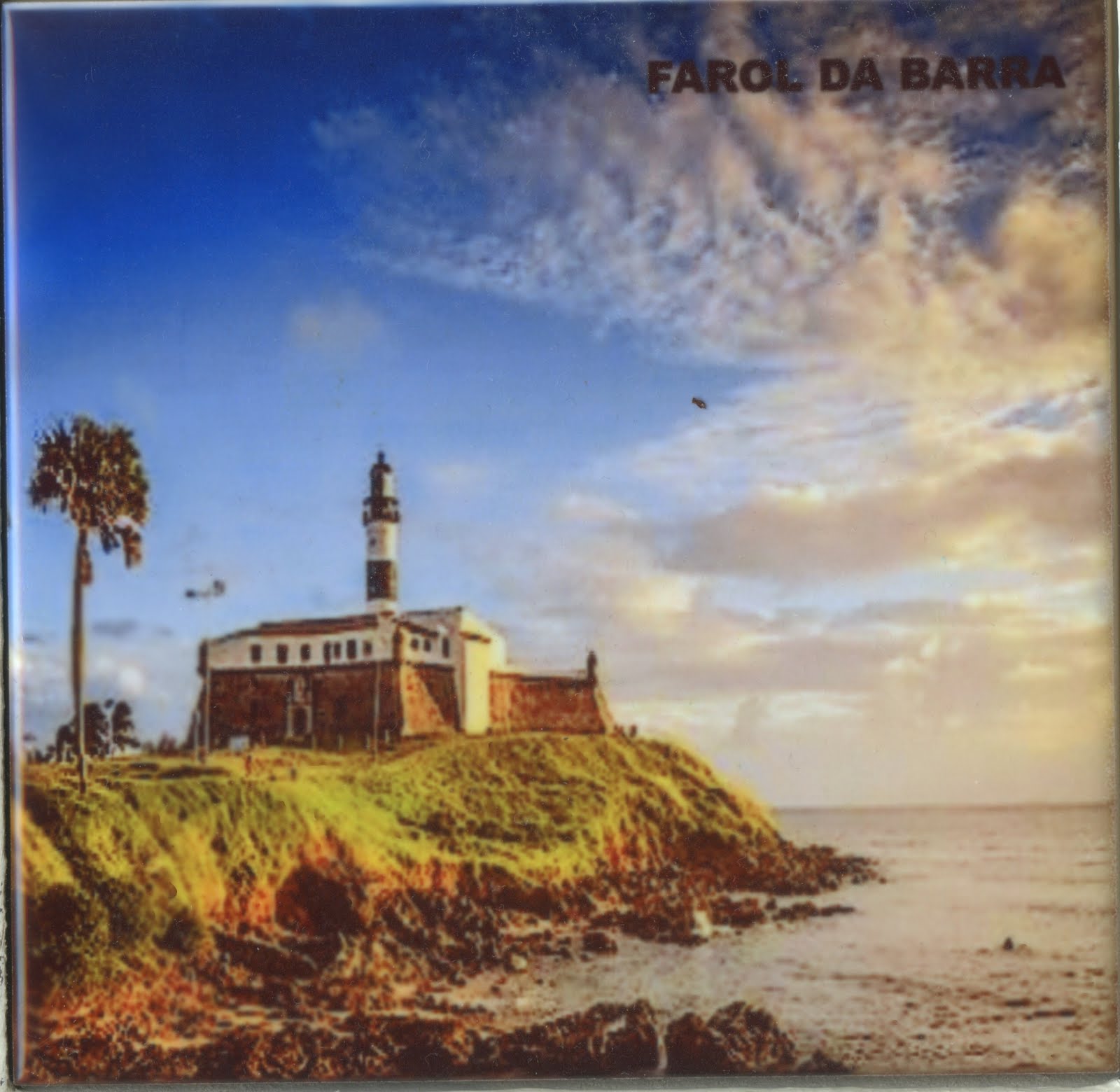
Hanging on the wall over my desk and next to my Merchant Marine license is a key ring holder.  Normally, such a pedestrian object would have no business there, but this key ring holder is special.  Furthermore, it is not there to hold keys.  A gift from Miss Patty after a recent visit with the children, it contains above the key-holding hooks a framed ceramic tile with a painting of a lighthouse on it.  While the world’s coastlines are full of lighthouses, this one serves as more than an aid to navigation.  It represents family.

In the southwest corner of Salvador, Bahia, Brazil, stands the Farol da Barra—the Lighthouse of the Barra—the Barra being the adjacent neighborhood of the city.  Situated on a slight promontory along the coast road, this light overlooks the confluence of the Atlantic Ocean and the Baia de Todos os Santos—the Bay of All the Saints.  This bay forms the seaport of Salvador.  The commercial shipping docks line the west side of the city with anchorage areas a short distance offshore.  Dating from 1698, this lighthouse has seen many vessels arrive and depart.  A comparatively new feature is the Museu Nautico da Bahia in an adjoining building.   A timeless feature is the magnificent view of the great South Atlantic Ocean, the Baia de Todos os Santos, and the adjacent coastline.  People traverse great distances to visit the Farol da Barra and enjoy the breathtaking beauty of the site.

Nearly every visit to the children in Brazil by family members from the north has included a visit to the Farol da Barra.  All of us have strolled the seaside promenade leading to the lighthouse.  The majestic sight of the seemingly limitless South Atlantic, the gentle washing of the shore along the seawall by the small waves, and the peace and quiet of Nature in contrast to the commotion of the city soothe the soul and inspire the mind.

Similar vistas are also available, even if only briefly, on one’s arrival in Salvador by air.  On its approach to the runway about a dozen miles north of the city proper, the aircraft flies over the Baia de Todos os Santos on a northeasterly heading.  To the left one sees the sheltered bay, the anchored cargo ships, and part of the commercial waterfront.  To the right one sees the open Atlantic, the Farol da Barra, and the Barra neighborhood of Salvador.  A fleeting but nonetheless breathtaking view from the air.

Five centuries ago, the Portuguese brought the supernal light of Christianity to Brazil.  They also established navigational lights to guide their ships along the coast.  Visiting this lighthouse in particular has become a family tradition, and every visit yields a spiritual experience.  In addition to illuminating the coast line, the Farol da Barra reminds us of the sublime light that our children and grandchildren bring into the family, and their light guides us to the Supreme Light that illuminates not only coast lines and families, but the entire world. 

Now for some photography.  First, the image of the Farol da Barra that's on the tile in the key ring holder:


Next are two photographs of the Farol da Barra taken by my son James on Friday, February 15, 2019:


We did have more photographs of the Farol da Barra, but unfortunately most of these were lost when my daughter's computer developed problems.  All the more reason to make a return visit, then!

Sunday, September 16, 2018

The Last Voyage


An old cliché holds that there is a first time for everything.  Less often repeated is the obvious truth that there is also a last time for everything.  I now look back on several last times.  Some examples are my last transatlantic voyage (aboard the Comet in 1983), my last transpacific voyage (also aboard the Comet, in 1984), my last voyage as a paid employee (aboard the Kane in 1986), the last time I took the license exams (in Boston in 1984), and my last visit to company headquarters in Bayonne (in 1987).

More recently, I have experienced several last times in my family life ashore.  There was the last time I rode the train from Boston to the Family Headquarters in New York to visit my parents, the last time I walked home from the Mineola station, the last time I brought flowers to my mother, the last time I showed Mom pictures of her grandchildren and great-grandchildren, the last time I bid my parents farewell when returning to New Hampshire, and so on.

We also made a last voyage.  When my now-widowed father decided to leave the old family home and relocate to an assisted living facility here in Nashua, Miss Patty and I returned to New York to get him.  On Wednesday, August 15, 2018, he made what will likely be his last voyage aboard ship.  At 12:00 noon that day the three of us along with Bradley, the dog, sailed from Orient Point, Long Island, to New London, Connecticut, aboard the Cape Henlopen.

As a young man in the 1940s, my father had sailed on troopships across the Pacific and back.  He traveled in less-than-luxurious accommodations to less-than-idyllic destinations and was happy to simply return to the United States unscathed.  In his middle years, he skippered the family sailboat Justine along the South Shore of Long Island.  More enjoyable and much safer than his treks across the Pacific, these happy times yielded many fond memories and formed the basis of my own interest in the sea.  Later, on summer vacations, he crossed the Delaware Bay several times aboard the ferries of the Delaware River and Bay Authority fleet.  Still later in life, my parents made numerous sailings on the Cross Sound fleet to visit their grandchildren in New England.  Today’s voyage aboard the Cape Henlopen would serve as a fitting capstone, perhaps a grande finale, to a long family tradition.

We boarded the Cape Henlopen about fifteen minutes prior to her scheduled departure time and ensconced ourselves in a comfortable spot with a good view on the port side promenade deck.  The meteorological conditions were perfect for making a voyage: a clear blue sky with bright sunshine, excellent visibility, a very light breeze, a mild temperature, and a calm sea.  The “beauty of the earth”[1] indeed!  My father took in the magnificent view of Gardiners Bay and the Orient Point beach with obvious delight.  At the appointed time, the whistle blew and the Cape Henlopen backed easily away from her berth and set sail for New London.

For the next hour and a half, our little family, and my father in particular, savored the gentle motion of the Cape Henlopen through the water.  As she accelerated away from the dock at Orient Point the Susan Anne arrived.  The two vessels passed starboard to starboard, and then the Susan Anne eased into the berth that the Cape Henlopen had just vacated.  Proceeding eastward, the Cape Henlopen came abeam of the Plum Gut Lighthouse and then turned to port to transit the Gut and come out onto the more open water of Long Island Sound.  The Connecticut hills stood out clearly in the distance as the Cape Henlopen now turned onto a more northeasterly heading.  Next the Jennifer C and shortly after her the Mary Ellen came into view as they sailed in the opposite direction toward Orient Point.  To the northwest, close to the Connecticut shore, the Coast Guard buoy tender Juniper[2] lay stationary as she serviced aids to navigation.

The Cape Henlopen sailed on steadily past Plum Island and across the deep blue water of the open Sound.  As she did so, we ate a light lunch and recalled that five generations of the family have now sailed on this great ship.  As we discussed this and remembered previous voyages, Bradley made friends with several of the other passengers and their dogs.  He was the first family pet to sail aboard one of the ferries, and he seemed to like it very much.

Soon the New London Harbor Light at the mouth of the Thames River came into view, and then the John H came downstream and passed the Cape Henlopen close by to port.  It was a busy day on the water!  Too quickly—and these voyages are always too short—the Cape Henlopen proceeded up the Thames and slowed for her approach to the docks in New London.  Shortly after 1:30pm, it was time for us to disembark.

This was an especially bittersweet moment.  My father had enjoyed his voyage aboard the Cape Henlopen tremendously.  But we all knew, as we continued our journey north to Nashua and the assisted living facility, that at age 96 he would in all likelihood not return to Long Island again. Thus, there would be no more voyages aboard the Cape Henlopen or any other vessel.   Shakespeare expressed it very succinctly: 

I shall no more to sea, to sea,
Here shall I die ashore.[3]

Very sad, but time had marched on, and we could not turn it back.

Happy memories of the bygone time remain, though, and some bright future still lies ahead.  Far from being isolated in a geriatric infirmary, the family patriarch now resides comfortably in a state-of-the-art facility with a home-like atmosphere close to a son, daughter-in-law, and grandson.  Furthermore, with the long range capability of the cell phone, he receives regular updates from and photographs of other grandchildren and great-grandchildren in Brazil and Alaska.  These family ties, both in person and electronic, dispel the melancholy of loneliness with the happiness of companionship, and prove the proverb, “As cold waters to a thirsty soul, so is good news from a far country” (Prov. 25:25).     

Photographs of the Cape Henlopen, her fleet mates, and landmarks along their route abound in our family’s collection.  I’m pleased to share some of them here:
 
The New London bound Cape Henlopen as seen from the Orient Point bound John H on Tuesday, June 21, 2016.  The fresh coat of paint really stands out against the gray sea and sky.
The Cape Henlopen coming up the Thames River to New London, seen from the outbound John H on a bright and sunny Wednesday, August 17, 2016.
Bradley aboard the Cape Henlopen just prior to departure from Orient Point on Wednesday, August 15, 2018.  All subsequent pictures are from this voyage.
The Plum Gut Lighthouse with Orient Point in the background.
The Orient Point bound Mary Ellen passing the Cape Henlopen port-to-port just north of Plum Island.
The Juniper servicing aids to navigation on Long Island Sound with Connecticut in the background.
New London Harbor Light at the mouth of the Thames River.
The John H leaving New London for Orient Point and passing the Cape Henlopen port-to-port.


[1] Folliott S. Pierpoint, “For the Beauty of the Earth,” in  Hymns of The Church of Jesus Christ of Latter-day Saints, Salt Lake City: The Church of Jesus Christ of Latter-day Saints, 1985, p. 92.
[2] The Juniper (WLB-201) has an interesting but sad history.  She participated in the recovery operations of Trans World Airlines flight 800 in 1998 and EgyptAir flight 990 in 1999.  Finally, she assisted in New York immediately following the terrorist attack of 2001.  See https://en.wikipedia.org/wiki/USCGC_Juniper_(WLB-201).
[3] The Tempest, II:ii:44-45.

Sunday, September 9, 2018

All the Girls


The oceanographic survey ship Bartlett rested quietly alongside the wharf in Port Everglades, Fort Lauderdale, Florida, on Friday, January 4, 1985.  She was preparing for a two-weeks-long voyage in the Gulf of Mexico and would sail on Monday, the 7th.   Late this Friday afternoon, the day’s work was winding down, but it would resume promptly the following morning.  Nearly at the end of my own duties for the day, I went up to the bridge and glanced out the windows in the direction of the inlet that connects Port Everglades with the open Atlantic, and there I beheld a great sight.

Entering port through this narrow inlet was the Cunard Line’s famous passenger ship Queen Elizabeth 2.  I watched as this magnificent vessel slowly and gracefully glided in from the sea, turned around in the basin, and eased alongside her berth.  Her mooring lines then snaked ashore, and she was made fast directly across the wharf from the comparatively diminutive Bartlett.  Next, I wrote up the log, went off duty, and had my dinner.  Afterwards, I went ashore for a closer look at the great Queen.

Almost a thousand feet in length, the Queen took up nearly the entire dock space on the east side of the Port Everglades basin.  To look this ship over carefully involved a lot of walking.  This great sight was worth every step, though, for the Queen Elizabeth 2 was clearly the most interesting  thing in Fort Lauderdale that day.  Several of my shipmates felt the same way, and a group of us roamed the pier admiring the Queen.

In the early evening twilight, the passengers aboard the Queen began to stream ashore to enjoy a night on the town in Fort Lauderdale.  They came out by the dozens, and they made for a somewhat odd sight.  The vast majority came ashore as couples.  Without exception, the men were much more advanced in age than the ladies.  This was clearly evident in their balding heads, gray fringes, sagging jowls, and pot bellies.  The ladies, by contrast, were tall and slender with long flowing hair and radiantly beautiful faces.  They were dressed in evening gowns, and the men wore tuxedos.

After stepping off the gangway, each couple walked a few steps to a waiting lineup of limousines.  The drivers, also attired in tuxedos, hurried with lavish gesticulation to open the doors for the young ladies.   Several of the older men gruffly interrogated the drivers about their vehicles:  “Do you have a wet bar?  Do you have a TV?  Do you have a phone?”  If a particular limousine failed to meet these expectations, the older man turned his nose up in the air and led his young lady away to a more worthy conveyance.  Once embarked in their limousines, the couples were chauffeured away into town. 

This spectacle continued for quite a long while.  There were just so many of these superbly dressed but oddly matched couples coming ashore from the Queen and then being whisked away by this enormous fleet of luxurious limousines.  This ostentatious display of wealth astonished me almost as much as each couple’s blatant disparity in age.  Yet there it all was, and doing a very brisk business.

Later in the evening, their shore excursions completed, these same couples returned to the Queen in their limousines.  The tuxedoed chauffeurs again held the doors for the young ladies, received their tips from the older gentlemen, and then drove their now empty vehicles away.  At dawn the next morning, Saturday the 5th, the Queen Elizabeth 2 took in her lines and went to sea again.  The Bartlett remained behind and continued preparations for her own upcoming voyage.

My initial reaction on seeing this parade of old men and young girls was bewilderment.  Somehow it just didn’t seem kosher.  In thinking about it, I figured that they were probably not fathers and daughters, nor uncles and nieces, nor grandfathers and granddaughters.  I did not hear any of the girls call any of the men “Daddy,” or “Uncle,” or “Grandpa.”  The thought of such innocent pairings-up seemed too idealistic and unlikely, not to mention naïve.  By process of elimination, I concluded that I was most likely seeing what was euphemistically called an escort service.  These old men obviously had money, and they were willing to spend it on young, pretty girls.  And they no doubt expected returns on their investments. 

Fearing that I was becoming too cynical while still in my twenties, I was relieved to hear an older colleague remark, “These girls are making hay while the sun shines.”  It was expensive hay, too, much more than anyone on the Bartlett could afford.  Yet the Bartlett was crewed mostly by young men, about the same ages as these girls.  That seemed like a more natural source of attraction than old men so far past their prime.  But some such men still salivate over young, pretty girls, and some girls love what money can buy.  Otherwise, I could not imagine what they would have in common socially.  I wondered, though, when the sun stopped shining and the thrill of sailing on the Queen wore off, how would these girls then feel about their careers as “escorts?”

With their many warnings against moral decadence and degeneracy, the ancient scriptures attest that the lechery of old men is not a new phenomenon.  These senior citizens embarked on the Queen would have done well to heed the proverb’s counsel, “Lust not after her beauty in thine heart; neither let her take thee with her eyelids” (Prov. 6:25).  They were not the only ones, though.

Many years later while working ashore, my employer feared that I had suffered a hernia and sent me to be examined by a physician.  Miss Patty accompanied me.  As we and numerous other people sat quietly in the waiting room, an odd spectacle developed.  The administrative area behind the receptionist was open by both sight and hearing to the waiting room.  Everything that happened there was easily visible and audible to the waiting patients.  When we first arrived, all was quiet.  But then an obviously older man (receding hairline, grayish-white fringe, sagging jowls, and pot belly) approached a much younger lady (slender, long blond hair, and pretty face) working at a desk.   At first we thought nothing of it, but after a moment, the one-sided conversation caught our attention.

As a room full of patients waited for the physician, this sixty-plus-year-old man flirted publicly, loudly, and shamelessly with this approximately twenty-year-old girl.  He laughed at his own inappropriate jokes while she sat silently and looked extremely uncomfortable with it all.  This performance continued unchecked for several minutes.  As we watched in amazement, I remarked to Miss Patty, “I wonder who that guy is?”

“I don’t know,” she replied  “Maybe he’s the office manager.”

After a few more minutes, the show ended and then we were called into an exam room by a nurse.  She took care of the preliminaries with us and then left saying, “The Doctor will be right in.”

A minute later, the old man who had just been carrying on with the young lady entered the room.  He caught us both by surprise, and Miss Patty blurted out, “You’re the Doctor?!

He then introduced himself.  Miss Patty and I exchanged inquisitive glances with raised eyebrows, and the Doctor saw this.  The medical checkup that followed was carried out in what we thought was an unprofessional and condescending manner.  This man had been caught, and he clearly did not like it.  My employer was paying him, so I did not protest.  If it had been my dime and my time, however, I would have left and gone elsewhere.  But the good news was that I did not have a hernia, only a mild muscle strain.

Afterwards, I read the Doctor’s posted credentials in the waiting room.  He was a board certified surgeon, had medical licenses in two states, and held academic degrees from two of this country’s most prestigious universities.  With all these lofty qualifications, I would have expected more professional behavior.  Instead, I thought of Shakespeare’s famous lament, “How ill white hairs become a fool and jester!”[1]

On a happier note, a portrait of the Queen arrived in the mail some time after my encounter with her in Port Everglades.  This was part of an advertisement for a travel agency.  It was a beautiful photograph of a beautiful ship, and it proved that not all junk mail is junk!  I’m happy to share it here: 


[1] King Henry IV, Part II, V:v:51.

Sunday, June 10, 2018

Finished with Engines


The two ships that passed in the night in early January of 2018 stayed their courses on their voyages through life.  Following her birth on January 24, Miss Katherine Elizabeth was officially underway on the outset of  what we hope will be a long, healthy, and happy voyage. Her great-grandmother—my Mom and my children’s Nana—remained on home hospice care on Long Island, buoyed by news and photographs of the new baby.

As winter gradually became spring, my daughter-in-law brought Miss Katherine from distant Alaska to her family home in New Hampshire, with plans to visit Mom in New York as well.  During this interval, however, Mom’s long voyage started winding down more quickly.  Finally, during the night of Thursday, May 24th, four months after the hospital staff’s prediction and one week before Miss Katherine’s scheduled visit, Mom quietly rang up “Finished with Engines.”  She was 99 years, 6 months, and 23 days old.  With her earthly voyage at last concluded, she returned to the celestial realm from which she had come nearly a century ago.

Mom and Miss Katherine crossed paths the following Wednesday, May 30th.  The very young paid respects to the very old in a graveside service at the Cemetery of the Holy Rood in Westbury, Long Island.  Though she never met her great-grandmother face to face in this life, little Miss Katherine sat happily on her great-grandfather’s lap and brought joy to his heart.  The family line was continuing unchecked, and our baby’s future looked bright.

The next afternoon we returned to New England.  At sea between Orient Point, Long Island, and New London, Connecticut, we sailed aboard the ferry Cape Henlopen.  By its very nature, the sea has always been an ideal place to contemplate eternity.  This time, however, there was an added dimension.

With Miss Katherine now embarked, fully five generations of our family have sailed aboard the Cape Henlopen.  In the 1970s, my grandfather and my parents and I sailed on her when she was working the Delaware Bay route.  Since she joined the Cross Sound fleet in the 1980s, Miss Patty and I have sailed on her with our children and grandchildren.  The Cape Henlopen, then, is the vessel that bridges the generations, the ship that we all share in common with each other.  She thus holds a place of honor in our family heritage.

On that calm, cool, and sunny afternoon as we sailed once again aboard the Cape Henlopen, I gazed at the eternal sea and sky and thought of the beloved lady whom we had just laid to rest.  She had always enjoyed the sea and admired its supernal beauty.  I like to think that she was looking down lovingly on her new great-granddaughter, and in her own sublime way, was wishing Miss Katherine Elizabeth a fair wind and a following sea throughout her earthly voyage.

Sunday, June 3, 2018

Going Back to Work


Leaving home to join a ship was seldom a simple matter.  Some complication usually arose, which meant that going back to work was often an adventure and sometimes a misadventure.  Factors such as flexible schedules, weather delays, changing dock assignments, and personal emergencies contributed to the confusion, but they were all part and parcel of the transportation business and so were understandable.  Sending a crewman to join a ship which by its very nature was moving most of the time could be a hit-or-miss affair.  But sending someone to join a vessel that was parked in a drydock seemed like a comparatively simple job, since the ship was now a stationary target.

On Saturday, May 24, 1980, I left New York aboard a United Air Lines DC-10 bound for San Francisco.  In my third assignment as third mate, I was on my way to join the Mercury, then in drydock in Alameda, California.  I had spent the previous day at company headquarters in Bayonne, New Jersey, where the powers-that-be had prepared me for my flight west and my subsequent new position aboard ship.  For my part, I had complete confidence that they had fully prepared me for everything and that it would all proceed smoothly and with no problems.  How naïve I was!  Sitting comfortably on the airplane as I crossed the North American continent for the first time, I remained blissfully ignorant of the disarray that awaited me on the West Coast.

On landing in San Francisco, I was to take a taxi to the Islander Motel in Alameda, across the bay from the city.  The crew was being billeted there until the shipyard work was complete, and then everyone would move on board.  I was to be one of the last crewmen to join the ship; most had already arrived.  There would be a lot of work to do on a tight schedule, but by the end of the coming week, the Mercury would sail.  Being young and ambitious, and after two months at home, I was ready to go!

After the aircraft landed I collected my luggage, went out front, and found a taxi.  As I put my suitcase in the trunk, I told the driver that I was going to the Islander Motel in Alameda.  He gave me a confused look, shrugged his shoulders, and said, “Where dat, man?”

Startled by this inquiry, and thinking that of the two of us he should know, I replied with, “You’re asking me?”

Leaving me to wonder what I had just gotten into, the driver stepped into the dispatcher’s office.  Through the window I could see the two men studying a map.  After several minutes he returned to the taxi and said, “Ees okay.  I find eet.“ Away we went, then, over the Bay Bridge, across Oakland, and then through a tunnel.  Emerging into the daylight again, the driver turned to me and announced, “Deesa Alameda.”  The Islander Motel stood a moderate distance farther along.

In an attempt to situate myself, I asked the driver about the locations of the motel, the shipyard, and the subway.  I specifically asked him, “Can I get the BART1 subway here in Alameda?”  I preferred to use that instead of paying for expensive taxi rides.  The driver assured me, “Yay, ees right by dee hotel.”  And a moment later we arrived there.

As I checked into the Islander Motel, I explained to the desk clerk that I was to be a crewman on the Mercury and was joining a group of shipmates who were already registered there.  The clerk stared at me uncomprehendingly and replied that there were no crewmen from any ship staying at the Islander.  Seeing my bewilderment, he then inquired about the Mercury and my business with her.  In the course of this very confused conversation, it became clear that my employer had sent me to the wrong place.

Feeling bad for me, the clerk placed a call to the shipyard so I could try to get some information about the Mercury and her crew.  The yard bird who answered the phone resented my inquiries and threw a minor tantrum:  “There ain’t no Mercury here!  She’s still the Illinois!  You guys don’t even own the thing yet and yer askin’ me all these questions!!  How am I supposta know this stuff?  I ain’t no infermation booth!!  Why don’t you come over here and see fer yerself?  There’s a couple a yer guys on the thing.  Maybe they kin tell ya what’s goin’ on!”

I had already decided to do just that.  After all, I had gone out there to work, not to just sit around and wait for something to happen.  So I asked the desk clerk to point me the way to the subway station that the taxi driver had said was near the motel.  He looked at me in astonishment.  “There is no BART station in Alameda,” he exclaimed.  “You need to go into Oakland for that, and it’s much too far to walk.  I can’t imagine why he said there’s a BART stop here.  That’s just crazy!”  He called another taxi for me instead, and off to the shipyard I went.

The Todd Shipyard was a modest affair situated on the north side of Alameda Island and across the Oakland Inner Harbor from Oakland itself.  Aboard the Mercury I introduced myself to Captain Edward Lanni.  Completely surprised by my unexpected arrival, he asked me many questions.  “How did you get here?  What are you doing here?  And why are you here on Memorial Day weekend?  Did you just come out from the base in Bayonne?  You got any luggage?”  And so on.  Another very confused conversation followed, and it left my new boss feeling exasperated.

“You gotta be kidding me!” the Captain finally exploded.  “Those folks in Bayonne!  They need to look out the window once in a while!”  Counting on his fingers as he spoke, he continued, “First, they send you out here on a holiday weekend.  They don’t want to pay overtime, so the crew isn’t working until Tuesday.  You could have stayed home with your family longer!  Second, they send you to the wrong hotel.  We’re all put up at the Jack London Inn.”  Pointing across the water, he went on, “It’s right over there in Jack London Square.  Nice place, good neighborhood, great restaurant, and a short walk to downtown Oakland.  You can get the train there and go into San Francisco.  Third, they don’t tell you anything about the ship.  We don’t even own it yet, but we’re here anyway to get her into shape.  She still belongs to States Lines, and she’s still officially the Illinois, and they’ve got their own skipper and chief mate here to help us out.  Fourth, there is no way this ship is going to sail a week from now.  It takes more time than that to bring a ship this size out of layup and put her back in service.  And finally, I suppose they didn’t give you any cash for your taxi rides or your dinner tonight.  Am I right?  Yeah, I knew it!”  He threw up his hands and shook his head in disgust.

It was by now getting late in the afternoon.  With nothing for me to do just yet aboard the Illinois-Mercury, and with my belongings in a room at the Islander, we agreed that I would spend the night there and join everyone else at the Jack London tomorrow.  Captain Lanni would dispatch another young mate with the company car on Sunday morning to help me change hotels.  Come Tuesday, he would have the purser reimburse me for my taxi rides and dinner tonight.  Finally, he ordered me to have some fun: “This is a great port.  Go out!  See the sights!  Have a good time while you’re here!  Just be ready to work on Tuesday morning.”

As promised, the second mate arrived at the Islander Motel with the company car the next morning.  He was Manny Subda, a graduate of Fort Schuyler and a few years older than I was.  Delivering me to the Jack London Inn, he described the crew’s work schedule and duties while the Illinois-Mercury was undergoing her renovation.  Everyone lodged at the hotel because the ship was as yet uninhabitable.  We would all move on board when the domestic mechanical systems became fully functional and the company officially took possession of the vessel.  Then the Mercury would sail, probably in mid-June.  This was good to know, and I started to feel better about everything.  Then, after settling in at the correct hotel, I followed Captain Lanni’s orders to “go out” and “see the sights,” and San Francisco soon became one of my favorite cities!

On Tuesday, May 27, I went to work.  The company vehicle shuttled the crew between the hotel and the ship, which over the holiday weekend had been refloated and towed to the Military Ocean Terminal on the west side of Oakland.  One of my first duties was meeting with Charlie Malone, the purser.  While grumbling about the time and money that Bayonne had wasted in sending me to the wrong place, he did all the paperwork necessary for me to recoup my expenses.  “One of us could have gotten you at the airport with the rental car and brought you to the Jack London,” he lamented. “No need to send you chasing all over California!”

As things turned out, I joined a good ship and a good crew.  I spent many hours working with Manny Subda, the second mate, stockpiling and organizing nautical charts, navigational publications, and related materials, and we became quite friendly.  I also assisted Paul Dino, the chief mate, with several projects relating to cargo stowage and emergency equipment.  He, too, was a very good shipmate, and also a mentor for many of the younger fellows.  In my free time in the late afternoons and on weekends, I explored San Francisco and its environs, using the BART system as inexpensive and reliable transportation.  No more taxi rides for me! 

In due time, through the good work of all thirty-five crewmen, the Illinois-Mercury became fully ready to go to sea again.   Some bureaucratic snags delayed the transfer of ownership, and we officially took charge of the Mercury on Friday, the 13th of June.  That same day we all checked out of the Jack London Inn and took up residence aboard ship.  At 9:00am on Fathers’ Day, June 15, 1980, the Mercury departed from Oakland and went to sea.  It was my first time sailing on the bright, blue, and beautiful Pacific.

While this assignment got off to a bad start, it had a happy ending.  More importantly, this experience taught me valuable lessons.  Never again would I blindly believe everything the Bayonne folks told me about a shipboard assignment.  Never again would I assume that a taxi driver knew where he was going and what he was talking about.  Never again would I fly off to a place I had never been before without first studying it on maps and memorizing its salient features.  Never again would I leave company headquarters without company cash in my pocket for the inevitable unexpected expenses.  Never again would I enable such a fiasco to take place.  Skepticism and improved self-preparation would replace naive gullibility and misplaced trust.

Church leaders in recent years have spoken extensively about life experience, self-reliance, and preparation, applying these points to both spiritual and temporal matters.   President Thomas S. Monson once asserted that “Life is a school of experience,”2 and that “Preparation for life’s opportunities and responsibilities has never been more vital.”3

Wise people prepare as much as possible for everything, learn from both good and bad experiences, and avoid repeating mistakes.  By following these simple principles, we find assurance that “The day will come when we will look upon our period of preparation and be grateful that we properly applied ourselves.”4  My trek to join the Mercury taught me both the educational value of experience and the practical value of preparation.


1 Bay Area Rapid Transit.
2 Thomas S. Monson, in Teachings of Thomas S. Monson, comp. Lynne F. Cannegieter, Salt Lake City: The Church of Jesus Christ of Latter-day Saints, 2014, p. 10.
3 Op. cit., p, 231.
4 Op. cit., p. 231.