Sunday, May 19, 2024

From the Seaside to Woodside

Childhood memoriesMy father drove the family car along the waterfront on the West Side of ManhattanI sat in the right-hand back seatAs the traffic crawled along, I enjoyed a prolonged view of the Hudson River passenger ship piersGreat vessels rested quietly at their berths, giant steel cliffs rising majestically from the waterThe names painted on their bows identified them as the grandes dames of the North AtlanticIn the 1960s, many of these names were household wordsI distinctly remember seeing the United States, the America, the Independence, the Constitution, and the Atlantic.  I’m sure I enjoyed these great ships much more than my father enjoyed the traffic! 

My father also drove us along the aptly named Shore Parkway in BrooklynJust south of the then-new Verrazano-Narrows Bridge, this road skirted the Lower Bay, and from my back seat I gazed upon this wide expanse of water with its anchored cargo ships and oil tankersOccasionally, in the channel beyond the anchorage, I could see a vessel entering or leaving port.  It was a fascinating viewEven at my young age, I knew this water and this fleet of ships stretched from New York to the very ends of the EarthHow exotic and other-worldly it all seemed! 

Another route that my father drove took us out of Manhattan via the Queens-Midtown Tunnel and then on the elevated Long Island Expressway through the inaptly named Woodside section of QueensAt night, this lofty but traffic-clogged perch afforded a grand view of Brooklyn and Queens, blazingly aglow with lightFor about a mile, however, the road ran adjacent to a zone of total darkness From my back seat window, I observed this island of complete blackout surrounded by a vast sea of artificial lightThe contrast was blatant and mysteriousSomething about this expanse of blackness seemed intriguing and other-worldly, but my child’s mind could not formulate any idea of what it might beI wondered about it but did not give it any serious thought. 

Little did I know then that one day cargo ships and oil tankers would take me far from my native New York, and that after my return, a small spot in the black ground of Woodside would become supremely important to my family. 

As I later learned, this black ground was Calvary Cemetery. Operated by the Catholic Archdiocese of New York, it was and remains the largest cemetery in the United States, with just under two million interments.  Someone with great foresight acquired this large tract of land for the Church in the mid-nineteenth century, and it has been filling up steadily ever since.         

Still later, Miss Patty and I pursued the history of my great-great-grandparents, Daniel O’Connor and Honora MacDonaldThis was a slow and laborious task, as much of their personal information had been lost in the mist of time.  Furthermore, variations in the spelling of their surnames created confusion and caused setbacks in the researchFinally, though, Miss Patty found Daniel’s military records from the American Civil War, and these documents clinched the case.  Briefly, Private Daniel O’Connor served as an infantry soldier in Company K of the 164th New York Volunteers.  He lost his life in the Battle of Cold Harbor, Virginia, on June 3, 1864Family tradition held that his widow Honora travelled South afterwards to collect the corpse and return it to New York for interment.  Daniel was then laid to rest in Calvary Cemetery on June 25, 1865. 

One hundred and fifty-seven years later, on a bright and sunny Thursday, October 6, 2022, Miss Patty and I travelled to Calvary Cemetery and located Daniel’s graveA well-worn white stone marked the spotMany of its inscriptions were illegible, but his name remained clear enoughWritten records from the cemetery archives confirmed that he was indeed buried there, along with his wife Honora and several other family members.  

I found it especially striking that the O’Connor grave lay in very close proximity to the elevated Long Island ExpresswayThis structure dominated the skyline to the north, and the thunderous  racket generated by the traffic bordered on overwhelmingNonetheless, visiting the grave was a tremendously sublime spiritual experienceA feeling of supernal peace and almost-quiet permeated the atmosphere, the adjacent noise and commotion notwithstanding.  Also, it amused me somewhat to think that so many years ago I had sat in that very traffic and unknowingly looked down at my great-great-grandparents’ grave siteI felt that I had truly come a long way. 

The culmination of this journey took place a month later in Belmont, MassachusettsSeveral temple ordinances had been done previously for Daniel and Honora, but not all of themSo on Saturday, November 5, 2022, in the Boston Temple of The Church of Jesus Christ of Latter-day Saints, I served as proxy for his endowment, and after that, Miss Patty and I stood in for both of them as they were sealed for time and eternityLike the visit to Calvary Cemetery, these events were sublime spiritual experiences, but happily they took place in a much more tranquil setting! 

A long span of years now separates my childhood observations from the back seat of the family car and my adult participation in temple ordinances for family members It’s still an ongoing voyage filled with experiences which, like sea water, stretch from New York to the ends of the Earth But they don’t stop there When the voyage in this life is complete and we ring up “Finished with Engines,” we will go ashore in our celestial home port and join the many family members who are waiting for us there on the pier. 

Now let’s look at a few photographs: 


The impressive port bow of the American Export Lines' Constitution rises like a steel cliff from the water at her berth on the West Side of Manhattan on Monday, August 23, 1965.  My older brother, then a teenager, took this picture on the occasion of our grandparents' departure for Europe.
 
A postcard of the battlefield in Cold Harbor, Virginia.  
 

Three views of the battlefield in Cold Harbor, Virginia, on Monday, December 29, 1997.  A walking trail led through the remains of Confederate earthworks and trenches which were still visible even after 133 years.  Our tour guide was a very pleasant and hospitable Southern gentleman.  It was uplifting to think that, while his ancestors and mine were mortal enemies, he and I met on the battlefield as friends.  North and South have indeed come a long way.


The gravestone of Daniel O'Connor, his wife Honora MacDonald, and several other family members in Calvary Cemetery in Woodside, Queens, New York, on Thursday, October 6, 2022.  In the distance, the Empire State Building, the Chrysler Building, and other Manhattan landmarks are visible.  The elevated Long Island Expressway stands out of the picture to the right.  While these structures are more well-known, the O'Connor gravestone remains for me the most important.
 
 
Finally, the chapel at Calvary Cemetery on an overcast Sunday afternoon, August 13, 2000.  This was taken on an earlier visit to Calvary that, while very interesting, did not produce the desired results.  The inscription over the doorway reads, "I am the resurrection and the life" (John 11:25).  Requiem Masses and prayers for the deceased are offered here regularly.

Monday, September 11, 2023

Staring at the Ocean


During my teenage years in the 1970s, my family vacationed every summer in Cape May, New Jersey, a seaside resort at the southern tip of the state.  With the Delaware Bay on one side of the peninsula and the Atlantic Ocean on the other, Cape May was all but surrounded by water.  It was thus the perfect location for folks who loved the sea, as my family did.

My grandfather, Robert Burns, accompanied us on these excursions.  When a friend in New York asked him once why he was going to Cape May, he replied, “to look at the ocean.”  And that was a large part of what we did there.  Of course, we did other things, too.  We went swimming.  We strolled along the boardwalk.  We played mini golf.  We sailed on the ferries to Delaware and back.  But we spent a lot of time just looking at the ocean.

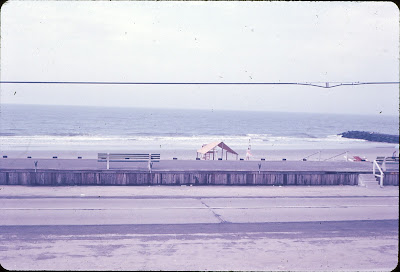
We stayed at the Coachman’s Motor Inn at 205 Beach Drive, directly across the street from the beach and the ocean.  My grandfather and I frequently sat together in the canvas chairs on the second floor balcony that overlooked the beach and the water.  From this vantage point we enjoyed an unobstructed view seaward.  To my inexperienced and unenlightened teenage mind, it was simply a nice view.  To my grandfather, however, it was so much more, and he often shared his observations and insights with me.

As a scientific man, my grandfather thought in patterns of observation, analysis, and conclusion.  While watching the Atlantic from the Coachman’s balcony, he studied the conditions of the sea and sky with attention to the wave action, wind speed and direction, cloud cover, range of visibility, and air quality.  He understood oceanography and meteorology, and as a former ocean traveler and recreational boater, he knew well the effects of the sea and sky on waterborne commerce.  As he and I kept watch together, he often pointed out to me aspects of the surf, the play of the wind on the water, the formation of distant clouds, the longshore current, and the rise and fall of the tide.  It was a wonderful educational experience for me.  In retrospect, I wish I had written down all that he said.  Such a collection of notes would now be a family heirloom.

In the years since these happy times in Cape May, I have spent countless hours in school, aboard ship, and ashore, studying the sea and sky.  Of necessity, it became an important professional habit.  A ship at sea is surrounded by two things, water and air, and the interaction of these elements determines the safety and comfort or the danger and discomfort of the voyage.  I took meteorological observations for transmission to the National Weather Service.  I analyzed the clarity of the horizon to assess the accuracy of navigational sights.  I studied the cloud cover and compared it to the weather forecasts.  I paid particular attention to the sea surface and noted patterns and changes in the wave and swell systems.  All of this was for the safety of the ship and to estimate how rough or smooth the voyage would be.

Later in life, when visiting the oceanfront with Miss Patty and our children, I continued to observe and analyze the sea and sky in addition to enjoying and appreciating their tremendous natural beauty.  Sometimes, however, I just sat there and stared at the ocean, content to simply enjoy it without undertaking a professional evaluation of everything.  I can still do this for hours on end—it never grows tiresome—and I often wonder, how can anyone not like this?  How can anyone not marvel at this?

Actually, many people do like and marvel at the sea.  They find in it comfort, solace, and even a glimpse of Divinity.  Something about the sea speaks to the human soul of higher and greater things, recalling for us the Lord’s words to Isaiah:

For as the heavens are higher than the earth,

so are my ways higher than your ways, and

my thoughts [higher] than your thoughts (Isa. 55:9).

The supernal quality of the sea and the counsel of Isaiah remind us of our place in the cosmos and inspire us to raise our minds to a more sublime level.  In so doing, we grow in knowledge, wisdom, and the Spirit.  Thus, we become able to apprehend more than just a fleeting glimpse of Divinity when we gaze upon the sea.

Sometimes when I am staring at the ocean from a spot on the New England coast, I think of my family’s vacations in Cape May.  If only it were possible to sit with my grandfather again and look seaward with him!  No longer as an ignorant adolescent but as a seasoned merchant seaman would I speak with him.  As we recounted experiences, shared insights, compared observations of the sea and sky, and analyzed recent oceanographic and meteorological discoveries, we would have so much to discuss!  I’m certain that it would be a very long, pleasant, and inspirational conversation.

Next, let's look at some photographs:


An evening view of the Coachman's Motor Inn from a postcard.  The street, boardwalk, beach, and Atlantic Ocean lie in back of the photographer.
 
 
Two views of the Atlantic in front of the Coachman's, taken by my father on an overcast day in the summer of 1967, on our first visit to Cape May.  This was actually a few years before my adolescence and before the times that my grandfather accompanied us on our vacations.
 
Many years later, on Easter Sunday, April 4, 2010, we see the open Atlantic from the beach in Wells, Maine, a wonderful place to contemplate the sublime mystery of this very special day.
 
Finally, we sail aboard the ferry John H from Long Island to Connecticut on Saturday, October 8, 2022, an exceptionally gorgeous day on the water.


Sunday, August 20, 2023

The Gray Ghost of the Maine Coast

A ship that I have scarcely thought about until recently is the old State of Maine.  She was the training ship at the school I attended when I was young and aspiring to become an officer in the U.S. Merchant Marine.

Built by the New York Shipbuilding Corporation in Camden, New Jersey, in 1952, the State of Maine began life as the Upshur, a combination passenger and cargo ship owned and operated by the federal government in support of military operations.  For many years in the 1950s and 1960s, she carried soilders, their families, and cargo between the United States and Europe and between the United States and the Far East.  She became the State of Maine when she began her second career as a school ship in 1973.[1]  In this capacity, she remained at her dock in Castine for most of the academic year.  Thus, she came to be called “the gray ghost of the Maine coast.”  She ventured to sea in the summers, carrying cadets and their instructors on training voyages.  Occasionally, she went to a shipyard for drydocking and overhaul.

While she remained parked in Castine, the State of Maine served as a floating laboratory, dormitory, and tourist attraction.  In my first year at the school, I lived aboard the ship for several months.  I spent copious hours studying her design, structure, bridge, engine room, cargo holds, and mechanical systems.  There was a lot to learn.  I also spent many hours removing rust, painting, cleaning, and assisting with repairs.  This was often dirty work, but necessary to maintain the ship in her best possible condition.

The first of my two voyages aboard the State of Maine took place in the summer of 1976.  As part of the American Bicentennial celebration, the ship visited historically significant Boston and Philadelphia.  In addition, the ship called at Norfolk, Virginia, for fire fighting and damage control training.  Then, she visited St. George, Bermuda; Newport, Rhode Island; and Bayonne, New Jersey, in support of the tall ships extravaganza for the Bicentennial.  Following the Independence Day festivities in New York, she returned to Castine.

While we could go sightseeing ashore when in port, there was always ample work to do aboard ship.  Everyone was busy.  As an underclassman I was assigned work everywhere—on deck, on the bridge, in the engine room, in the galley—and usually under supervision.  The upperclassmen tried to cram as much navigation and engineering work as possible into their schedules.  In less than a year, they faced the daunting prospect of license exams, and after that, seagoing employment with serious responsibilities.

My second voyage aboard the State of Maine took place in the summer of 1978.  By this time, I had become an upperclassman.  Now I felt the compelling need to seize the opportunity and do as much as possible to prepare for the license exams.  This included navigation, radar training, weather reporting, radiotelephone licensing, anchoring, maneuvering, emergency drills, docking and undocking, lifeboat maintenance, and more.  I spent seemingly countless days and nights practicing celestial navigation, at that time a critically important skill.

On this voyage the State of Maine sailed transatlantic and visited Rotterdam, the Netherlands; Portsmouth, England; Nantes, France; and Funchal, Madeira.  With the exception of Bermuda, which hardly counted because it had been full of Americans, this was my first time sailing overseas to different countries.  It was an eye-opening, educational experience.  I liked it very much, and I wanted to do more of it.

A year later, to my great satisfaction, I did do more of it.  In May of 1979, as a brand new third mate, I joined the Rigel in Norfolk when she was preparing to sail to Southern Europe.  But first, and by a happy coincidence, the State of Maine was also in Norfolk then, and the two ships were docked within walking distance of each other.  As a graduate, I had open gangway to visit the State of Maine, and I took full advantage of this opportunity when I wasn’t busy aboard the Rigel.  I visited the ship daily for several days, each time chatting with instructors, crewmen, and younger cadets that I had known.  I remember one such meeting as particularly significant.

Professor Captain Louis S. Hathaway had been one of my instructors both at school and aboard ship.  He taught meteorology, seamanship, mathematics, and license preparation.  Additionally, as a guest of the Sun Oil Company one summer, he had sailed aboard the New Jersey Sun, the ship I had sailed on as an apprentice in 1977.  A professionally demanding and rigorously conscientious Merchant Marine officer of the old fleet, he maintained an exceptionally high standard of performance and had been revered almost as a god by my entire class.  Affectionately calling him “Hap” behind his back, we both loved and feared him.  We knew that everything he said and did was for our benefit, and we respected him enormously.  Aboard the State of Maine on Wednesday, May 15, 1979, someone suggested that I go topside and knock on Hap’s door to say hello.

Finding Hap’s door open, I timidly addressed him.  He turned around in his desk chair, saw me, and responded very enthusiastically.  “Well, well, look who’s here!  Come right in!  Come in and sit down!”  And he motioned me to a chair.  We had a great visit and chatted for an over an hour about the State of Maine, the New Jersey Sun, the Rigel, my school days, his upcoming retirement, and much more.  Hap shed his stern magisterial formality and spoke with me as if I were his equal.  It was very, very pleasant, and I saw a side of him that I had never seen previously as his student.

This occasion left a lasting impression on me.  Later, when I told a friend about it, he explained, “You’ve made it.  You stayed the course and graduated with your license.  Hap saw you accomplish what you set out to do.  That’s why he’s so friendly now.”

Well, yes, I had made it through school and aboard the State of Maine.  Next, I needed to make it aboard the Rigel and subsequent ships, and also through the second mate’s and chief mate’s license exams.  There was plenty of hard work behind me, and plenty more of it lay ahead of me!

As I remember my formative years aboard the State of Maine, looking back beyond the times of trial and tribulation that full adulthood provided later, I see that

A marvelous stillness pervaded the world, and the stars, together with the serenity of their rays, seemed to shed upon the earth the assurance of everlasting security.  The young moon recurved, and shining low in the west, was like a slender shaving thrown up from a bar of gold.[2]

The golden stillness and security of a sojourn aboard ship without full responsibility but with the hope of a bright future eventually became a happy and treasured memory.  Of course, it was not perfect; life never is.  But it had a certain ineffable quality, a particular uniqueness, which only the mates and engineers who graduated from the State of Maine can truly understand and appreciate.

Now, let’s look at some photographs of the Gray Ghost:


My father took this photograph of the State of Maine on Saturday, August 23, 1975, the day I reported to Castine as a first-year cadet.
 
Almost a year later, I took this picture as the State of Maine sailed down the Delaware River from Philadelphia on Friday, June 4, 1976. 

On the same day, the Goodyear blimp supervised as the State of Maine got underway from Penn's Landing in Philadelphia and started downstream.
 
A few weeks later, the State of Maine departed from St. George, Bermuda, on Sunday, June 20, 1976.  
 
Almost two years later, the State of Maine reposed at anchor in Penobscot Bay on Wednesday, May 3, 1978.  I took this view from a lifeboat during a drill.


Three perspectives of the State of Maine on the beautifully calm Atlantic in May of 1978.
 
When the State of Maine docked in Portsmouth, England, on Wednesday, June 7, 1978, we had the honor of visiting H. M. S. Victory, Admiral Horatio Lord Nelson's flagship during the Battle of Trafalgar, seen in this postcard view.
 
On Friday morning, June 16, 1978, the State of Maine anchored off Funchal, Madeira, while waiting for dock space to become available.  An unidentified passenger ship passed the State of Maine as she departed Funchal.
 
Finally, the State of Maine arrived in Castine following a shipyard overhaul on Monday, April 9, 1979.  That week I took the series of examinations for the third mate's license, which I received on Saturday, April 28.


[1] For a detailed and informative history of the Upshur-State of Maine, see https://vesselhistory.marad.dot.gov.

[2] Joseph Conrad, Lord Jim, Garden City, NY, Doubleday & Company, Inc., 1920, p. 12.