Sunday, May 18, 2025

Along the Coastal Trail

It was high tide on Knik Arm at 8:30am on Wednesday, April 30, 2025.  The patches of snow and ice on the ground at sea level had all melted away in the recent rain, but a cold wind still blew from the west and drove trains of wavelets onto the rocky shoreline.  As the water splashed among the rocks it produced a soft and soothing sound that could have easily induced me to sleep despite the cold breeze.  But then I would have missed the full grandeur of the scene.

An extensive layer of stratocumulus clouds overhung the water, but blue sky and sunlight were emerging in the north and east.  In the distance to the west, Mount Susitna was visible, its snow-covered upper reaches merging into the white-gray cloud cover.  In the north, the Talkeetna Range with its extensive snow collection stood out more clearly beneath a brighter portion of the sky.  In the northeast and much closer to me, the boxy buildings of downtown contrasted against the backdrop of the Chugach Range.  In the center of all this, a tug and barge reposed at anchor.  The pull of the line connecting the barge with the mooring buoy indicated that the current was setting into port and thus the tide was still rising.  There was beauty all around me, and I felt like I was present at the very center of Creation, following the scriptural injunction to “stand in holy places” (D&C 101:22).   Still immersed in the Latin I had learned decades ago, I thought, Hic est gloria Dei.  This is the glory of God, and only twenty minutes’ walk from my son’s house!

I had come to Anchorage a week previously, on Wednesday the 16th, for the purpose of visiting my son Steven and my granddaughters Miss Katie and Miss Abby.  It was my sixth time in Alaska in ten years, and it felt good to be back, both with the family and in such a beautiful and interesting place.  We had a wonderful three weeks together that included both Easter Sunday and Miss Abby’s birthday.  As an extra benefit, I had the leisure to explore Anchorage while they were busy at work and in school, and I strove to make the most of this golden opportunity.

In order to understand Anchorage, one must first understand its waterways.  The Cook Inlet, named for Captain James Cook of the Royal Navy, leads from the open Pacific in the southwest to a headland that splits the inlet into two branches.  The headland is the sight of the Anchorage International Airport.  Knik Arm, the larger and deeper branch, leads northeast to downtown and the commercial seaport.  Turnagain Arm leads southeast into the woods.  Its name comes from Captain Cook’s crewmen.  Taking soundings and finding the water too shallow, they told the helmsman repeatedly to “turn again.”

These names from the European discovery of Alaska have lingered.  Besides the inlet, Captain Cook now has two streets, a hotel, and a housing development named after him.  Turnagain Arm has two streets, a school, a church, an office building, a dental practice, and a neighborhood named after it.  Knik Arm, despite being the more significant of the two branches, as far as I could tell only has one street named after it.

Starting downtown and running along the south side of Knik Arm is the Coastal Trail, a paved recreational pathway for walking, jogging, and bicycling.  Appropriately close to the trail’s beginning stands Resolution Park, a large wooden balcony set on the hill at the corner of 4th Avenue and L Street that bears the name of Captain Cook’s ship and commands a panoramic view of Knik Arm, the distant mountains, and the nearby commercial seaport.  A statue of the Captain gazes seaward; a bronze plaque on its bases describes his voyages of exploration.  I present both here as I saw them on Tuesday morning, April 22: 


When reading this account of Captain Cook, I marveled that he had not been knighted for his accomplishments, but then I recalled that King George had more pressing matters on his mind in the 1770s.  Perhaps the view of the waterfront, including this container ship as it was discharging cargo on the same day, serves as a more fitting memorial to him:


Descending from Resolution Park, I regained the Coastal Trail at Elderberry Park and then ducked through a pedestrian tunnel that passed underneath the main line of the Alaska Railroad.  This brought me to a viewing spot at the water’s edge, although at low tide, it was actually at the edge of the extensive mud flats.  Whatever the state of the tide, however, the view was pleasant and punctuated by an anchored tug and barge on the same overcast Tuesday:


From a little farther along the trail, the extent of the mud flats became even more apparent, and with the anchored tug and barge still there:


In brighter weather on Monday the 21st, I found a different cargo barge at anchor just beyond the mud flats:

On a still brighter day, Wednesday the 23rd, I took in this westward view of Mount Susitna beyond the mud flats and deep water of Knik Arm at low tide.  The headland on the left is the northern end of the Anchorage International Airport:

The commercial shipping of any seaport always interests me.  In the overcast afternoon of Tuesday the 29th, I was able to capture several vessels in one photograph.  On the far left the tug Glacier Wind was towing a barge seaward with Kodiak as her destination.  Next, the tug Gladys M rested at anchor with her barge.  At the docks north of downtown were the vehicle cargo ship North Star (with the dark hull and white superstructure), and the smaller container ship Matson Anchorage[i] on the far right:

About a mile and a half from downtown, the Coastal Trail again ducks under the railroad and briefly enters the neighborhood of Westchester Lagoon.  Here the Chester Creek drains into Knik Arm, and the surrounding marsh and lake area form a haven for nesting birds.  Seagulls accustomed to human company unreservedly posed for me on the same sunny Monday the 21st:


Later, on Thursday, May 1, the lagoon reposed quietly with the Chugach Range behind it to the east:

As lovely as Westchester Lagoon was, however, my favorite part of the trail remained alongside the salt water of Knik Arm.  Soon after emerging from the third and final pedestrian passage under the railroad, these three scenes greeted me on Friday the 2nd, a day that truly looked less like winter and more like spring.  In the first, looking northward, the Talkeetna Range loomed over the water in the background:


In the second, Mount Susitna blended into the low cloud cover in the distant west:


Finally, my favorite that day was this one with the largest expanse of water at the widest part of the arm with the mud flats completely covered at high tide:


Monday, May 5, was my last day in Anchorage.  Carpe diem, I thought, and seizing this final opportunity, I walked up to the waterfront early for a last look at Knik Arm before getting ready to leave.  It was a beautiful day with a beautiful view, and knowing that it would be many months before I would return to Alaska, I had great difficulty pulling myself away from the shoreline and heading back to the house.  Fortunately, with my cell phone camera, I could in a sense take some of the waterfront home with me.  My favorite photograph from that morning was this peaceful scene of the anchored tug and barge in the rising tide:  


At four o’clock that afternoon, I left Anchorage aboard an Alaska Airlines 737 bound for Seattle.  The aircraft took off into a west wind and then turned to port as it ascended.  From my window seat on the starboard side I enjoyed a fleeting but magnificent view of Knik Arm, the Cook Inlet, and the surrounding mountain ranges.  Then cloud cover intervened.  After the airplane had settled onto a southeasterly course at cruising altitude, it left the clouds behind.  Beneath me then for the next two hours lay the great blue expanse of the Pacific Ocean stretching to the far horizon.  I had not seen the open Pacific in a very long time, not since the 1980s from the Comet, and it felt great to be back, even at such a height!

While the purpose of my three weeks’ sojourn in Anchorage was to visit family, my leisure time at the waterfront came as a wonderful side benefit.  The Coastal Trail was a place of peace and quiet and solitude that soothed my soul, a spiritual haven where the sound of silence spoke volumes and enabled me to achieve communion with the Divine through Nature.  The confluence of seawater, tidal mud flats, snow-covered mountains, and the overarching sky provided an opportunity for quiet contemplation that yielded insight and inspiration.  In this magnificent location the scriptural promise manifested itself:

Draw near unto me and I will draw near unto you;

seek me diligently and ye shall find me (D&C 88:63).


[i] Shipping information from www.marinetraffic.com. 

Sunday, January 19, 2025

Cold Beauty

With the conclusion of the cruise ship and excursion train season in southeastern Alaska, it became time to make the long drive from the workplace in Skagway to the family home in Anchorage.  Curiously, no roadway or railroad link connects the Alaska panhandle to the main part of the state.  One must leave the country, drive through British Columbia and the Yukon, recross the border back into Alaska, and then continue southwestward to Anchorage.  I accompanied my son James on this journey through a snow-filled and mountainous landscape on Thursday and Friday, October 24 and 25, 2024.  On arrival in Anchorage, my son Steven and his two little girls, Miss Katie and Miss Abby, welcomed us to their home, as yet untouched by snow.

Before Halloween, however, this changed.  The clean, white, fresh-fallen snow that now blanketed the city reminded me that the beauty of the Earth is not confined to the oceanfront or the high seas but can be found in our own neighborhoods as well.  Accordingly, then, I set out with my trusty little cell phone camera to record some of this simple yet majestic beauty, and I’m pleased to present some of the results here.

For this first photograph, taken at midday on a bright and sunny Wednesday, October 30, I faced west across a field near my sons’ house.  Note the long shadows cast by the Sun.  At this far northern latitude, about 62 degrees above the equator, the Sun at the highest point of its transit remained quite low in the sky and shone nearly horizontally:

Twenty-four hours later, on Halloween, I looked eastward across the same field.  The trees obscured a busy street and a railroad bridge, and thus they gave the neighborhood an almost rural appearance:


Later in the afternoon on Halloween, the sky changed to overcast in the south.  These two views from James’ front window presented a snow-covered semi-suburban residential street scene.  Most of this snow remained unplowed for several days:


On Friday, November 1, All Saints Day and my sainted mother’s birthday, we visited the Anchorage Temple.  I felt rather sentimental about this building because three years earlier, on Wednesday, October 6, 2021, we had done my parents’ sealings here.  Now this temple is due to be replaced by a much larger edifice currently under construction nearby:

While this older temple remains with us, however, we can enjoy views like this one that feature the statue of Moroni standing above the treetops and silhouetted by the low-lying early afternoon Sun:

We can also glimpse the future in this architectural rendering of the new Anchorage Temple:

Back in my sons’ and granddaughters’ neighborhood on Sunday afternoon, November 3, I stopped by the Rustic Goat, a locally famous restaurant that features al fresco dining.  Somehow, though, I got the impression that this outdoor dining option was more popular in the summer:

Three days later, on a comparatively mild and sunny Wednesday, November 6, I stepped out onto James’ balcony.  With sufficient layers of warm clothing, this was actually a very pleasant spot for sitting quietly, reading a good book, and surveying the neighborhood:

Such mild weather did not last long, however.  After more snowfall and its subsequent cleanup, I walked to a different spot in the neighborhood on Friday, November 8.  Beyond the plowed piles of snow and the row of houses, the mountains of the Chugach Range were visible southeast of the city:

Finally, after yet more snowfall, I found our two precious granddaughters, Miss Katie and Miss Abby, watching the weather from their front window on Monday, November 11, a day they had off from school:

The winter beauty of Alaska notwithstanding, these two little girls were the main reason to make the long trek to Anchorage.  Every visit with them seems too short; hence the need to return and see them again.  Hiking around the city and observing its repose in the snow served as a wonderful collateral benefit while visiting the girls.  It gave me the time not only to observe the natural beauty of winter, but also to reflect on the great gift of children and grandchildren.  The psalmist informs us that “children are an heritage of the Lord” (Ps. 127:3), and the Lord himself asserts that “of such is the kingdom of heaven” (Matt. 19:14).  How blessed I am in my posterity!

Sunday, December 1, 2024

Celebrating Retirement

On the first day of my retirement, I left town and travelled to Skagway, Alaska.  This was not a convenient place to reach.  I left Boston at 6:00am on Saturday, October 19, 2024, on Air Canada, changed aircraft in Toronto and Vancouver, and flew into Whitehorse, the capital of the Yukon Territory.  Following a roller coaster flight through wild turbulence over the Rocky Mountains, the diminutive airplane touched down in a snow-saturated landscape at 5:00pm.  My son James met me at the Whitehorse airfield.  After dinner in a local restaurant, we made the two-hour drive through the mountains of the Yukon, northwestern British Columbia, and southeastern Alaska to Skagway and sea level.  My objective in travelling to this remote location was to spend several days visiting James and seeing his excursion trains and cruise ships.

Skagway sits at the head of navigation on the Lynn Canal.  Not really a canal at all, this body of water is one of the many fjords and bays that comprise the Inside Passage, a network of inland waterways that stretches from Washington through British Columbia to Alaska and is sheltered from the open Pacific by a series of islands and peninsulas.  Long an important route for commercial shipping, the Inside Passage is now frequented largely by cruise ships and ferries.  Many of these stop at Skagway, the place where the shipping lines and the railroad meet.

James’ employer, the White Pass and Yukon Route, operates excursion trains for the cruise ship passengers.  These trains embark everyone at the docks downtown and then run “up the hill” on a line that climbs mountains, skirts river gorges, ducks through tunnels, crosses bridges, and delivers the sightseers to scenic spots in British Columbia and the Yukon.  The entire route is tremendously scenic, and therein lies the appeal to folks on vacation.  After several hours of sightseeing aboard the trains, the railroad returns the passengers to the docks in Skagway, and there they rejoin their cruise ships and put to sea again.

As a guest of the White Pass, I had the privilege of riding these trains and sitting up front in the locomotive with James at the controls.  This made for a fascinating series of journeys up the hill and back down again, and to both the cruise ship piers downtown and the railroad shops at the edge of town.  It was late in the tourist season, however, and instead of lush foliage in the mountains, there lay a thick carpet of snow with walls of icicles clinging to the rocks.  It was a very impressive and truly beautiful landscape; nonetheless, I still felt drawn to the waterfront, and I found it just as appealing.

The mountains and the sea together formed my favorite part of the landscape.  Two worlds met at the Skagway waterfront; it was a confluence of geology and oceanography and a place of breathtaking beauty.  Little wonder that so many people sailed there to see it.  My first view of this waterfront took place on Sunday afternoon, October 20.  Watching from an empty cruise ship pier, James and I witnessed the arrival of the ferry Hubbard of the Alaska Marine Highway from Juneau.  I took a sequence of photographs of this event, and I’m happy to present the best ones here:


There were no cruise ships in port that day, nor on the Monday following, but the Norwegian Bliss of the Norwegian Cruise Line arrived on Tuesday the 22nd, and I was able to take one good picture of her.  The weather had changed by this time.  It was snowing along the railroad in the mountains, but raining at sea level, and so here we see the Norwegian Bliss through the rain:

The next day, Wednesday the 23rd, saw the arrival of the Norwegian Jewel, also of the Norwegian Cruise Line.  The rain and snow had stopped by this time, but a strong and bitterly cold wind was blowing instead, and this made photography challenging.   Nonetheless, I was able to capture a few views of the Norwegian Jewel at her berth:


In this last photograph of the port side amidships, we see how modern cruise ships can resemble high-rise apartment buildings ashore instead of traditional transoceanic passenger liners.  A bold new concept in sea travel, cruising has proven tremendously popular with vacationers.

Wednesday was the last day of cruise ship and excursion train operations in Skagway.  The vacation season of 2024 thus drew to a close.  The ships sailed south to a warmer climate, and Skagway hunkered down for the winter.  James and I left town and made the long drive through the Yukon and the Alaskan interior to Anchorage, where I would enjoy a two-and-a-half-weeks-long visit with my son Steven and my granddaughters Miss Katie and Miss Abby.  Memories of Skagway and its trains and ships would remain with me, though, and so in parting I present some views of the White Pass Route. 

First, this locomotive reposed on a passing siding in a spot called Glacier[1] on Tuesday the 22nd, as it waited for a passenger train to come by on the main track:


Next, as seen from the conductor’s seat in the leading locomotive on Wednesday the 23rd, the train was about to cross a short bridge over a river gorge and then duck into a short tunnel on a stretch of track called the High Line[2].  The surrounding massive rock formations and the abundance of coniferous trees formed a very distinctive Alaskan landscape:

Not far from the tunnel this massive rock wall sported an impressive collection of icicles formed by a succession of daily freeze-thaw cycles, also on Wednesday the 23rd:

Finally, the unofficial railroad photographer, Rod Jensen, took this picture of James and me alongside the main line in a spot called Gulch on the same Wednesday as the excursion train operations were winding down for the season:

As both a seaport and a railroad town, Skagway provided an exciting start to my retirement.  Even at my age, it was clearly not too late for new destinations and new adventures.  Surpassing these opportunities, however, was the priceless gift of time spent with a beloved son in his special element, and this would soon be amplified by time spent with another beloved son and two beloved granddaughters in Anchorage.   

For all of this I was very grateful and also mindful of the scriptural injunction to “live in thanksgiving daily, for the many mercies and blessings which he hath bestowed upon you” (Alma 34:38).


[1] James possesses an encyclopedic knowledge of the makeup and operations of the White Pass.  In response to my simple request for the name of the place where this siding is located, he informed me that “It runs from milepost 12.7 to 14.1, it’s 7,400 feet long.  It was lengthened by a mile in 2019.”

[2] Once again from James’ remarks:

The short tunnel is at MP 15.9.  The bridge is a wood trestle which was built in the winter of 1898-1899.  The area has no official name although informally the bridge crosses “Glacier Gorge” and the tunnel runs through “Tunnel Mountain.”

Sunday, October 13, 2024

The Lady of Hampton Beach

Even though I have lived in New Hampshire for upwards of forty years, I have only visited Hampton Beach three times.  The first of these occasions took place many years a go on a bitter cold winter day.  It was a very short visit, and I scarcely remember it.  The second visit, with two grandchildren, took place on a beautiful summer day two years ago.  I remember this one very well.  The grandchildren were fascinated by both the Atlantic Ocean and the marine biology exhibits at the adjacent Blue Ocean Discovery Center.  The third, without the grandchildren, took place just recently, on Wednesday, September 25, 2024.  This one was quite different and more serious. 

Long and wide sandy beaches are rare in northern New England, and so Hampton Beach becomes extremely crowded on hot summer days.  For this reason, we always avoided it in favor of less crowded facilities in nearby Maine.  Besides, the Maine beaches were closer to Miss Patty’s parents’ house.  But we thought Hampton Beach would likely not be crowded on a September weekday, and so we seized the opportunity.  As always, it felt wonderful to gaze upon the great Atlantic, scan the horizon, feel the breeze, and watch and listen to the surf.  It was also very pleasant to stroll along the promenade that parallels the beach.  Several attractive pavilions for public accommodation and park administration dot this promenade, and at its northern end stands the New Hampshire Marine Memorial.  I had never seen or heard of this before, and so I felt drawn to it.

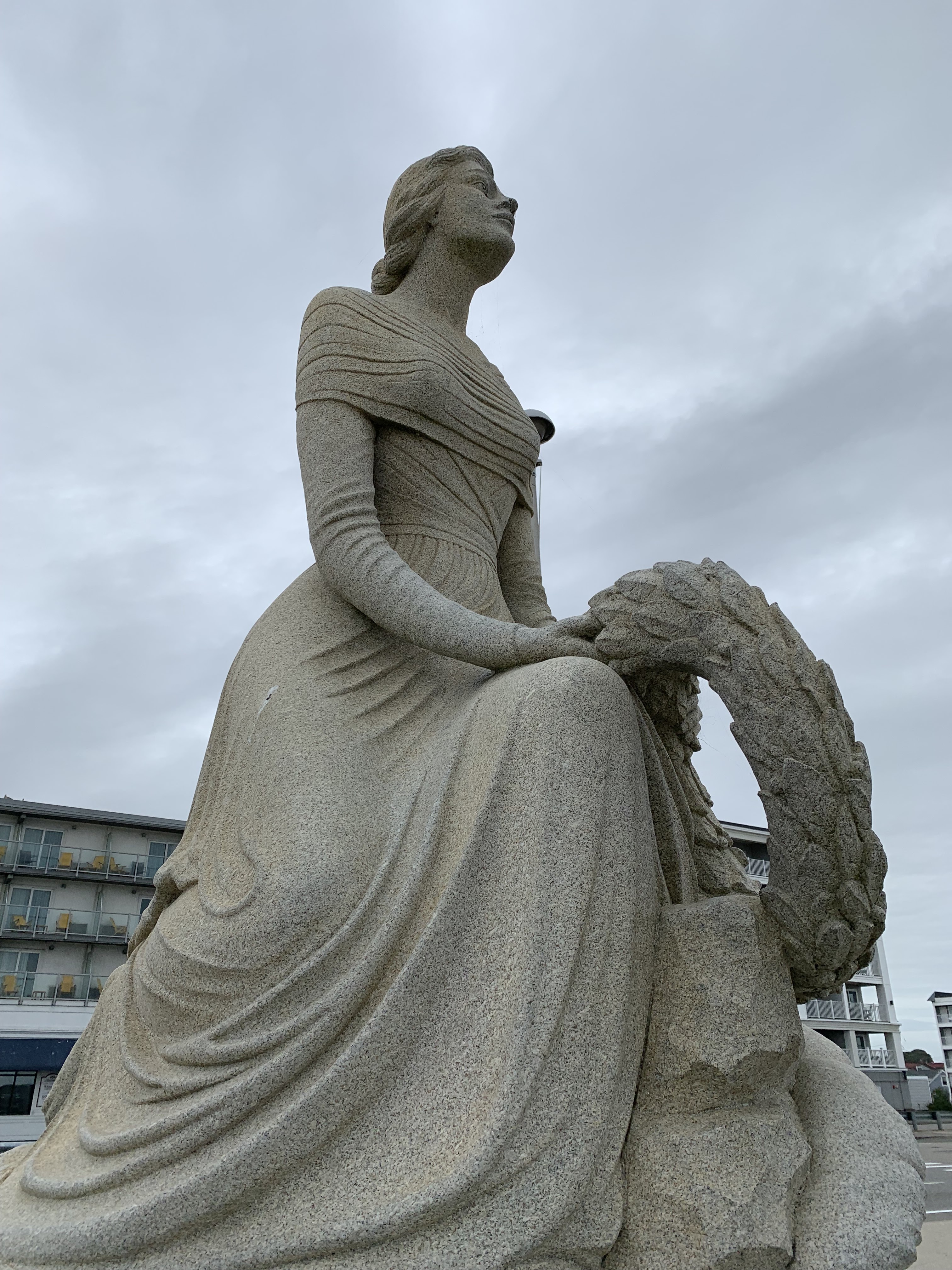
The memorial features a statue of a young lady facing seaward and holding a wreath in honor of the New Hampshire residents who served in the armed forces and were lost at sea.  Around the upper base of the memorial, two verses of poetry are inscribed in large letters:

Breathe soft, ye winds,

Ye waves in silence rest.[1]


Beneath this, on the lower base of the monument, is further inscribed:

In memory of New Hampshire’s heroic war dead

Lost at sea in defense of our country.

Following this and occupying a large part of the lower base is an alphabetical list of approximately 240 names of servicemen, with their branches of the service indicated.   The vast majority were Navy men.  Several were Marines or Coast Guardsmen.  A few were Army or Air Force.

Seeing and studying the New Hampshire Marine Memorial for the first time was a moving experience for me.  I had not expected to discover this during a leisurely and carefree day at the oceanfront.  But there it was, and it commanded my attention.  While I naturally regretted the loss of life that it represented, I was pleased that these seamen were remembered and that their sacrifices were publicly acknowledged.  I also wondered how many beachgoers on a hot summer day paused to look at this monument and contemplate its significance.

My only reservation was that the list of names did not include the many merchant seamen who perished at sea in wartime.  In the 1940s, the Merchant Marine was incorporated into a federal organization titled the United States Maritime Service, or USMS.  The seamen who manned the cargo ships, oil tankers, and troop transports suffered a casualty rate exceeded, on a percentage basis, only by the Marine Corps.   While monuments to their sacrifices do exist, they tend to be not very well known by the general public.

Nonetheless, I was pleased to come upon this monument to our state’s military personnel who tragically lost their lives at sea.  It left me with little to say but much to consider.  Fortunately, it was an uncrowded, off-season day at the beach, which created an atmosphere suitable for quiet contemplation.  I appreciated that very much.

Now, I’m pleased to share some photographs.  First, we see the full monument.  The young lady portrayed, flanked by the New Hampshire state flag, faces east toward the sea.  The building in the rear is a hotel:


Next, we have three close-up views of the young lady.  The facial expression, combined with the background of dark cumulus clouds, seems to convey a sense of foreboding: 


Finally, we look southeastward over the surf and beyond to the horizon of the great Atlantic Ocean.  Despite the ominous appearance of the low-hanging cloud cover, it really was a magnificent day at the waterfront:


[1] Lines from John Gay (1685-1732), “Epistle to a Lady,” 1714.  Information from https://www.seacoastnh.com/places-%26-events/nh-history/hampton-beach/sculpture-by-the-sea.


Sunday, September 1, 2024

The Celestial Refuge

When I’m unable to hurry away to the oceanfront and stare at the sea, I stay home and focus on the sky instead.  The two actually complement each other very well.  They interact with one another constantly, separating the day from the night, ordering the seasons, generating the tides, and producing both the day-to-day weather and the long-term climatic conditions.  The natural sciences of oceanography, meteorology, and astronomy are thus intimately intertwined, and we all live with the results.  I find the ways in which the elements work together a fascinating aspect of the miracle of Creation.  It would be wonderful to spend a lifetime studying these sciences of Nature.  Oftentimes, though, I’m content to simply enjoy the view and imbibe the beauty of the sky even without seeing the ocean beneath it, and I can do this without leaving my own neighborhood.

After many years of waking up for work in the middle of the night, it has become automatic for me.  Thus, from my front porch in the winter, I can admire the constellation Orion in the southeast and remember using its premier stars, Rigel and Betelgeuse, for navigation many years ago.  Beneath Orion shines Sirius, the brightest of the stars.  From the back of my house, I can see Polaris, my favorite star, and the constellations Ursa Major and Ursa Minor.  These stars don’t photograph well, though, so instead I present two pictures of the Moon.

One of my favorite celestial bodies, the Moon, when full or nearly so, served me well at sea by illuminating the horizon so I could take star sights.  I really appreciated the Moon, and when I see it now it reminds me of happy times aboard ship.  The Moon also inspires and edifies me as it fulfills its unique role in the heavens and casts its benevolent influence upon the Earth.  In this first photograph, we see a full Moon shining through a thin cloud layer in the southwest at 4:38am on Monday, July 22, 2024:


Next, we see a waxing gibbous Moon, also in the southwest, shining through a clear black sky at 8:37pm on Wednesday, August 13, 2024:

After the darkness comes dawn.  Looking east from my front porch, we see the trees silhouetted in the morning twilight at 5:16am on Sunday, August 11, 2024:

After the dawn comes sunrise.  Looking east from the neighborhood ice cream stand, we see the Sun shining through some haze as it clears the treetops at 6:11am on Sunday, July 28, 2024:


Sometimes I make the hike along the railroad track to the boat ramp on the Merrimack River and watch the day break there.  This is perhaps my favorite location in the neighborhood.  Its isolation makes it an unpopulated and quiet vantage point in the early hours, well worth the half-hour of walking needed to reach it.  In this series of photographs, we witness the dawn of a new day at ten-minute intervals from 4:30am to 5:00am on Sunday, July 21, 2024:


Then the Sun rises over the Merrimack and peeks through the trees on the eastern bank at 6:12am on Sunday, August 11, 2024:

While the Sun always rises, it is sometimes obscured by fog, a function of relative humidity, dew point, and a decreasing air temperature.  While obviously dangerous for navigation, fog often has an almost other-worldly beauty that lends a certain mystique to its surroundings.  Such is the case here on the Merrimack River at 6:35am on Sunday, October 1, 2023:


Closely related to fog is an overcast sky; both consist of water vapor at the saturation level often with certain undesirable consequences for the transportation industry.  Nonetheless, an overcast sky and the precipitation that it produces are critical components of the worldwide water cycle which is essential for the existence of all life.  I find a particular beauty in an overcast sky, especially this one over the neighborhood playground in the early morning of Sunday, August 4, 2024:

Much more popular, however, is the classical fair weather blue sky with billowing altocumulus clouds such as these in the afternoon of Sunday, August 11, 2024:

Altocumulus clouds come in a variety of sizes and shapes, all of them quite lovely, as this view from Thursday afternoon, July 18, 2024, demonstrates:

Sometimes, when illuminated from below by the Sun before it has risen above the level of the trees, altocumulus clouds can almost look like fireworks, as they do here at 5:30am on Sunday, July 7, 2024:

Then there are the colors of twilight.  In the right atmospheric conditions, the sky can seem kaleidoscopic in the early dawn.  These two eastward views from the playground at 4:56am on Wednesday, June 26, 2024, illustrate the celestial grandeur of my favorite time of day:


Finally, we see a brilliant explosion of light in the east from my front porch at 6:04am on Tuesday, August 20, 2024:

As much as I treasure time spent at the oceanfront, and as much as I consider the sea to be a refuge from the sound and fury of our secular society, I also deeply appreciate the easy access to the celestial realm that I have in my own neighborhood.  I need not go far to gaze into the heavens and find there a place of peace and quiet, a place of inspiration and edification, a place to witness the supernal splendor of Creation, and a place to find God “moving in his majesty and power” (D&C 88:47).